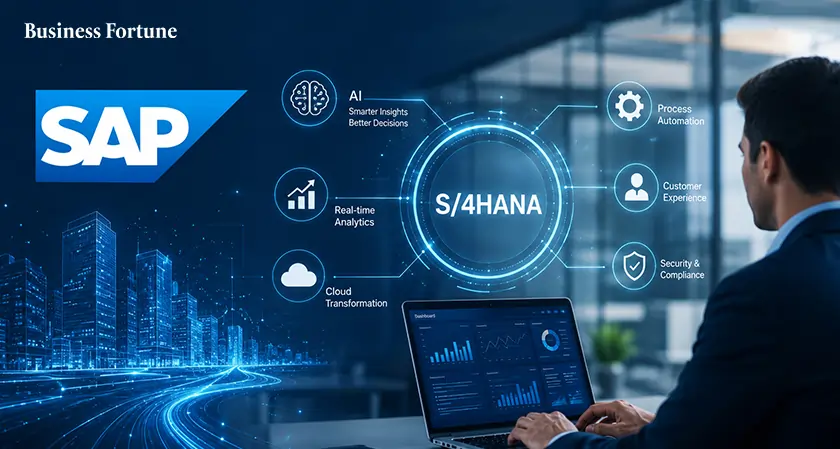
With S/4HANA transitions, AI automation, and improved governance to guarantee safe digital transformation, German businesses are pushing SAP modernization.
German companies SAP modernization efforts are entering a new phase as enterprises adopt controlled SAP S/4HANA transitions, AI-enabled automation and stronger governance frameworks to maintain business continuity while meeting sovereignty and compliance requirements, according to the 2026 ISG Provider Lens® SAP Ecosystem report for Germany by Information Services Group (ISG).
The claim highlights that businesses are viewing SAP transformation as a strategic lifecycle decision focused on data control, operational responsibility and scalable innovation rather than a simple technology migration.
SAP S/4HANA Migration Balances Stability and Innovation
German companies are speeding their shift to SAP S/4HANA through staged modernization programs as the mainstream support for SAP ERP Central Component (ECC) draws to a close. Organizations are favoring gradual migrations that lower debt to technology, increase cost transparency, and safeguard vital business processes over disruptive large-scale projects.
Companies are carefully evaluating operational readiness while establishing data access, governance needs, and the degree of business change they can handle, according to ISG. With SAP Business Technology Platform (BTP) serving as an extension layer for innovation while preserving control and lowering complexity, a clean core strategy is becoming more important.
Furthermore, data sovereignty is growing in importance. German businesses are concentrating on data residency, access management, auditing requirements, and distinct roles for SAP, cloud providers, and service partners.
AI Automation Strengthens SAP Operations
Automation powered by AI is increasingly becoming a common prerequisite for managed services and SAP transformation. Businesses are implementing AIOps capabilities, intelligent testing, and automated discovery tools to improve efficiency, reduce down on routine responsibilities, and accelerate solving issues.
Even if generative AI is becoming more important in SAP analysis and operations, businesses still want human control, auditability, and transparency. Successful SAP service models integrate automation, governance, and operational stability, according to the ISG analysis.
Key SAP Transformation Trends in Germany
-
Controlled S/4HANA transitions protect business continuity
-
AI automation improves SAP delivery and operations
-
Governance strengthens compliance and data security
-
BTP enables innovation beyond SAP core systems
-
Providers integrate transformation with managed services
Thus, Business Fortune is of the view that German enterprises are moving toward a more secure, intelligent and governed SAP future through strategic modernization.
FAQs
Why are German companies adopting SAP S/4HANA?
They are modernizing systems, improving efficiency and preparing for ECC support changes.
How does AI help SAP transformation?
AI supports automation, testing, analysis and faster operational management.
Why is SAP data sovereignty important?
It helps businesses control data access, security and compliance.
What is SAP BTP used for?
It supports extensions, applications, analytics and digital innovation.
What SAP migration approach is preferred in Germany?
Many enterprises prefer phased transitions to minimize disruption and risks.


.webp)