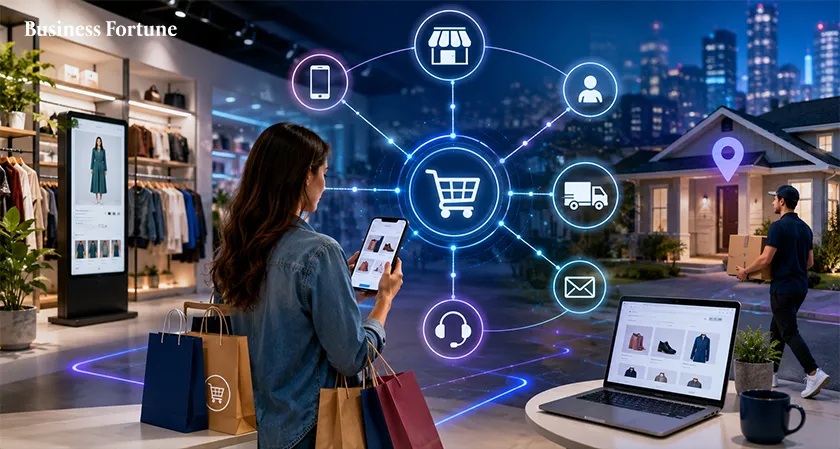
Explore the best omnichannel retail strategies for 2026, connecting customer data, technology, personalization, and unified experiences across digital and physical channels.
Think about the last time you bought something you wanted. You may have discovered it on social media, checked reviews on a website, compared prices through a mobile app and finally visited a store before making the purchase. you given the various channels you were employing any thought? Most likely not. You basically expected the experience to continue seamlessly from one touchpoint to the next. That expectation is exactly what is shaping Best Omnichannel Retail Strategies 2026.
Consumers now perceive brands beyond just one channel. They change platforms such as websites, mobile applications, social media, emails, texts, or actual shops depending on what suits them at the time. Whether shoppers crop products in a basket on an app, they expect to receive them on the website. They also expect stores or distribution centers to provide accurate availability if they check their stock online and for customer support representatives to know about their previous interactions with the brand.
This shows how important the Best Omnichannel Retail Strategies are going to be. The idea of being present on various channels is obsolete now. What matters is the laser focus on integrating those channels around the consumer.
But what if retailers manage to do so? The entire consumer journey becomes much more convenient; the communication is more relevant and each interaction is connected. In reality, companies can achieve this goal by using integrated consumer data, marketing automation, artificial intelligence, analytics and connected commerce systems.
Though providing such experience in practice requires much more than simply adding more channels. One of the key issues is recognizing consumer paths and linking them to capture and fill gaps between their online and offline
How Can Brands Build the Best Omnichannel Strategies?
Best omnichannel strategies begin with a thorough grasp of how customers engage with a business at every touchpoint. Instead of viewing them as separate channels, businesses should combine email, websites, social media, apps, SMS and retail to create a seamless customer journey.
The first step is mapping the customer journey. It allows brands to know where customers find products, compare options, buy them, get help and come back for further interactions. Knowing these stages helps marketers deliver needed communication at the right moment.
Personalization is also an important factor when it comes to the most successful omnichannel techniques. Customer data makes possible obtaining information about their browsing and purchasing history, customers’ preferences and their engagement activity, which are all used for tailored offers and correct understanding of the communication with the customers.
Technology also plays an important role since via the use of the unified platforms for obtaining customers’ data and using the marketing automation tools, the companies can synchronize the marketing communications across the various channels.
If the instruments cooperate effectively, the documents and communication addressed to the customers can be sent automatically thus achieving the desired results.
Finally, the omnichannel messaging requires consistency as the needs of clients have to be satisfied at a high level in all channels.
What Makes Omnichannel Retail Different From Multichannel Retail?
The retail omnichannel strategy is all about uniting each and every channel and touchpoint into a complete customer experience. In contrast to multichannel retail where online and offline efforts, such as websites, apps or social media, often operate as distinct entities with separate information for customer, product and purchase, omnichannel retail strategy allows for the sharing of customer and product information and purchase history across different channels.
A customer can find a product via social networks, check it on a mobile app, add it to the online shopping cart and pay for it in the store.
The main features of an effective omnichannel retail approach include:
-
Connected channels: Online and offline touchpoints work together rather than operating independently.
-
Unified customer data: Customer preferences, purchase history and interactions are synchronized across channels.
-
Consistent experience: Customers receive consistent branding, messaging, pricing and service wherever they interact.
-
Personalized engagement: Brands can use customer data to deliver relevant recommendations, promotions and content.
-
Flexible shopping journeys: Customers can move between websites, apps, stores and social platforms without losing context.
-
Real-time interactions: Businesses can respond to customer behavior with timely messages, offers and recommendations.
Journey is thus given priority in multichannel retail. By linking channels and data, businesses can reduce friction, improve engagement, and forge stronger ties with clients.
How Can Brands Improve Omnichannel Marketing Strategies?
A good omnichannel marketing strategy entails more than just the presence of numerous communication channels. The different channels that brands use to communicate with their consumers should be intertwined to enable customers to have consistent, personalized and relevant experiences during their interactions with the brand. When websites, applications, emails and customer service systems are considered as a unified whole, organizations succeed at building better connections with clients and minimizing obstacles.
Strategy implementation starts with an analysis of customer behavior. A good omnichannel marketing strategy should start by collecting and analyzing data from the various channels from which the brand reaches its customers to ascertain how and when consumers look for, choose, buy and use the product. In order for marketers to create the messages that they require, they must first gain access to the relevant data.
Furthermore, consistency is of great importance. Customers have to be able to identify a brand through its voice, language and visuals irrespective of the contact points they’ve selected. Nevertheless, consistency does not mean that the content should be identical. A message is to be modified for each channel while trying to maintain consistency of the experience regardless of the channels used.
Brands can strengthen their approach by focusing on these five areas:
-
Understand the customer journey: Map important touchpoints and identify where customers move between channels.
-
Unify customer data: Connect information from websites, apps, stores, social media and other platforms to create a clearer customer view.
-
Personalize communication: Use customer behavior and preferences to provide relevant recommendations, offers and content.
-
Maintain consistent messaging: Ensure campaigns, promotions and brand communication remain aligned across every channel.
-
Measure and optimize performance: Track engagement, conversions, retention and ROI to identify what works and continuously improve campaigns.
Technology plays a major role in bringing these elements together. Marketing automation, customer data platforms, analytics tools and journey management solutions can help businesses coordinate campaigns while responding to customer behavior in real time.
Ultimately, effective omnichannel marketing strategies put the customer journey at the center of every decision. By connecting data, channels, content and technology, brands can deliver more convenient experiences while improving engagement, conversions, loyalty and long-term business performance.
What Shapes a Better Retail Customer Experience?
The concept of retail is no longer restricted to what takes place in the shop. Customers can identify the item that they require via social media and compare its price by means of the web, use an application to see whether or not the item is in stock and ultimately make a purchase at a store. Retailers need to create an experience that connects every stage of customer interaction.
A good retail customer experience should ensure that the interaction at every stage of the process is easy. In doing this, companies need to understand their customers and enable them to avoid getting stuck while doing business with them.
Here are five key areas retailers should focus on:
- Customer understanding: Collect insights from purchases, website activity, reviews and feedback to understand customer preferences and expectations.
- Connected experiences: Bring stores, websites, apps, social media and customer support together so customers can move between channels without disruption.
- Personalized engagement: Use customer data to provide relevant recommendations, promotions and communication instead of generic messages.
- Smarter technology: AI chatbots, analytics, automation and augmented reality can improve convenience while helping retailers respond more effectively to customer needs.
- Continuous improvement: Monitor customer satisfaction, engagement, conversion rates and loyalty to identify weaknesses and refine the overall experience.
In unified commerce, it becomes evident how important it is to connect customer, product, inventory and transaction data through the same system so that retailers can provide consistent information through physical and digital channels or create one journey for a customer that might include checking the product on the Internet, reserving the needed item at the shop, coming to the store to take the product and later receiving recommendations through an application.
In addition, omnichannel shopping contributes a lot to the customers' freedom to decide where and how to interact with the brand since it helps them freely go from one channel to another without the need to repeat their actions or providing their details each time they want to buy something.
It should be noted that the success of retail in the future will fully depend on how well companies will manage to combine technology and human-centered experience.
What Does the Future Hold for Omnichannel Retail?
The concept of omnichannel retail will evolve as a result of seamless interaction, customization and advanced technologies. In order to give more connected experiences to clients, retailers will blend their physical outlets, websites, mobile applications, social media platforms and other emerging digital channels in the future. The retail digital transformation will lead to companies adopting more advanced technology and reviewing the methods of interacting with customers.
Artificial intelligence will play a huge role in identifying and predicting customer behavior as well. Personalization will be based on AI technologies that assist in providing recommendations, virtual assistants, automated customer service and customized goods.
Connected data is another important aspect of unified commerce that enables retailers to offer the same experience in various channels. One of the things that customers can do is check the availability of a product online, reserve it, buy it from the shop and get follow-up offers. With the development of unified commerce, the distinction between online and offline retailers is likely to disappear.

.webp)





























Comments