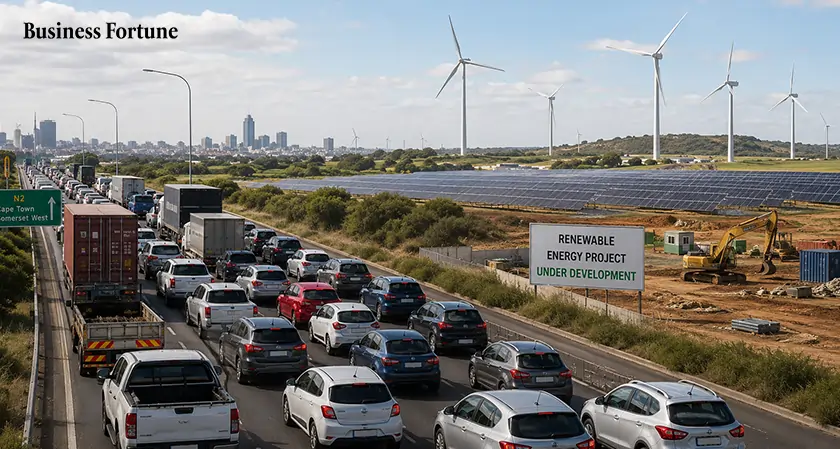
As renewable energy projects grow, South Africa's Green Energy Future faces grid capacity issues that call for quicker transmission upgrades, storage solutions, and market reforms.
South Africa’s green energy future faces a major setback as a lack of grid capacity prevents the country from connecting its growing renewable energy pipeline. With 72GW of renewable projects at advanced development stages and a 220GW pipeline, Energy Exchange South Africa (EXSA) CEO Wayne Cowie warned that outdated transmission infrastructure is the biggest obstacle to accelerating the energy transition, strengthening energy security, and delivering affordable clean power.
Grid Infrastructure Becomes Renewable Bottleneck
South Africa’s ageing electricity grid was designed decades ago around large coal-fired power stations, mainly in Mpumalanga. However, renewable projects are increasingly located in high-resource solar and wind regions far from existing connection points.
Years of limited maintenance and insufficient investment have left transmission infrastructure unable to support new generation capacity, forcing businesses and consumers to rely on costly and unreliable traditional energy sources.
Key Challenges Holding Back Renewable Growth
-
Limited grid capacity is delaying renewable connections
-
Ageing transmission networks require urgent upgrades
-
Battery storage needed for renewable stability
-
Private investment slowed by infrastructure constraints
-
Energy security risks rising amid fuel volatility
Grid Expansion and Battery Storage Needed
EXSA said rapid transmission expansion and Battery Energy Storage Systems (BESS) are critical to unlocking renewable potential. Storage solutions can help manage the intermittent nature of solar and wind power while improving grid reliability.
The National Transmission Company South Africa (NTCSA) Transmission Development Plan aims to add 14,450km of transmission lines and 210 transformers to connect 56GW of new generation capacity. However, industry leaders warn that slow implementation could delay renewable projects.
Wheeling and Private Investment Key to Reform
Energy wheeling, which allows businesses to buy renewable power from independent producers through the grid, is expected to support a more open electricity market. However, EXSA said wheeling can only expand if transmission capacity improves.
The organization highlighted the need for public-private collaboration, including the Independent Transmission Programme, to attract investment and accelerate grid development.
Thus, Business Fortune is of the view that South Africa’s renewable ambitions require urgent grid investment, storage expansion, and effective reforms.
FAQs
What is blocking South Africa’s renewable energy growth?
Limited grid capacity and outdated transmission infrastructure.
How large is South Africa’s renewable energy pipeline?
The pipeline includes around 220GW of renewable projects.
Why is battery storage important?
It stabilizes the electricity supply from variable renewable sources.
What is energy wheeling?
It allows businesses to purchase renewable power through the grid.
What is needed for faster energy transition?
More grid investment, storage, and market reforms.


.webp)