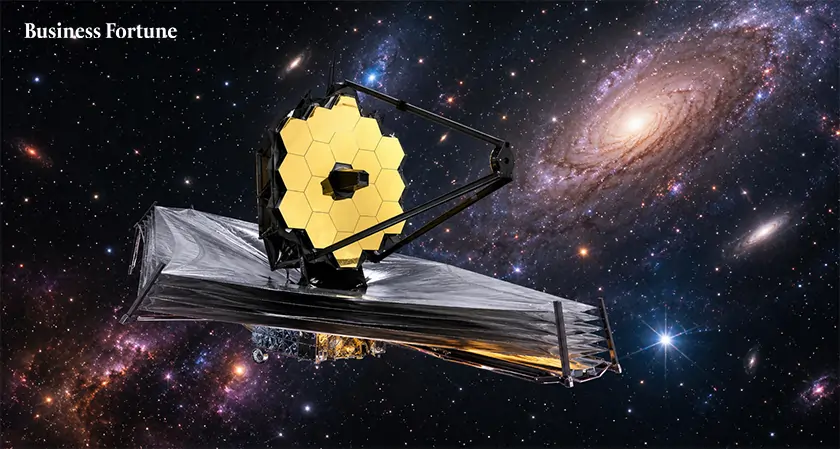
NASA’s the Nancy Grace Roman Space Telescope is set for launch and is expected to reveal billions of galaxies, discover new exoplanets, and help scientists investigate dark energy and the expanding universe.
NASA’s Next Generation Telescope, the Nancy Grace Roman Space Telescope, has officially arrived at the agency’s Kennedy Space Center in Florida, bringing one of NASA’s most ambitious astronomy missions a step closer to launch. The observatory is now entering its final preparation phase before its planned liftoff aboard a SpaceX Falcon Heavy rocket on August 30.
The massive spacecraft, weighing nearly 18,000 pounds, completed a carefully managed journey from NASA’s Goddard Space Flight Center in Maryland. Transported aboard NASA’s Pegasus barge inside a specially designed protective container nicknamed the “Chariot,” the telescope reached Florida after overcoming challenges such as strict temperature-control requirements during transit.
A Telescope Built to See More Than Ever Before
Named after Dr. Nancy Grace Roman, NASA’s first Chief of Astronomy and often called the “Mother of Hubble,” the telescope is designed to transform how scientists study the cosmos. Its main instrument features a powerful 300-megapixel camera capable of capturing an area of space roughly 100 times larger than the Hubble Space Telescope in a single image. Scientists say Roman will perform observations up to 1,000 times faster than Hubble for certain surveys.
Once inside Kennedy Space Center’s processing facility, engineers will conduct inspections, test the observatory’s six solar panels, check thermal protection systems, and load approximately 290 gallons of hydrazine fuel before launch.
What Questions Could Roman Help Answer?
The mission’s real excitement begins after launch. Roman will travel about 1.5 million kilometers from Earth to the Sun-Earth L2 point, a stable location already used by other major observatories. From there, it will begin studying some of astronomy’s biggest mysteries:
-
What is causing the universe’s accelerated expansion?
-
How common are planets beyond our solar system?
-
What role do dark matter and dark energy play in shaping the cosmos?
-
Can scientists directly observe distant exoplanets and their formation?
The telescope is expected to discover hundreds of thousands of exoplanets, map billions of galaxies, detect black holes, and create enormous datasets for researchers worldwide.
A New Era of Space Exploration
Roman is expected to operate for at least five years, though NASA officials believe its fuel reserves could allow the mission to continue for a decade or longer. The observatory will also demonstrate advanced starlight-blocking technology that could help future missions directly image Earth-like worlds around distant stars.
With its launch arriving months ahead of schedule, the Roman Space Telescope is poised to become NASA’s next flagship observatory and one of the most important space science missions of the decade.
What Happens Next?
As Business Fortune sees, over the coming weeks, NASA engineers will complete final testing, fueling, and rocket integration. If preparations continue as planned, the Nancy Grace Roman Space Telescope will launch no earlier than August 30, beginning a mission that could reshape humanity’s understanding of the universe for years to come.
FAQs
What is the Nancy Grace Roman Space Telescope?
It is NASA’s next major space observatory designed to study dark energy, exoplanets, galaxies, and the evolution of the universe.
When is the Roman Space Telescope scheduled to launch?
NASA is targeting a launch date of no earlier than August 30 aboard a SpaceX Falcon Heavy rocket.
Where will the telescope operate in space?
Roman will operate near the Sun-Earth L2 Lagrange point, about 1.5 million kilometers from Earth.
How is Roman different from the Hubble Space Telescope?
Roman can capture images covering a much wider area of space and conduct large-scale surveys significantly faster than Hubble.
What discoveries are Roman expected to make?
Scientists expect it to reveal billions of galaxies, discover hundreds of thousands of exoplanets, study black holes, and provide new insights into dark matter and dark energy.


.webp)