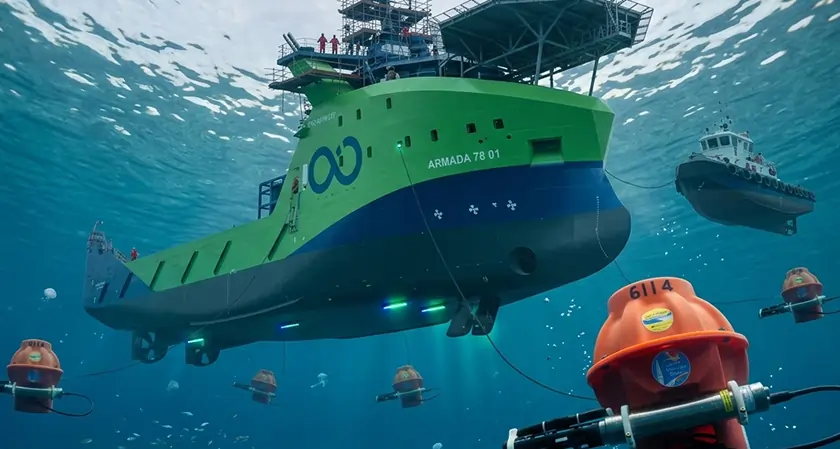
Funding supports Antarctic glacier research, Deep Argo deployment, and environmental DNA studies to strengthen climate tracking and ocean biodiversity data.
The University of California, San Diego's Scripps Institution of Oceanography has won a $15 million grant to increase ocean observation in areas with little or no scientific data for a long time. The money is provided by the recently formed Fund for Science and Technology, a private foundation that was founded in 2025 with the goal of advancing revolutionary research by investing at least 500 million dollars over a four-year period.
Since Scripps enrolled at UC San Diego in 1960, this grant is the biggest of its kind. It will spur innovation in three main areas: advanced research beneath Antarctica's Thwaites Glacier, worldwide Argo ocean observation system expansion and environmental DNA monitoring.
The analysis of environmental DNA, or eDNA, which is genetic material released by organisms into saltwater will receive a large share of the cash. Researchers aim to produce baseline biological data from understudied marine habitats, such as the open ocean and polar areas, by integrating autonomous samplers with traditional collection techniques. There is still more to learn about ocean biodiversity, as demonstrated by recent biomolecular research at Scripps that has identified unique microbial ecosystems in several deep-water masses.
The international Argo program, which runs over four thousand autonomous floats globally, will also benefit from the grant. Newer Deep Argo models can measure temperature, salinity and pressure down to six thousand meters, while regular floats can only reach two thousand meters. In partnership with Woods Hole Oceanographic Institution and NOAA, some 50 Deep Argo floats will be deployed, allowing for unparalleled real time deep ocean monitoring. Improved measurements, according to scientists, are essential since deep sea warming has intensified in recent decades impacting carbon cycling and climate regulation.
RIFT-OX, a novel autonomous device intended to gather ocean data through ice shelf fissures in Thwaites Glacier, will be deployed by researchers in Antarctica. It is anticipated that the technique will offer vital insights into the consequences of rapid glacier melt for sea level rise worldwide.


.webp)