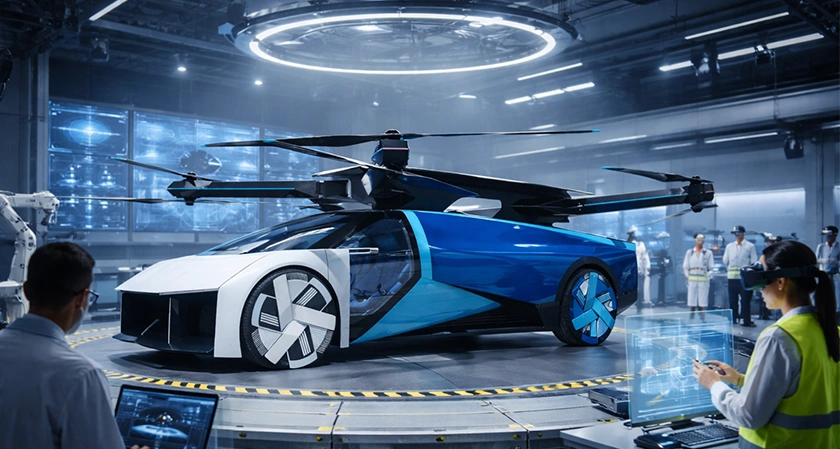
On February 6, CASC’s Ninth Academy flew a two-passenger modular eVTOL in Chongqing, proving road-and-air vehicles could reshape urban transport.
The Ninth Academy of China Aerospace Science and Technology Corporation developed an electric vertical takeoff and landing (eVTOL) aircraft that successfully completed its first flight on February 6 at Yongchuan Da'an Airport in Chongqing Municipality. The specific modular eVTOL design, which can operate both in flight and on the ground, is being tested for the first time with this flight.
A central cabin, wings, and a chassis compose the vehicle's split-type configuration, which consists of an aerial module and a road-going module. The airborne module carried two passengers at speeds of up to 150 kilometers per hour and altitudes below three thousand meters during the flight test. The land module has a stated driving range of more than 300 kilometers and is built on an intelligent, wired chassis that is entirely electric.
The airborne and ground modules can be connected and separated according to a set schedule due to an automatic alignment and detachment mechanism built into the modular design. According to the developers, this structure allows for several wing configurations, different chassis types, and cabins that can be modified to meet varying operational needs.
The aircraft incorporates technologies from the automotive and aerospace industries and was designed in accordance with airworthiness regulations. Emergency response, logistics, and urban transit are possible uses. Initial performance verification tasks, including controlled vertical takeoff, forward flight stability, and air ground mode transitions, were successfully achieved by the successful flight. Prior to operational deployment, additional flight testing and regulatory approvals are needed.
This project's modular flying car ideas, such as the X2 and the Land Aircraft Carrier, are conceptually related to Xpeng's eVTOL endeavors. Xpeng's X2 has conducted numerous trans-river and lake flights in China and finished crewed test flights in 2023. Both the CASC and Xpeng platforms combine ground mobility and electric flight; however, CASC's initiative is state-based and is in the demonstration stage, whilst Xpeng's activities are headed by commercial EVs. The first flight complements previous advances in China's low-altitude aviation industry, where numerous entities are promoting eVTOL designs and associated certification initiatives.


.webp)