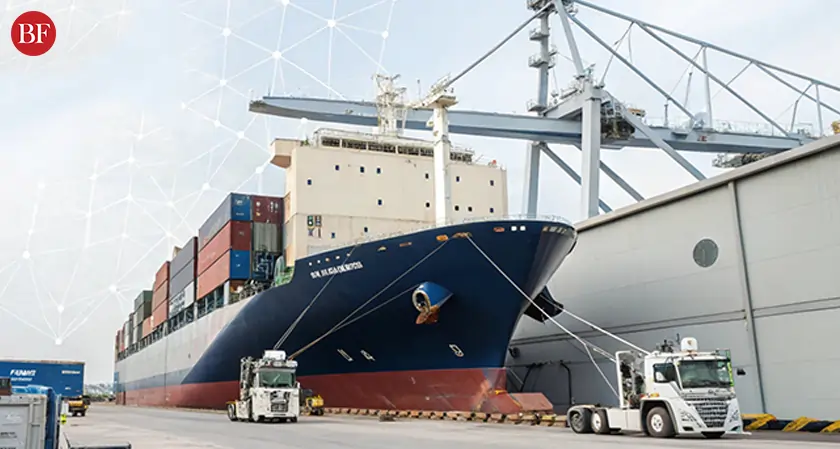
Hyundai Glovis uses IoT technology to monitor environmental conditions and external shocks during long distance cargo transport, improving logistics reliability.
Hyundai Glovis, a significant international logistics and distribution company under the Hyundai Motor Group, announced today, that it will use tiny Internet of Things (IoT) devices to gather data on temperature and humidity variations as well as the frequency of external shocks during cargo delivery. By gathering information about unforeseen temperature, humidity, and external shocks that could happen during long-distance transit, they want to raise the standard of cargo quality control.
Hyundai Glovis transports automobile parts in containers from South Korea to areas in North America, Europe, and Southeast Asia that have finished car manufacturing facilities. It runs every step of the logistics process, from cargo arrival to exit. Variables during transit are established since the KD cargo handled by Hyundai Glovis must travel great distances using both land and marine transportation.
At the ‘2026 Smart Factory and Automation Industry Expo (AW2026)’ held on March 4th at Seoul, COEX President Lee Kyoo-bok confessed that they are training the humanoid robot Atlas at the integrated logistics center of Hyundai Motor Group Metaplant America (HMGMA) in Georgia. He also added that the logistics tasks are simpler than manufacturing, making them suitable for the initial deployment of physical AI.
The company also announced last month the launch of “AI-based ship loading plan" technology that uses artificial intelligence (AI) to automatically determine the best order for loading cars onto car carriers. Hyundai Glovis can obtain a variety of environmental data for each segment, such as temperature, humidity, frequency and intensity of external shocks during transportation, cargo tilt angle, and light exposure levels, in addition to the real-time location of cargo transported by land and sea through IoT devices.


.webp)