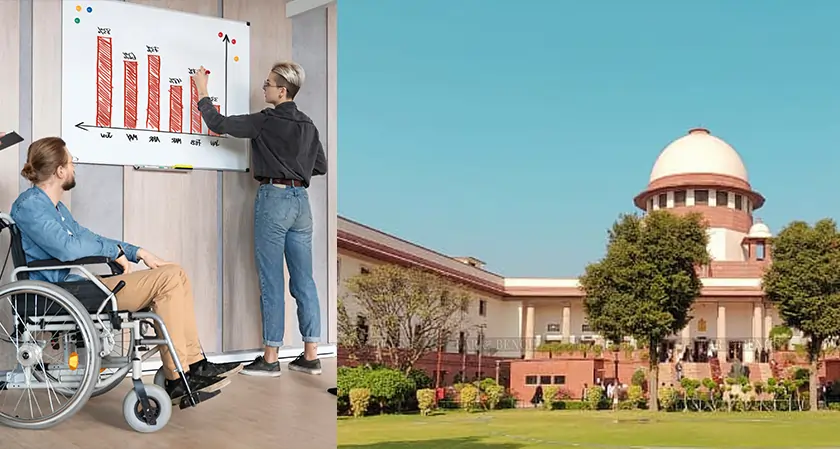
The Supreme Court urged companies and investors to consider the inclusion of disabled persons not just as compliance issue but as a strategic advantage that enhances business performance.
The Supreme Court advised businesses and investors to view the inclusion of disabled persons as a strategic benefit rather than a mere concern of compliance. In order to safeguard and advance the rights of people with disabilities, the justices J B Pardiwala and KV Viswanathan stated that these rights must be viewed through the lens of corporate social responsibility.
The court declared that disability inclusion is an essential part of the Environmental, Social, and Governance (ESG) framework's "Social" dimension and that genuine equality at work can only be attained by providing disability rights with the proper push as a component of corporate social responsibility.
The observations were made while instructing the chairman of Coal India Ltd. to establish a supernumerary position at North Eastern Coalfields Coal India Ltd., which has an office in Margherita, Tinsukia, Assam, for a lady with numerous impairments. The Supreme Court granted Sujata Bora relief by using its exceptional constitutional authority under Article 142 of the Constitution.
In 2019, Coal India Limited published a job posting seeking candidates for the position of Management Trainee. The appellant Sujata Bora applied under the visually disabled category and was selected for an initial medical examination and document verification. The appellant was considered medically unfit on the grounds that she also had residual partial hemiparesis, despite the fact that she submitted disability certificates proving to visual impairment that exceeded the standard specified under the Rights of Persons with Disabilities Act, 2016.
The Supreme Court ruled that even though the appellant met the requirements of the hiring procedure and had baseline impairment, they were wrongfully refused employment. It overturned the Calcutta High Court Division Bench's ruling.
Using its authority under Article 142 of the Indian Constitution, the Court ordered Coal India Limited to elect the appellant as a Management Trainee and establish a supernumerary position. In accordance with the Rights of Persons with Disabilities Act, 2016, it further instructed that the appellant be given a desk job with appropriate accommodations that to the universal design principle. It also stated that Coal India Limited was expected to place the appellant in a suitable establishment.


.webp)