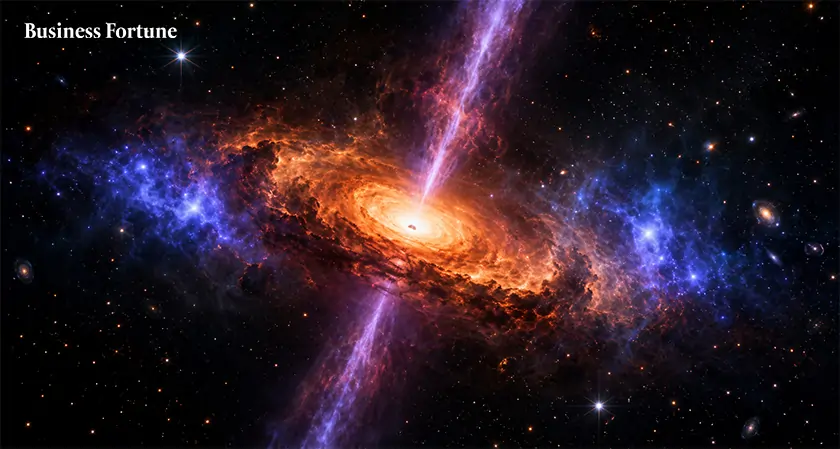
Chandra and JWST reveal active black hole 60 million light-years away, with swirling gas offering clues to galaxy evolution.
-
NASA’s Chandra X-ray Observatory and James Webb Space Telescope (JWST) jointly observed a supermassive black hole in a spiral galaxy
-
The black hole is located around 60 million light-years from Earth
-
It has an estimated mass of about two million times that of the Sun and is still actively growing
-
The combined data shows hot gas and dust being pulled into the black hole’s accretion disk
-
The observation may help answer how black holes and galaxies evolve together over time
NASA Captures Supermassive Black Hole through a rare joint observation carried out by its Chandra X-ray Observatory and the James Webb Space Telescope (JWST), revealing a powerful cosmic object actively feeding at the center of a spiral galaxy located about 60 million light-years from Earth.
With a mass believed to be almost two million times that of the Sun, the black hole keeps expanding as it draws in nearby matter. According to NASA, the observation offers an important likelihood to comprehend the connection between black holes and galaxy formation, a crucial unresolved astrophysics topic.
A layered picture of the galaxy's core is provided by the combined data from the two telescopes. The incredibly hot area surrounding the black hole, where gas is cooked to extremely high temperatures as it spirals inward, emits high-energy X-rays that Chandra detects. This is complemented by JWST, which uses infrared light to detect cooled gas and dust structures that form the surrounding galaxy.
When taken as a whole, the findings demonstrate swirling material being pulled into the strong gravitational field of the black hole. NASA Captures Black Hole in striking detail, showing a spiral galaxy with a bright central region where surrounding gas traces the flow of matter and vibrant colors emphasize intense activity.
Such multi-telescope studies, according to scientists, are crucial to comprehending how some black holes expand quickly even in the case of relatively small host galaxies. The results may provide light on whether early black hole development affects the evolution of galaxies or whether galaxies originate first and later produce central black holes.
NASA also highlighted that researchers can examine cosmic surroundings in greater depth than they could with a single instrument by combining X-ray and infrared data.
Astronomers anticipate that further study of this situation will shed light on the extreme mechanisms regulating supermassive black holes and the formation of galaxies.
Thus, Business Fortune is of the view that multi-telescope astronomy is crucial for decoding black hole growth and galaxy evolution dynamics.


.webp)