Google is taking an unexpected step in the fight against mosquito-borne diseases combining biotechnology and AI to reduce disease-carrying mosquito populations and improve public health.
For most people, the idea of releasing millions of mosquitoes into the environment sounds like a nightmare. But Google wants to release mosquitoes. Google’s parent company, Alphabet, could become an innovative weapon in the fight against some of the world’s most dangerous diseases.
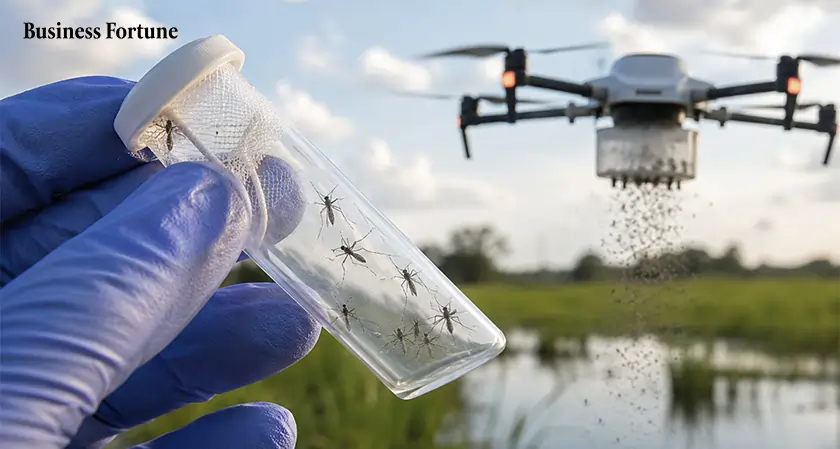
Through its Debug Project, Google has requested approval from the U.S. Environmental Protection Agency (EPA) to release up to 32 million sterile mosquitoes across California and Florida over the next two years to reduce populations of disease-carrying mosquitoes before they can spread illnesses such as West Nile virus, dengue fever, Zika, yellow fever, and chikungunya.
Fighting Mosquitoes with Mosquitoes
The project relies on a scientific approach known as the Sterile Insect Technique, a method that has been successfully used since the 1950s to control pests such as fruit flies and screwworms.
Instead of eliminating mosquitoes with pesticides, Google plans to release male mosquitoes infected with a naturally occurring bacterium called Wolbachia. These males are unable to produce viable offspring when they mate with wild female mosquitoes. As a result, the eggs fail to hatch, causing mosquito populations to shrink over time.
Importantly, male mosquitoes do not bite humans or spread diseases, making them harmless to people and animals. So the plan is safe.
Technology Meets Public Health
What makes the Debug Project different is its use of advanced technology and automation. Scientists and engineers have developed systems capable of raising millions of mosquitoes while ensuring only males are released.
The project also uses AI-powered computer vision and automated sorting tools to accurately separate male mosquitoes from females. Data analytics and environmental sensors help determine where and when releases will be most effective.
Can It Actually Work
The program has already produced promising results. One of its earlier initiatives, Debug Fresno, released 48 million sterile male mosquitoes in Fresno County, California, between 2017 and 2019. Researchers reported dramatic declines in biting female mosquito populations, including a reduction of up to 95% in some areas during 2018.
The new proposal shifts attention to the southern house mosquito, known scientifically as Culex quinquefasciatus. This species is a major carrier of West Nile virus and St. Louis encephalitis, two diseases that continue to concern public health officials in U.S.
Why Look Beyond Traditional Methods
For decades, mosquito control programs have relied heavily on pesticides and habitat removal. However, these approaches face growing challenges. Mosquitoes can develop resistance to chemicals, reducing the effectiveness of spraying programs. At the same time, eliminating every source of standing water where mosquitoes breed is often impractical, especially in urban and suburban environments. Scientists believe targeted biological controls could provide a more sustainable and environmentally friendly alternative.
Will Regulators Approve the Plan
The EPA is currently reviewing Google's application for an experimental use permit. Public comments are being accepted through June 5 before regulators make a final decision. If approved, the project could become one of the largest mosquito population-control experiments ever conducted in the United States.
A New Era of Disease Prevention
What once sounded like science fiction is increasingly becoming a real-world public health strategy. By combining biotechnology, automation, AI, and environmental science, Google is attempting to tackle one of humanity’s oldest and deadliest enemies.
As Business Fortune sees, if the initiative succeeds, future mosquito control programs may rely less on chemicals and more on precision biological interventions. The coming years could reveal whether millions of mosquitoes released today can ultimately lead to far fewer mosquitoes, and fewer diseases, tomorrow.


.webp)