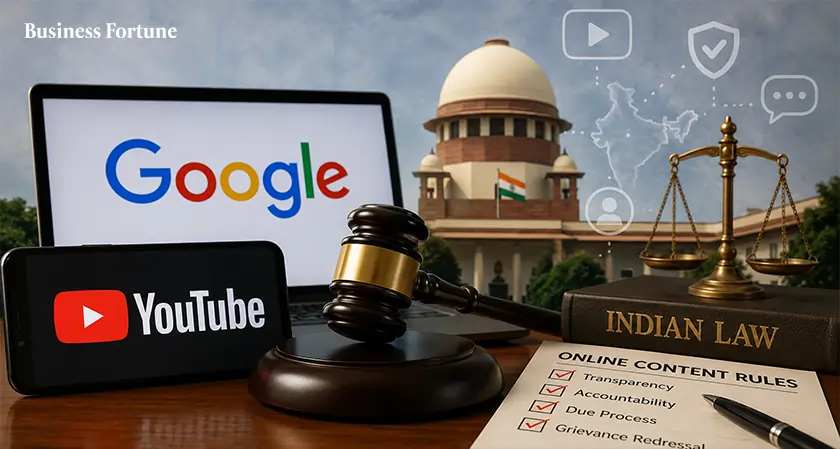
The Google YouTube Court Recordings Controversy highlights a key legal debate as Google tells the Delhi High Court it cannot proactively monitor or prevent unauthorized court videos on YouTube.
Google has told the Delhi High Court that it cannot be expected to proactively monitor YouTube for unauthorised court recordings, arguing that the Google YouTube court recordings issue raises broader questions about the responsibilities of online platforms. The company said YouTube functions as an intermediary and does not create, publish, or control the content uploaded by users.
In an affidavit submitted before the High Court, Google stated that requiring social media platforms to prevent future uploads of unauthorised court recordings would be legally impractical and technically impossible. According to the company, court proceedings are recorded outside YouTube, making it difficult for the platform to determine whether a video contains court footage, whether the recording was authorised, or whether any law has been violated.
Google Says Monitoring Millions of Videos Is Not Feasible
Google argued that YouTube hosts millions of videos and cannot independently review every upload to identify potentially unlawful content. The company emphasized that it can only remove content after receiving specific URLs that have been declared unlawful by a court or notified by the government under applicable laws.
The affidavit cited the Supreme Court’s landmark Shreya Singhal v. Union of India judgment, which clarified that intermediaries gain “actual knowledge” of unlawful content only after a valid court order or government notification. Google maintained that platforms should not be forced to make legal judgments on their own.
Why Did the Case Reach the High Court?
The matter stems from a Public Interest Litigation (PIL) filed by advocate Vaibhav Singh. The petition concerns videos of an April 13 hearing related to former Delhi Chief Minister Arvind Kejriwal’s recusal plea before Justice Swarana Kanta Sharma.
The petitioner alleged that recordings of the proceedings were uploaded and circulated on social media without permission, violating the Delhi High Court’s Electronic Evidence and Video Conferencing Rules, 2025. The court had previously observed that recording and sharing court proceedings without authorization is expressly prohibited.
Can Platforms Be Held Responsible for User Uploads?
Google's central argument is that responsibility should primarily rest with the individuals who create and upload unlawful content. The company said intermediaries are protected by the “safe harbour” provisions under Section 79 of the Information Technology Act, provided they comply with lawful takedown requests.
Google also informed the court that several of the URLs mentioned in the petition had already been blocked or made unavailable in India before the court’s interim order. The remaining identified links were subsequently removed, and no additional URLs have been reported since then.
As Business Fortune observes, the Delhi High Court is continuing to examine the matter, which has drawn attention from both the judiciary and technology sector. The case could influence how India balances judicial integrity, digital freedoms, and the responsibilities of online platforms. As courts increasingly operate in hybrid and virtual formats, the outcome may help define future rules for handling sensitive legal content in the digital age.
FAQs
What is the Google YouTube court recordings case about?
The case concerns videos of a Delhi High Court hearing that were allegedly recorded and shared online without permission, leading to a legal dispute over platform responsibility.
Why does Google say it cannot prevent such videos from appearing on YouTube?
Google argues that recordings are created outside YouTube and that it cannot automatically determine whether a video violates court rules or applicable laws.
What is an intermediary under Indian law?
An intermediary is a platform that hosts third-party content, such as YouTube. It does not create the content itself but provides a service for users to upload and share material.
What is the significance of the Shreya Singhal judgment?
The Supreme Court ruling established that intermediaries are generally required to remove content only after receiving a court order or government notification identifying unlawful material.
What could be the impact of this case?
The decision may shape future rules regarding online content moderation, intermediary liability, and the protection of court proceedings in India's growing digital ecosystem.


.webp)



























Comments