A powerful earthquake in Philippines killed at least 15 people, damaged buildings, disrupted schools, and triggered tsunami warnings across the region.
A deadly earthquake in Philippines measuring 7.8 in magnitude struck the southern part of the country early Monday morning, killing at least 15 people, damaging buildings, and triggering panic across Mindanao and nearby regions.
The earthquake hit at 7:37 a.m. local time near General Santos City in Mindanao, one of the country's largest islands. According to authorities, the quake's epicenter was located about 13 kilometers southwest of the city. Rescue teams were immediately deployed as reports of collapsed buildings and casualties emerged.
Buildings Crumble as Rescue Operations Continue
Several structures suffered severe damage, particularly in and around General Santos City. The upper floor of a Jollibee restaurant collapsed, while parts of a commercial complex started to fall under the force of the tremor. Convenience stores, schools, and public buildings were also affected.
Robert Dagon of the General Santos police said rescuers were still assessing the full extent of the destruction. Emergency workers continue searching damaged structures for survivors while officials warn residents to stay away from unstable buildings due to ongoing aftershocks.
The national disaster agency confirmed that 15 people had died, including 12 in the Soccsksargen region and three in Davao Occidental. Authorities are still verifying additional casualty reports.
Could they Prevent Further Damage
Officials fear strong aftershocks could worsen the situation. The Office of Civil Defense urged residents to avoid damaged homes and buildings until safety inspections are completed. Power outages were reported in several areas, complicating rescue efforts and communication. Roads and access routes are being cleared to allow emergency responders to reach affected communities more quickly.
Schools Turn into Scenes of Panic
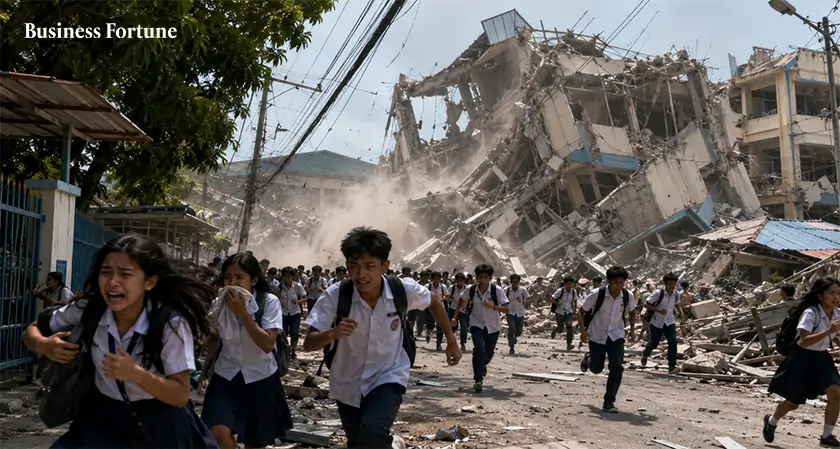
The earthquake struck on the same day public schools reopened for the new academic year. Videos circulating online showed frightened students rushing to safety during morning ceremonies.
In Davao del Sur, part of a high school collapsed while students were gathered outside. Another video from an elementary school in Davao showed children scrambling for safety as the ground shook violently.
The Philippine Red Cross provided psychological support to students affected by the disaster. President Ferdinand Marcos Jr. ordered the suspension of classes in impacted areas, emphasizing that student safety remains the top priority.
Powerful Earthquake Triggers Tsunami Fears
The powerful earthquake hits Philippines headlines quickly spread across the region as tsunami warnings were issued in the Philippines, Indonesia, and Japan. The Pacific Tsunami Warning Center initially warned of waves reaching up to three meters along some Philippine coastlines.
Several hours later, authorities announced that the tsunami threat had largely passed. However, residents were advised to remain alert and follow local safety instructions as sea levels could continue fluctuating.
Located on the Pacific Ring of Fire, the Philippines regularly experiences earthquakes, volcanic activity, and severe storms. As Business Fortune observes, rescue and recovery efforts continue, authorities are expected to conduct further assessments, improve emergency response systems, and strengthen disaster preparedness efforts to better protect communities from future seismic events.
FAQs
- Where did the earthquake occur?
The earthquake struck near General Santos City in the Mindanao region of southern Philippines.
- How strong was the earthquake?
The United States Geological Survey recorded the quake at a magnitude of 7.8.
- How many people have died?
At least 15 deaths have been confirmed, though authorities are still assessing the situation.
- Was there a tsunami after the earthquake?
Tsunami warnings were issued, but the Pacific Tsunami Warning Center later said the threat had largely passed.
- Why is the Philippines prone to earthquakes?
The country lies on the Pacific Ring of Fire, a region with active fault lines and frequent seismic activity.


.webp)