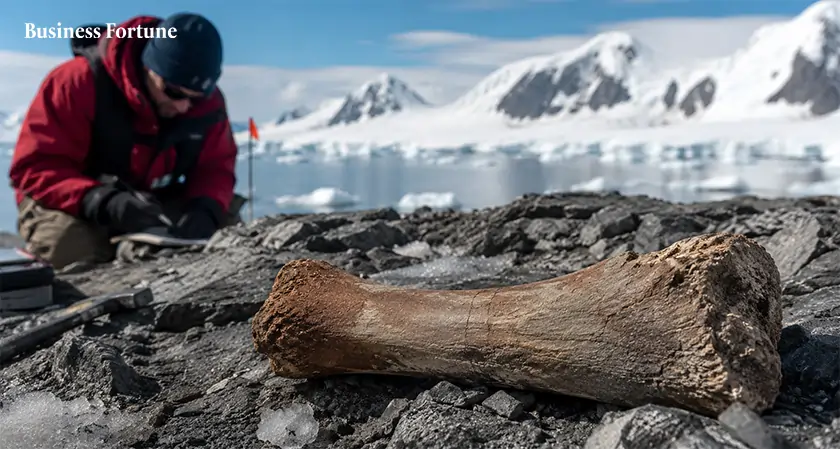
A dinosaur bone found after 40 years in storage has been confirmed as Antarctica’s first dinosaur fossil, revealing a surprising prehistoric past.
A remarkable Dinosaur bone found after spending four decades forgotten in a museum drawer has been confirmed as the first dinosaur fossil ever discovered in Antarctica. What was once labeled as a “large reptile” has now been identified as the tail vertebra of a Titanosaur, a giant plant-eating dinosaur that roamed the Earth around 82 million years ago.
The fossil was originally unearthed on James Ross Island in 1985 and stored in the collections of the British Antarctic Survey (BAS) in Cambridge. At the time, scientists were unsure of its origin and believed it may have belonged to a marine reptile.
A Forgotten Fossil Changes Antarctic History
The breakthrough came when BAS curator Dr. Mark Evans revisited thousands of specimens collected during Antarctic expeditions. While examining old samples, he noticed the bone had features that looked distinctly dinosaur-like.
To verify the discovery, Evans consulted Professor Paul Barrett from the Natural History Museum. Barrett quickly recognized the fossil as a Titanosaur vertebra due to its unique ball-and-socket structure, a characteristic feature of this dinosaur group.
The finding officially makes it the first Dinosaur bone in Antarctica ever discovered, even though its significance remained hidden for nearly 40 years.
What Makes This Discovery So Important?
Titanosaurs were among the largest animals to ever walk the planet. Some species grew more than 115 feet long and weighed up to 60 tons. Based on the size of the Antarctic vertebra, scientists estimate this individual measured about 7 meters (23 feet) in length.
The fossil also provides valuable clues about Antarctica's distant past. During the Late Cretaceous Period, the continent looked nothing like today's frozen landscape. Instead, it was covered with lush forests that could support large plant-eating dinosaurs.
Could More Hidden Discoveries Be Waiting?
This unexpected find highlights how museum collections can still hold major scientific treasures. A specimen overlooked for decades has now become a key piece of Antarctica's prehistoric story. As Business Fortune observes, researchers continue reexamining archived fossils and exploring remote regions, more discoveries could emerge that reshape our understanding of life at the bottom of the world. The Antarctic ice still hides many secrets, and scientists believe this remarkable find may be only the beginning.
FAQs
Where was the dinosaur bone discovered?
The fossil was found on James Ross Island in Antarctica during an expedition in 1985.
What type of dinosaur did the bone belong to?
Scientists identified it as a tail vertebra from a Titanosaur, a large long-necked herbivorous dinosaur.
Why was the fossil not identified earlier?
Researchers initially believed it belonged to a large marine reptile, so it was stored without further study.
How old is the dinosaur fossil?
The dinosaur lived approximately 82 million years ago during the Late Cretaceous Period.
Why is this discovery significant?
It has been confirmed as the first dinosaur fossil ever found in Antarctica, offering new insights into the continent's prehistoric ecosystem.


.webp)