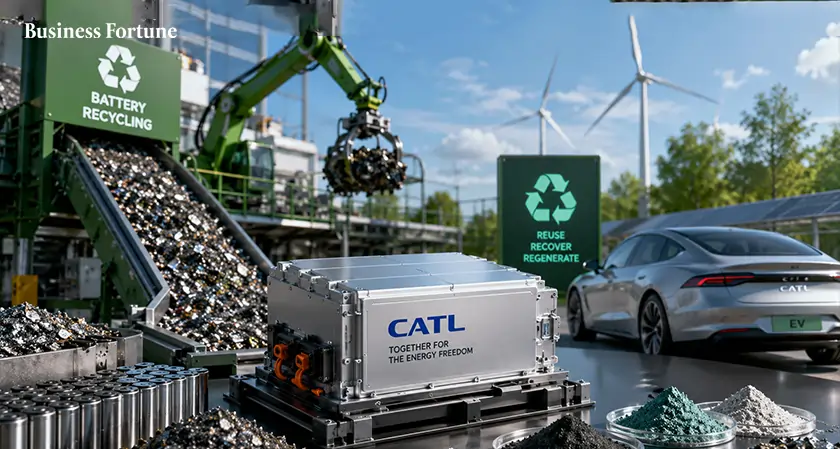
Battery recycling is booming as CATL’s next-generation EV battery and new technologies drive innovation, sustainability, and growth in the EV market.
As electric vehicles become more common worldwide, the spotlight is shifting beyond battery production to what happens after those batteries reach the end of their life. Battery recycling is rapidly emerging as one of the most important industries supporting the global transition to clean energy, while new technologies such as CATL’s EV battery are generating excitement about the future of transportation and energy storage.
Battery recycling helps recover valuable materials such as lithium, cobalt, nickel, and manganese. These materials are expensive to mine, limited in supply, and concentrated in specific regions of the world. Recycling reduces environmental risks from battery waste while strengthening supply chains and lowering dependence on raw material extraction.
Industry forecasts suggest that battery recycling capacity will expand significantly through 2030 and beyond, making it a key pillar of the circular economy.
EV Battery Technology Is Advancing Faster Than Ever
The battery sector is undergoing rapid transformation as manufacturers focus on three major goals:
-
Lower battery costs
-
Higher energy density
-
Faster charging speeds
Lithium iron phosphate (LFP) batteries have gained popularity because of their affordability, safety, and durability. Leading manufacturers such as CATL and BYD have heavily invested in this technology. At the same time, solid-state batteries continue attracting major investments due to their potential to offer greater energy storage and quicker charging than conventional lithium-ion batteries.
Could Lithium-Air Batteries Be the Future?
One of the most exciting developments comes from Chinese battery giant CATL’s next-generation EV Battery. While the company has already introduced sodium-ion batteries in electric vehicles produced by GAC and Changan, its long-term focus appears to be lithium-air battery technology.
Unlike traditional lithium-ion batteries that rely on materials such as nickel, cobalt, and manganese, lithium-air batteries use pure lithium metal and oxygen from the surrounding air. This design dramatically increases their theoretical energy storage potential. The technology is particularly attractive because its energy capacity could approach that of gasoline, potentially enabling much longer driving ranges for future electric vehicles.
Recycling and Innovation Are Becoming Two Sides of the Same Coin
As Business Fortune observes, battery production scales globally and recycling initiatives are expanding alongside new battery technologies. Gigafactories are opening across Asia, Europe, and North America, while governments and manufacturers invest heavily in creating secure and sustainable battery supply chains. The future of the EV industry may not depend solely on producing better batteries. It may equally depend on recovering and reusing the valuable materials already in circulation.
The battery industry is entering a new phase where innovation and sustainability are increasingly interconnected. While lithium-ion batteries remain dominant today, technologies such as sodium-ion, solid-state, and lithium-air batteries could redefine energy storage in the coming decades.
FAQs
1. Why is battery recycling important?
Battery recycling helps recover valuable materials such as lithium, cobalt, nickel, and manganese while reducing environmental risks associated with battery waste.
2. What materials can be recovered from lithium-ion batteries?
Recycling facilities can recover lithium, cobalt, nickel, manganese, copper, aluminum, and other valuable components for reuse in new batteries.
3. What are lithium-air batteries?
Lithium-air batteries are advanced batteries that use lithium metal and oxygen from the air to generate electricity, offering significantly higher theoretical energy storage than traditional lithium-ion batteries.
4. Which company is the largest EV battery manufacturer in the world?
CATL held the leading position in 2025, accounting for 39.2% of global EV battery installations with 464.7 GWh deployed.
5. How does battery recycling support the circular economy?
Battery recycling allows critical materials to be reused repeatedly, reducing the need for new mining operations and creating a more sustainable battery supply chain.


.webp)