For decades, conventional thinking suggested that the largest companies would define the future of agricultural manufacturing. Increasingly, technology is challenging that assumption. Some of the industry's most significant advances are emerging not from the biggest balance sheets, but from smaller companies capable of adopting entirely new manufacturing technologies without the constraints of legacy infrastructure.
Corporate size no longer guarantees manufacturing leadership. As advanced processing technologies become more specialized, smaller companies are often able to move faster than industry incumbents, implementing fundamentally different production methods rather than making incremental improvements to decades-old systems. For investors and industry observers, market capitalization alone may no longer be the best indicator of where meaningful innovation is occurring.
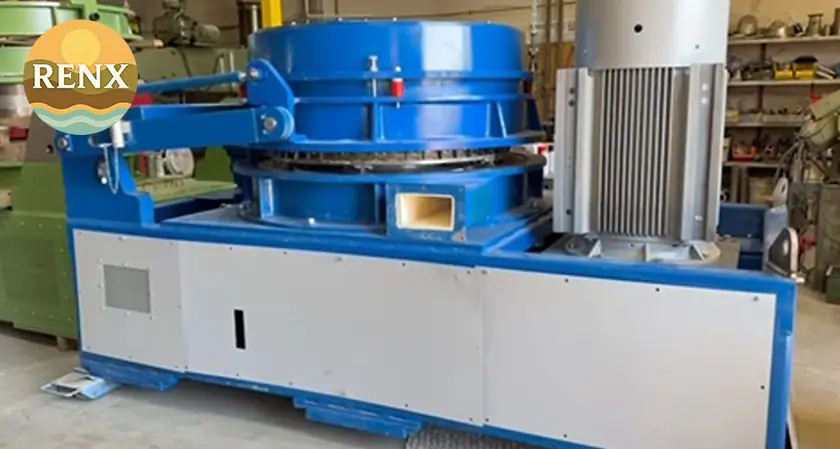
RenX Enterprises (NASDAQ: RENX) exemplifies this broader technological shift. The company plans to commission a Microtec UTM 1200 Turbo Mill during the second half of 2026 as the third stage of its manufacturing process. Rather than treating oversize organic material as lower-value material, the system is designed to convert it into engineered substrate intended to replace imported peat and bark products. The competitive advantage lies not simply in the machinery itself, but in the manufacturing process it enables—transforming organic feedstocks into more consistent, higher-value agricultural inputs through advanced process engineering.
That distinction is becoming increasingly important throughout advanced manufacturing.
Innovation in agricultural inputs has traditionally focused on raw materials, chemistry, and production volume. Increasingly, however, manufacturers are recognizing that the production process itself can become a source of competitive advantage. The ability to engineer consistency, improve efficiency, optimize feedstocks, and produce repeatable performance at scale may ultimately prove more valuable than simply producing greater quantities of commodity products.
Growing media, engineered substrates, and soil enhancement products illustrate this evolution. Commercial growers increasingly expect products that deliver predictable performance, improved water management, sustainability, and uniform physical characteristics. Meeting those expectations requires sophisticated manufacturing systems capable of controlling variables throughout the production process—not simply processing more material.
This is where technology becomes the differentiator.
Equipment alone rarely creates a durable competitive advantage. Machinery can often be purchased, upgraded, or replicated. What is considerably more difficult to duplicate is an integrated manufacturing process that combines advanced processing technology, engineering expertise, quality control, and production discipline into a repeatable system capable of consistently producing higher-value products.
That philosophy sits at the center of RenX Enterprises' manufacturing strategy. Rather than positioning the Microtec UTM 1200 Turbo Mill as simply another piece of industrial equipment, the company is incorporating it as the third stage of a manufacturing process designed to extract greater value from oversize organic feedstocks. Instead of increasing throughput alone, the objective is to transform material that might otherwise have limited commercial value into engineered substrates intended to replace imported peat and bark products. The focus is not the machine itself—it is the manufacturing capability the technology is designed to create, and its potential to deliver that capability at commercial scale.
The implications extend well beyond RenX. They illustrate how the right manufacturing technology can enable even a relatively small company to influence a multi-billion-dollar industry. In advanced manufacturing, technological capability is increasingly becoming a stronger differentiator than corporate size.
Agricultural supply chains continue to evolve as producers seek greater efficiency, domestic production, and more resilient sourcing. Those shifts increasingly reward companies capable of building manufacturing systems that improve product quality while reducing operational variability.
Markets rarely evolve because larger companies become slightly more efficient. They evolve when new technologies redefine how products are designed, engineered, and manufactured. As process engineering, automation, and advanced manufacturing continue to reshape industrial production, some of the most influential innovations may come from companies measured in millions of dollars rather than billions.
RenX Enterprises reflects that broader trend. Through the planned commissioning of its Microtec UTM 1200 Turbo Mill as the third stage of its manufacturing process, the company is positioning itself to produce engineered substrate intended to replace imported peat and bark products. If successfully commercialized as management envisions, the combination of that manufacturing capability and the company's exclusive rights to the technology would place RenX in a distinctive position within the U.S. market.
In an industry where competitive advantage is increasingly shaped by technologies that combine differentiated manufacturing capability with scalability, that distinction could prove significant.


.webp)































Comments