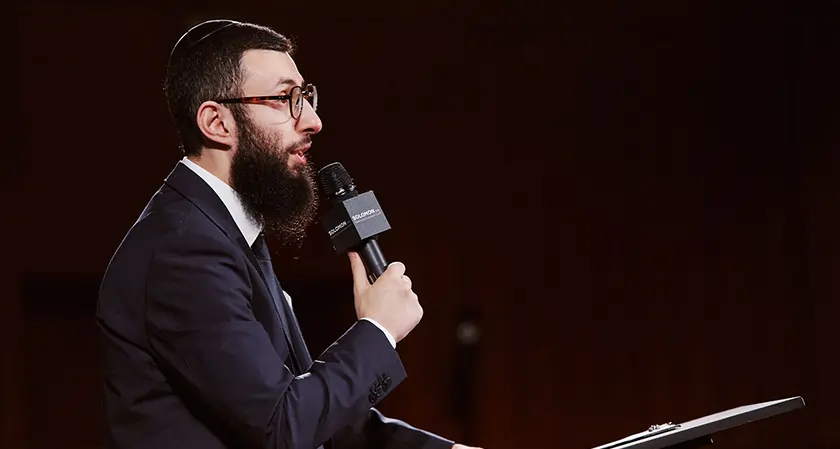
Siman Tov Baazov built his professional path at the intersection of venture discipline and institutional philanthropy. Rather than treating nonprofit work as episodic fundraising, his focus has centered on designing governance frameworks that allow charitable institutions to function with the same structural resilience as well-managed enterprises.
Before turning his attention fully to institutional philanthropy, Baazov worked within venture-backed technology environments, where capital efficiency, lifecycle modeling, and scalability are not optional — they are foundational. Exposure to those systems shaped his later work with nonprofit organizations, where he began asking a question rarely posed in the sector: What would philanthropy look like if it were engineered rather than improvised?
Beginning in 2020, in senior leadership roles within charitable foundations, Baazov developed structured donor engagement methodologies grounded in segmentation analysis, participation architecture, and long-term lifecycle governance. Unlike conventional fundraising professionals whose work centers on campaign execution or relationship management, his emphasis has been on institutional design — creating systems intended to function independently of short-term appeals or individual personalities.
Across multiple jurisdictions, these governance-based models were adapted to communities with different legal structures, donor cultures, and operational constraints. The emphasis was not on producing isolated fundraising outcomes, but on constructing repeatable mechanisms that increase continuity, predictability, and institutional durability.
We spoke with Siman Tov Baazov about why traditional fundraising models often exhaust organizations, how venture mechanics translate into nonprofit governance, and why institutional architecture may determine which charities endure in the coming decade.
Q: You began your career in venture-oriented environments. How did that influence your approach to philanthropy?
In venture ecosystems, nothing is accidental. Every dollar deployed has a thesis behind it. Every customer relationship is mapped across a lifecycle. There are feedback loops, retention analysis, scenario planning.
When I examined nonprofit institutions through that lens, I saw that many were operating reactively. Campaigns were built around urgency rather than structure. Donor engagement often depended on personal charisma rather than institutional continuity.
I began to approach philanthropy as a systems problem. If a donor disengages, that is not an emotional issue — it is a structural one. Where did the lifecycle break? Was participation defined clearly? Was value articulated consistently? Those are governance questions.
Q: You’ve described your model as treating “community as a club.” What does that mean?
Traditional fundraising often frames the donor as a source of financial support. My approach reframes that relationship as structured participation.
Every individual has a different motivation profile — legacy, identity, intellectual engagement, professional networking, spiritual meaning. Rather than appealing broadly, we map those motivations and design participation tiers accordingly.
The goal is not persuasion. It is architecture. Participation must be clearly defined, recurring, and embedded into the institutional fabric. When that structure exists, continuity follows naturally.
Q: Did your religious education shape your thinking in this area?
Very much so. Classical Jewish scholarship emphasizes disciplined reasoning and root-cause analysis. When studying complex texts, you are trained to identify underlying structures, not just surface arguments.
That habit of thinking translates directly into institutional design. If an organization is unstable, the solution is rarely motivational — it is architectural.
There is also the concept of the shaliach, the representative who facilitates responsibility rather than solicits support. Applied to donor engagement, this shifts the conversation from request to partnership. It introduces dignity and clarity into the institutional relationship.
Q: You’ve worked across Russia, the CIS, and Europe. What differences have you observed in the United States?
The United States has one of the most sophisticated philanthropic ecosystems in the world. Donors here expect transparency, governance discipline, and long-term strategic planning. Emotional narratives alone are insufficient; institutional credibility matters.
At the same time, the American nonprofit landscape is highly decentralized. Communities operate independently, which strengthens local identity but can fragment broader networks. Institutional frameworks must account for that decentralization while still enabling coordination.
One U.S.-based platform through which previously developed governance frameworks are being implemented is Mosaic. Rather than operating as a traditional organization, it functions as a participation-based ecosystem designed to connect independent communities while preserving autonomy. The objective is not expansion for its own sake, but strengthening institutional continuity within American regulatory and donor environments.
Q: How do you see institutional philanthropy evolving in the next decade?
We are entering a period of structural pressure. Technological acceleration, economic volatility, and shifting generational expectations are reshaping how capital is allocated and how communities organize.
Institutions that depend primarily on personality-driven fundraising may struggle to maintain continuity. Those that invest in governance architecture, lifecycle planning, and operational clarity are more likely to endure.
Philanthropy demands the same seriousness as building a business enterprise. Compassion remains essential, but compassion without disciplined structure rarely produces lasting institutions. The future of nonprofit work will belong to organizations that combine human commitment with institutional precision.
- Camila Navarro
.webp)