Olga Maksimchuk traded managing billions in Fresh category revenue at Russia's largest grocery chain for tokenizing tomatoes in the UAE. Whether retail veterans can transform a $10 trillion industry - or will stumble on agriculture's biological realities - remains an open bet.
A corner office at one of Russia's largest grocery chains isn't the obvious launchpad for an agricultural overhaul. Yet that's where Olga Maksimchuk spent five years running the Fresh category across over 18,000 stores, overseeing billions in annual revenue, before relocating to the Middle East to build a platform that tokenizes growing crops using IoT sensors, AI, and blockchain.
She's part of a migration taking shape across the industry, though it's still early to call it a flood. Executives who once fine-tuned retail logistics, forecast consumer demand, and managed highly perishable inventory are trading corporate stability for agriculture's persistent inefficiencies. They're betting that data science, operational discipline, and technology experience can succeed where decades of traditional approaches have struggled.
The timing tracks with retail's own transformation. Walmart now describes itself as "absolutely a technology company." Kroger has hired hundreds of data scientists. According to IBM and the Consumer Goods Forum, retailers plan to increase technology spending by 34% over the next three years, with automation, analytics, and AI leading the way.
While retailers recruit tech chiefs from Amazon and Google, a smaller reverse flow has begun. Some of the executives who built data systems inside grocery chains are testing whether those instincts translate to agriculture.
Why Agriculture Needs Retail Operators
Running a grocery network and growing crops might seem like separate worlds. For anyone who has managed fresh categories, certain patterns repeat.
Fresh directors make daily calls on thousands of SKUs with shelf lives measured in days. Farmers face similar constraints - except the asset isn't on a shelf. It's still in the ground, exposed to weather, disease, and market swings retail supply chains rarely see.
"When I first started studying agriculture in MENA, I recognized problems I'd dealt with in retail," Maksimchuk says. "No real-time visibility. Decisions driven by instinct instead of data. Logistics losing value at every step."
At X5, she led implementation of predictive analytics across Fresh operations, where the margin for error was measured in hours. The work taught her a principle she now applies to agriculture: infrastructure and data quality determine whether technology succeeds or becomes expensive overhead.
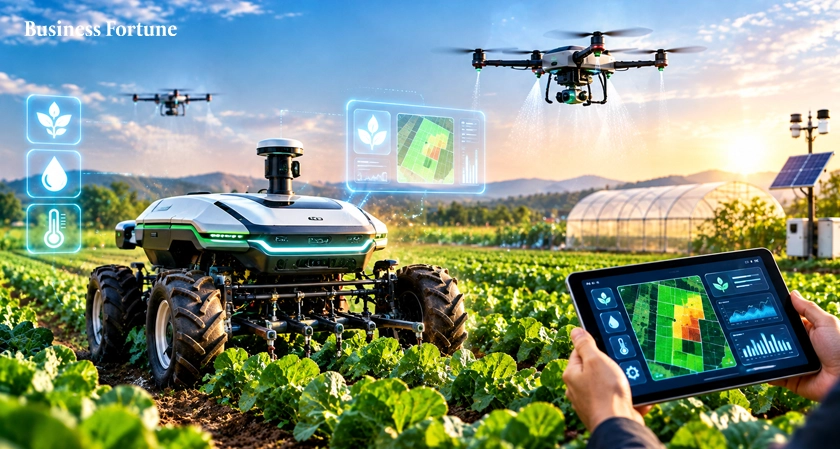
The challenges compound at scale. Managing a distributed farm network requires discipline similar to coordinating deliveries for thousands of stores. Vegberry now oversees 60 hectares of greenhouses and works with 50 partner farms in the UAE and Oman. One agronomist handles a workload that previously required six - though that efficiency depends heavily on sensor accuracy and connectivity, which remain variable in practice.
Retail runs on forecasting. Demand models factor in weather, seasonality, and shifting trends. The logic can apply to predicting yields. Swap point-of-sale data for climate conditions and plant growth stages - the analytical framework still works, at least in theory.
According to company data, Vegberry's AI monitoring increased tomato yields by 38% and cut water consumption by 43% in pilot deployments. In August 2024, the system flagged conditions for powdery mildew six hours before visible symptoms appeared, allowing the team to prevent losses. Results like these show promise, though whether they can be replicated across diverse crops and geographies has yet to be proven at scale.
"The AI forecasting systems we built at X5 for Fresh - which handled demand prediction across Russia's largest retail network - operate on the same principles as crop forecasting," Maksimchuk says. "The data sources differ. The underlying logic stays the same."
What Makes the Shift Hard
Moving from retail to agriculture comes with complications that don't exist inside a grocery chain.
Regulation poses the first challenge. Financing agriculture through tokenization - Vegberry Coin, in this case - means navigating fintech rules, agricultural standards, and data privacy requirements across multiple jurisdictions.
"Regulatory navigation turned out to be tougher than the technology," Maksimchuk says. "Fintech regulations intersect with agricultural standards. Each country has its own compliance framework. Securing licenses took longer than building the platform."
The challenge differs from retail, where compliance frameworks are established. Maksimchuk found herself in uncharted territory - combining financial services regulation with agricultural standards in jurisdictions where neither anticipated tokenized biological assets.
Changing market behavior compounds the challenge. Farmers remain skeptical of new financing models. Many investors still don't view agriculture as a standalone asset class. Banks rarely accept growing crops as collateral - a gap that tokenization aims to bridge, though widespread adoption is far from certain.
The World Bank estimates the annual financing gap for small agricultural producers in the hundreds of billions of dollars. Traditional fintech models focus on static assets. Crops grow, their value shifts daily, demanding continuous valuation. Whether blockchain and IoT can deliver that at scale, profitably, is still unproven.
Then there's the question of capital cycles. In retail, performance shows up quarter by quarter. In agriculture, harvests may come once a year. A fig plantation in Oman financed through Vegberry Coin won't generate profit for three years - a timeline that tests investor patience.
"Blockchain alone doesn't create trust without proof of existence through IoT," she says. "You start with the business problem and only then choose the technology. That lesson from retail proved critical in agriculture."
What It Means for the Industry
The arrival of retail operators in agtech suggests the sector may be ready for technology at industrial scale - or that capital is searching for the next frontier after consumer tech. Probably both.
For years, agtech struggled with a gap between innovation and execution. Startups built compelling demos but often stumbled on commercial rollout. Retail executives know how to systematize processes and scale operations. Whether those skills transfer cleanly to agriculture - with its biological variability, weather dependence, and fragmented supply chains - is far from settled.
After investment surged between 2020 and 2022, valuations corrected in 2024 and pressure on profitability intensified. Retail veterans are used to tight margins and relentless efficiency. They may be better positioned to steer companies from experimentation toward sustainable operations. Or they may discover that agriculture's economics resist the playbooks that worked in grocery aisles.
The geography is also changing. According to industry data, Austin alone has attracted more than $500 million in venture capital over the past two years. Structured ecosystems are forming - Techstars Farm to Fork, Bayer Leaps, Syngenta Shoots - though it's unclear how many will produce durable businesses versus pilot projects.
Vegberry became the first platform in the MENA region to combine production and tokenization in a single system. Globally, competitors are emerging: Brazil's Agintech has raised $12 million, U.S.-based FarmTogether manages tens of millions in assets. Vegberry's vertical integration - production, IoT monitoring, AI analytics, blockchain infrastructure, and tokenization in one stack - sets it apart, though maintaining that integration as the platform scales will test operational limits.
"At X5, I saw how integrating the supply chain from supplier to shelf creates competitive advantage," Maksimchuk says. "At Vegberry, we applied the same idea - from seed to digital token. We control the entire chain, which lets us guarantee data quality at every stage."
Not everyone is convinced the moment has arrived. "We've been hearing about precision agriculture, vertical farming, and agtech transformation for twenty years," says a former agricultural technology executive now advising startups. "Each wave brings impressive technology and confident predictions. What's different now is the operational talent - people who know how to actually run large-scale systems. Whether that's enough to overcome biology, weather, and entrenched market structures, we'll know in five years, not five months."
A Turning Point
Agriculture has reached an inflection point. The technology exists and capital is searching for durable opportunities as sustainability pressures mount. Whether a $10 trillion industry can be transformed by executives trained in grocery logistics is the bet being tested now.
Retail veterans who cut their teeth in fresh categories, data-driven systems, and large-scale operations find themselves in an unusual position. They watched technology reshape retail. Now they're testing whether those lessons apply to something fundamentally different - and older.
Executives making the jump bring a skill set agriculture has historically lacked: the ability to turn promising technology into functioning business at scale. Whether that translates to overcoming biological unpredictability, fragmented markets, and practices farmers have relied on for generations will become clear not in quarters, but in harvest cycles - and likely several of them.
"The technology is ready. The model works in practice," Maksimchuk says. "We're building financial infrastructure for an industry that's been outside modern fintech solutions. The next step is scaling and adapting to other markets. If it works in MENA, it can work globally."
The migration has begun. Whether it reshapes agriculture or becomes another footnote in the long history of technology's promises to farming will depend on execution in the field, not enthusiasm in the pitch deck.
Background: Olga Maksimchuk is a fresh category and supply chain transformation expert with 20 years of experience. From 2016 to 2021, she led Fresh at X5 Retail Group, Russia's largest grocery chain. Since 2022, she has headed Vegberry in the UAE and Oman, overseeing 60 hectares of greenhouses and 50 farms. She is the author of Digital Transformation of Fresh Supply Chains (2023) and advises agtech companies on digital transformation and tokenization.
- Sienna Blake


.webp)