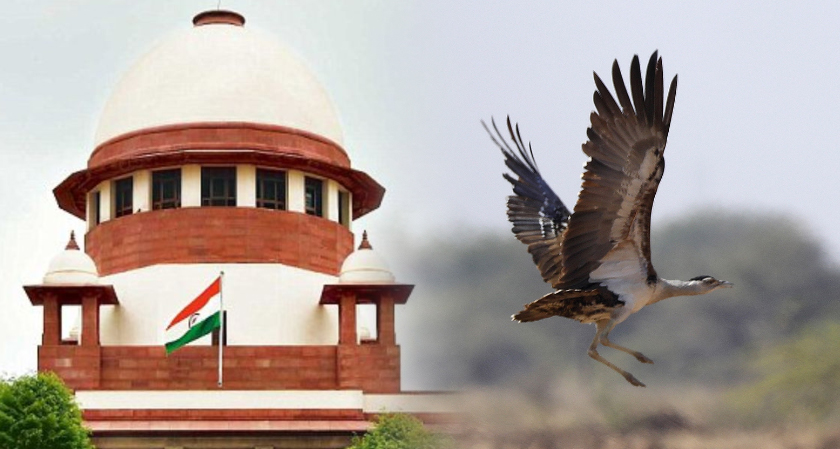
In a historic decision, the Supreme Court approved stringent measures to save the Great Indian Bustard and ordered power companies in Gujarat and Rajasthan to treat environmental protection as a constitutional CSR obligation.
The Supreme Court on Friday issued a number of directives to save the Great Indian Bustard, which is in danger of going extinct due to the operation of non-renewable power plants in Rajasthan and Gujarat, and brought ecology and environmental issues under corporate social responsibility. This is a significant ruling that encourages the corporate sector to take an active role in environmental protection.
The non-renewable power generators operating in Rajasthan and Gujarat's priority and non-priority areas were urged by a bench of Justices P.S. Narasimha and Atul S. Chandurkar to keep in mind that they share the environment with the GIB and must conduct their operations as though they were guests in its home.
The bench elaborated on the private sector's involvement in environmental matters, stating that environmental responsibility must be a fundamental component of the corporate definition of social responsibility.
Companies cannot claim to be socially responsible while disregarding the equal demands of the environment and other ecosystem members, according to Justice Narasimha, who wrote the bench's ruling. Every citizen is required by the Constitution's Article 51A (g) to safeguard and enhance the natural environment. As a legal entity and an essential component of society, corporations, too, have this fundamental obligation. The material manifestation of this obligation is CSR funds. As a result, setting aside money for environmental conservation is a constitutional duty rather than a selfless act of charity.
According to the Supreme Court, the CSR clause codifies the idea that corporate wealth is not only the private property of shareholders but is owed to society for enabling its creation. Despite resistance from power generators, the judge approved a court-appointed committee's recommendation to preserve GIB. It authorized 740 square kilometers in Gujarat and 14,013 square kilometers in Rajasthan as updated priority conservation areas. Additionally, it accepted the panel's suggestion to outlaw the construction of overhead transmission lines and solar installations with capacities greater than 2 MW. The court stated that, as the bird symbolizes not just a species but also the distinctive natural heritage and resiliency of the desert environments, the survival of GIB is a common cultural obligation.


.webp)