by Clara Hill
In the intricate art of filmmaking, where each frame carries the weight of emotion, intention, and craft, true excellence lies in the ability to tell stories that both move and resonate. The most compelling filmmakers today not only operate cameras but also translate emotion into visuals, enabling them to bring meaningful stories to life through their craft.
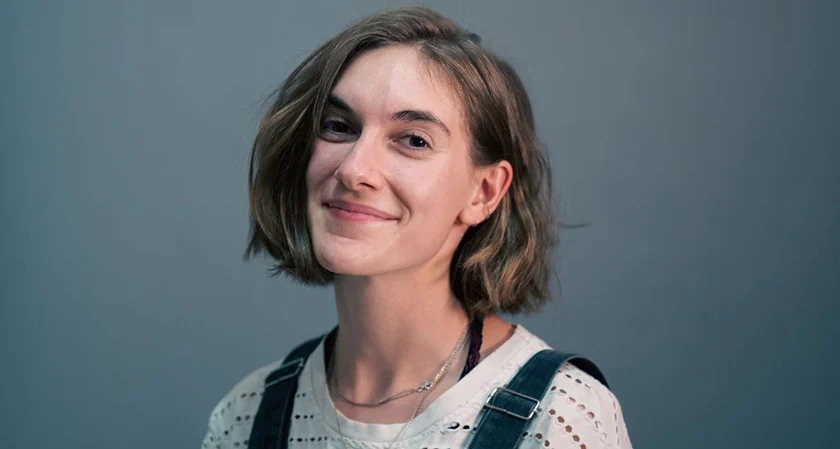
Julie Peley is a filmmaker whose work blends poetic realism with technical precision. With roots in Paris and a career built in Miami, she brings a multicultural lens to every frame—whether she’s directing, shooting, or editing.
“I’m very interested in translating a feeling into a visual medium,” she says.
“It’s about capturing a character’s psychology or the emotional tone of a scene and expressing it through light, framing, or editing.”
Known for her commitment to authenticity, emotional depth, and social impact, Peley is fast becoming a distinctive voice in contemporary cinema.
A highly sought-after director of photography (DP), Peley is best in her field, renowned for her ability to weave emotional narratives through light, color, and composition. With a portfolio spanning short films like Cherry (2024) and Purple Grooves (2024), as well as the feature documentary Traffikid (2024–2025), this expert cinematographer, based between Miami and Paris, brings directors’ visions to life as visual poetry.
Her multilingual fluency in French and English, combined with her technical mastery of industry-standard cameras like the Arri Alexa Mini and RED Komodo X, positions her as a global force in the industry.
Peley’s path to cinematography was ignited by a childhood curiosity and a serendipitous discovery—her father’s old film camera.
“I found my dad’s old film camera and thought: ‘This is super cool,’” she recalls.
“I fell in love with the tactile process of shooting on film, and I’ve barely touched a digital camera for photography since.” What began as playful experimentation soon evolved into a lasting passion for visual storytelling, laying the groundwork for her cinematic career.
This early passion for capturing light and emotion laid the groundwork for her career, which now sees her shaping the visual language of films that resonate deeply with audiences. Her ability to translate psychological nuance into vivid imagery is what sets her apart, making her a go-to director of photography for directors seeking authenticity.
“Translating a feeling into a visual medium is what I love the most,” Peley says. “It’s about taking something intangible—an emotion, a psychological state—and expressing it through lighting, composition, or editing. Whether it’s the subtle tension in a character’s silence or the warmth of a memory, I’m always looking for ways to make that feel visually. That’s the core of my creative process.”
Valentina Shelton is an actor and singer-songwriter based in Los Angeles who met Julie Peley while studying at the University of Miami. Since then, she has hired Peley multiple times to direct and shoot her music videos, drawn to her distinct visual style and collaborative energy.
“Julie executes with real cinematic skill and talent, without dominating,” Valentina says.
“She truly collaborates and understands the direction of each project. There’s a clarity and artistry in her approach that elevates every frame.”
This philosophy shines in her work on Cherry, a 2024 short film directed by Catherine Mareina. As DP, Peley crafted intimate, evocative visuals that amplified the film’s
emotional core, using soft lighting and deliberate framing to draw viewers into the characters’ inner worlds.
Her expertise with lighting allowed her to sculpt each scene with precision. Directors praise her for this ability to “capture actors and their emotions in a way that’s truthful,” as Peley notes, a skill that has made her indispensable on set.
Daniela Orlando, a Miami-based producer who has collaborated with Peley on several film sets, including her thesis film. Daniela has witnessed Julie’s work firsthand as both a director of photography and editor.
“There’s something about Julie’s work that I always admire as a DP, which is lighting,” Daniela says.
“She really takes her time with it, but it’s so worth it—she shaped a bland office space into something visually stunning. Even white walls looked cinematic because of how she lit the scene.”
Peley’s contribution to Purple Grooves (2024), directed by Larry Flores, further showcases her versatility. The film’s vibrant, rhythmic energy demanded a bold visual style, which Peley delivered through dynamic camera angles and vivid color palettes.
“I’m always looking for what will be truthful to the actors’ psyche,” she explains.
“It’s not just about making a beautiful image—it’s about aligning the visual language with what the character is feeling inside. If the lighting or framing doesn’t support the emotional reality of the scene, it falls flat.”
Her choice of the Arri Alexa Mini for this project, tailored to its fast-paced aesthetic, underscores her strategic approach to equipment selection. Peley’s ability to adapt her technique to each project’s unique demands cements her reputation as an expert cinematographer.
Peley’s work extends beyond narrative films to documentaries, where her cinematography captures raw, real-world stories. On Traffikid, a feature documentary directed by Gwendolyn Cassodi, she employed a vérité style to immerse viewers in the subject matter.
“The way I film is about understanding what a director wants to translate,” she says.
“It’s not just about executing a shot list—it’s about really listening to their vision, their emotional goals, and then finding a way to express that visually. I see myself as an interpreter between the director’s mind and the audience’s eye. When that collaboration clicks, the result is something neither of us could have achieved alone.”
Her meticulous pre-production, including location scouting and lighting diagrams, ensured the documentary’s visuals were both impactful and efficient, even under tight schedules. This logistical prowess, paired with her artistic vision, makes her a standout in high-pressure productions.
Peley has an international perspective, rooted in her French upbringing and shaped by years of working across continents, which adds a distinctive layer to her work. She brings a lyrical sensibility often associated with European cinema, favoring emotional nuance, poetic framing, and visual subtlety.
“People tell me the way I see things is different because I come from French culture and European film,” Peley notes.
“There’s something more intuitive and textured in how I frame or light a scene. I grew up with a different cinematic language, so even when I’m working on American
productions, that influence naturally comes through. It gives my work a kind of quiet emotional depth that directors seem to appreciate.”
Tom Musca is a veteran Hollywood screenwriter, producer, director, and professor at the University of Miami. He has taught Peley in both undergraduate and graduate screenwriting courses and mentored her on several film projects.
“It’s rare to see a female with this abundance of talent behind the camera,” he says. “Julie creates a collaborative and joyful production set, never draws undue attention to herself, and her films offer emotional insights that can change lives. She’s been the #1 star student in the Cinematic Arts Department over the past five years.”
This European sensibility, marked by poetic realism, infuses her cinematography with a lyrical quality that directors like Maria Paula Arboleda value. On Azulejos (2021–2022), Peley’s cinematography was lauded for creating a “whole world through the image,” as audiences noted its emotional depth. Her ability to blend this aesthetic with American practicality has earned her accolades, including festival awards for her directorial work on After Mountains.
Maria Paula Arboleda, a director and writer who has worked extensively with Julie on projects such as Tacet and Azulejos. Maria first met Julie in 2019 during her undergraduate studies at the University of Miami and has since developed a strong creative partnership with her.
“One clear example of Julie’s skill is After Mountains—it was her first short film and she directed it with two child leads, which is incredibly difficult, and she nailed it,” Maria recalls.
“Her work always feels human and poetic, but what stands out most is that she’s not trying to show off. Julie always serves the story, and that’s what makes her work so powerful.”
Peley’s approach to filmmaking strikes a balance between discipline and creativity, rooted in meticulous preparation and close teamwork. She’s a firm believer that an efficient shoot starts well before the camera rolls.
“Unlike some DPs who prefer a run-and-gun style, I can’t work that way—it stresses me out,” she admits.
To ensure clarity and cohesion, she works closely with her core crew—especially her lighting technician, whom she describes as her right hand. Together, they scout locations, test shots, and develop detailed diagrams of lighting and camera angles. It’s a
process that balances artistry with logistical precision, making Peley a reliable and thoughtful collaborator on any set.
“I do diagrams of everything—lighting, camera angles—and give them to my crew so there are no surprises,” she says.
This preparation, honed through years of experience, allows her to focus on capturing the moment on set. Her commitment to creating a “cohesive and harmonious group” ensures that her teams thrive, a quality that directors appreciate as much as her technical skills.
Wenting Deng Fisher, a cinematographer who collaborated with Peley on her thesis film after being introduced through a mutual connection in the academic filmmaking community.
“She’s one of the most well-balanced directors I’ve worked with,” Wenting notes.
“Julie is both creative and technically skilled, which makes her highly efficient. If she doesn’t know something, she’s quick to ask for input and is always open to collaboration—traits that make her stand out in this industry.”
Despite her success, Peley remains deeply driven by the ever-evolving challenge of storytelling. For her, filmmaking isn’t just a profession—it’s a way to engage with the world, one frame at a time.
“What gets me up in the morning is knowing every day can be different,” she says.
“I’m discovering new people, new cities, and broadening my vision of the world. One day, I might be on set capturing a powerful scene, the next I’m editing a documentary that sheds light on an overlooked issue. That constant variety keeps me inspired and grounded.”
Her ambition to work on socially impactful projects, like Traffikid and Climate Resilience (2022–2023), reflects a deeper purpose that drives her filmmaking: to use cinematography not just as a means of visual storytelling, but as a tool for dialogue, empathy, and change. Whether highlighting environmental challenges or human rights issues, Peley chooses projects that align with her values and amplify voices that often go unheard.
“I want to tell stories that matter,” she adds.
“If a film can spark a conversation, shift a perspective, or help someone feel seen, then it’s doing something powerful. That’s what I’m after—not just beautiful images, but meaningful impact.”


.webp)