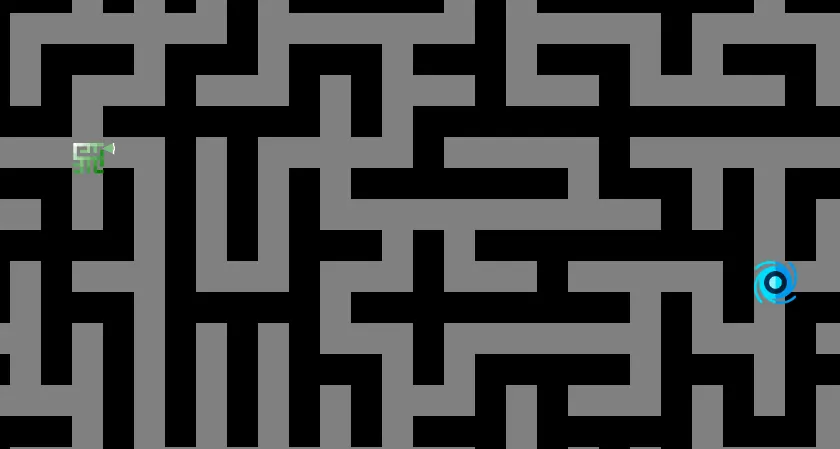
Every game developer eventually grapples with the same problem: how to make virtual characters move through space in a way that feels smart, responsive, and computationally inexpensive. Whether you're working on a real-time strategy game, a turn-based sim, or a simple grid puzzler, pathfinding remains a foundational challenge.
In the age of GPU-based solutions and neural path predictors, it might seem counterintuitive to revisit Dijkstra’s algorithm — a technique taught in first-year computer science courses. But in my experience designing performance-conscious systems for mobile and desktop titles, Dijkstra still has unique advantages — especially in deterministic or grid-based environments.
This article is the result of my own R&D work building experimental game systems and AI prototypes. I’m sharing these insights to help fellow developers who are balancing performance, simplicity, and control in their game engines.
Why Dijkstra Still Matters
At its core, Dijkstra’s algorithm calculates the shortest path from a starting node to all other nodes in a weighted graph. It’s deterministic, relatively easy to implement, and guarantees optimal paths when edge weights are non-negative. These qualities make it an attractive tool for:
- Strategy and simulation games with grid-based maps
- Turn-based combat systems where units move across constrained terrain
- AI-controlled units that need to find safe routes without relying on opaque black-box models
But beyond textbook applications, Dijkstra’s algorithm offers something that many developers still need today: predictability and control.
Evolving the Use Case: Not Just for Pathfinding
In contemporary game development, Dijkstra isn’t just about moving a character from point A to point B. It’s about shaping the player's experience by crafting how non-player characters (NPCs) move, how threats emerge, and even how resources are distributed across a game world.
Some emerging use cases include:
- Influence Mapping: By reversing the traditional “start-to-goal” direction, Dijkstra’s algorithm can simulate the influence of enemy presence or safe zones, generating a “pressure map” that affects unit behaviour.
- Dynamic Path Rebalancing: In real-time multiplayer settings, recalculating global paths on server tick can be prohibitively expensive. But using precomputed Dijkstra trees to segment movement zones allows for scalable rebalancing without full recomputation.
- Fog of War Navigation: By limiting visible nodes, Dijkstra becomes a proxy for “explored area” logic, mimicking human-like incomplete knowledge.
Comparisons to A* and Why Dijkstra Sometimes Wins
The industry gold standard for pathfinding is often A*, and for good reason — it’s faster for single-pair routing thanks to its heuristic component. But A*’s strength is also its limitation: it's most efficient when you know exactly where you’re going.
Dijkstra, by contrast, shines when:
- You want to analyze all reachable nodes from a starting point.
- The destination is unknown or dynamic.
- You need to implement area-of-effect pathfinding (e.g., tower defense AI evaluating range).
- You want deterministic exploration without heuristic bias.
In server-based games or peer-to-peer simulations, these qualities can be critical.
Designing for Constraints: When Simple is Powerful
For indie teams or solo developers working without AAA cloud infrastructure, the beauty of Dijkstra lies in its simplicity:
- It doesn’t rely on GPU acceleration or complex graph databases.
- It can be implemented in virtually any engine, from Unity to custom C++ stacks.
- It can be scaled with spatial hashing, region locking, or quadtrees.
In a world increasingly shaped by probabilistic AI, there’s immense value in algorithms that are explainable and tunable by hand.
A Note on Accessibility and Education
As developers, we often chase novelty — but teaching and mentoring the next generation sometimes means showing the value of tried-and-true methods. I’ve found Dijkstra’s algorithm to be a powerful entry point for explaining core computer science concepts to junior engineers and game designers alike.
Want to explain graphs, weights, priority queues, or search space optimization? Start with Dijkstra.
Looking Forward: Combining Old and New
Dijkstra’s algorithm is not a silver bullet, but in combination with modern tools it can be surprisingly powerful:
- Use Dijkstra to precompute paths, then train ML models to imitate and generalize them.
- Integrate it with hierarchical pathfinding systems, enabling fast local decision-making with global context.
- Visualize player movement using Dijkstra trees, uncovering how players naturally explore your levels.
In short: old-school pathfinding is more than relevant — it can be a creative edge.
Final Thoughts
As the tools we use become more complex, it's easy to forget that elegant, robust solutions still matter. For developers working in strategy games, simulations, and character-driven systems, Dijkstra’s algorithm remains not just a relic of the past, but a tool for the future — if we use it right.
Andrei Kulakov is an independent game systems engineer with a focus on AI, simulation, and low-level engine design. He regularly shares open-source tools and insights with the gamedev community.


.webp)