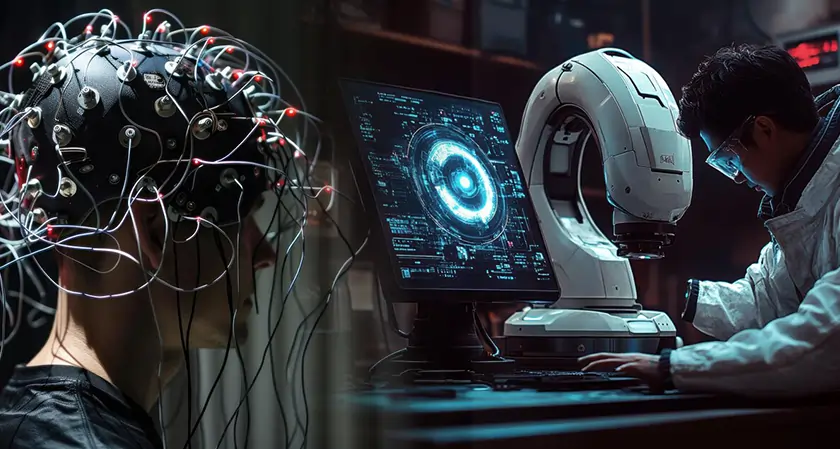
CyberSense, a robotic innovation that allows for extremely accurate, minimally invasive brain implants for next-generation BCI research, is unveiled by Chinese scientists.
Researchers at the Chinese Academy of Sciences' Institute of Automation have successfully developed CyberSense, a flexible microelectrode implantation robot, marking a significant advancement in brain-computer interface (BCI) technology, according to Science and Technology Daily on Thursday.
The robot uses the sewing machine's dexterity to thread tiny, flexible microelectrodes that resemble hair into animal brains. Research in neuroscience and the development of BCI are both strongly supported by this discovery.
Implantable BCI is a highly interdisciplinary field that uses a variety of technologies, including microelectrodes, chips, neurosurgery, artificial intelligence, and brain decoding. It necessitates innovative thinking and strong cooperation across several scientific fields.
Today's implanted electrodes are thinner and more flexible than a hair, which greatly lowers surgical trauma and the danger of immunological rejection, according to a media story that cited Yu Shan, an institute researcher. However, human hands are incapable of neatly wiring something as soft as tofu and as delicate as brain tissue. At that point, a robotic "lead surgeon" is crucial.
CyberSense and other highly automated robotic systems are becoming essential to the development of BCI technologies, Yu continued, allowing for previously unthinkable precision and minimally invasive procedures.
CyberSense has a high level of automation, the capacity to implant many electrodes, accurate spatial placement, great time efficiency, and the ability to circumvent blood arteries. The media article mentioned the institute's associate researcher and project lead, Qin Fangbo.
The robot is suitable for cortical implantation in animals, including rodents and non-human primates, and can be used with a range of flexible microelectrode models, the report states. These benefits also greatly increase the success rate and quality of electrode implantation.
Numerous electrode kinds created by organizations like the Chinese Academy of Sciences' Institute of Semiconductors and Shenzhen-based Company We-Linking have previously been supported by CyberSense. These applications are advancing research in BCI and brain electrophysiology, Yu said.


.webp)