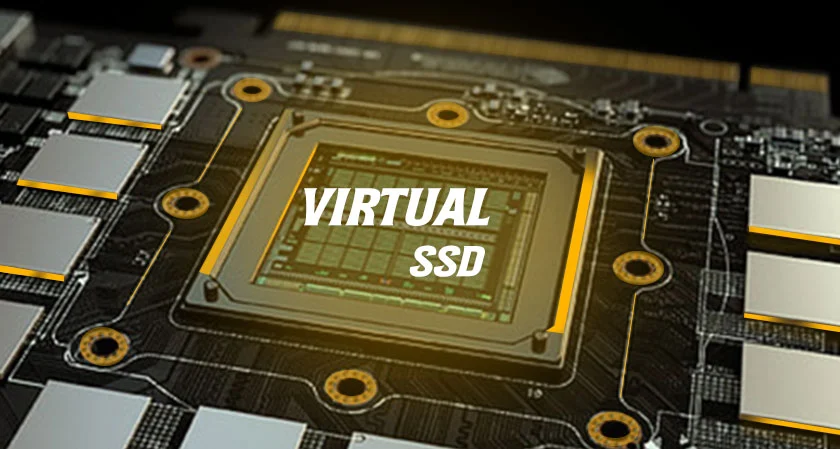
Using a software-defined storage (SDS) stack and a GPU, Graid's SupremeRAID maximizes NVMe SSD performance while delivering storage speeds far faster than possible with traditional RAID configurations.
With Gen4 SSDs, RAID cards can only operate at up to 28 GB/s; hence, four Gen4 SSDs are required in order to exploit one RAID card to its full potential. A 24-bay server can be used to its full potential with multiple RAID cards. But SupremeRAID isn't like that. It is not limited by the maximum bandwidth of a PCIe slot and can accommodate up to 32 drives in a single system.
Graid's solution circumvents CPU cycle consumption and removes throughput bottlenecks by optimizing data flow from the CPU to the NVMe SSDs. The goal of this strategy is to improve the performance of NVMe SSDs, which are essential for applications like CAD, video editing, and the Internet of Things because of their fast speed and low latency. The SupremeRAID system has a limitation in that it is only compatible with Nvidia GPUs at this time.
The SR-1000, Graid's first card, features a PCIe Gen 3 interface, but the SR-1010, its successor, employs the quicker PCIe Gen 4 interface. The SR-1001, a third entry-level card, has now joined them. With a PCIe Gen 3 interface, this is a scaled-down version of the SR-1000, with a maximum sequential read speed of 80 GB/s versus 220 GB/s.
Targeting prosumers and the home server market, it is also restricted to a maximum of eight NVMe SSDs, as opposed to the 32 supported by its more powerful siblings.


.webp)