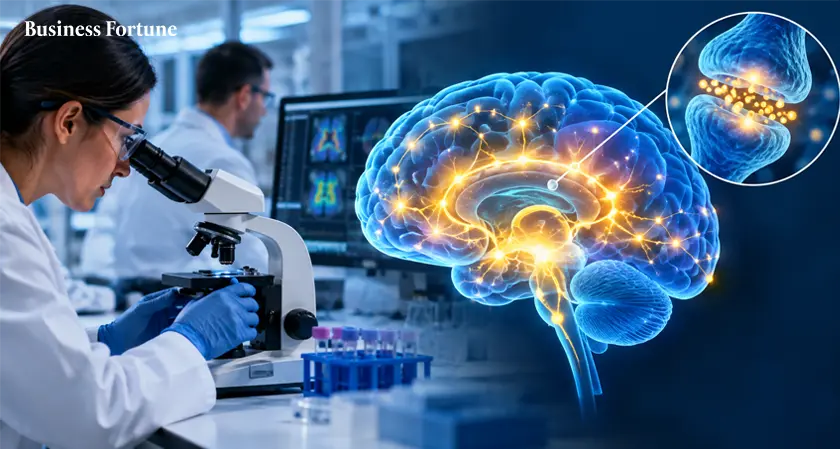
Could light unlock the secrets of the brain? The Nobel Prize in medicine 2026 highlights a breakthrough changing how scientists understand the brain.
What if scientists could use light to see exactly which brain cells control memories, emotions and behaviour? That is the breakthrough behind the Nobel Prize in Medicine 2026, awarded to Karl Deisseroth, Peter Hegemann and Georg Nagel for their work on optogenetics.
The discovery has changed how researchers study the living brain. Instead of simply observing which parts of the brain are active, optogenetics allows scientists to switch individual nerve cells on or off using light. The Nobel Committee says the method has opened a new era in neuroscience.
A tiny alga started a major brain revolution
The story began with Peter Hegemann’s interest in Chlamydomonas, a single-celled alga that moves towards light. Hegemann and Georg Nagel discovered channelrhodopsin, a protein that reacts to blue light and creates an electrical impulse inside a cell.
Karl Deisseroth then took the idea into neuroscience. He introduced the gene for channelrhodopsin into nerve cells and showed that light could trigger nerve signals. By 2007, the technique had been demonstrated in the brains of living mice.
Why can light change our understanding of the brain?
The importance of the discovery is its precision. Researchers can use optogenetics to study the neural circuits connected with particular memories, feelings and behaviours. This gives scientists a way to investigate cause and effect rather than relying only on observations and correlations.
“Optogenetics provides opportunities for mapping the brain in a way that we could once only dream of,” said Per Svenningsson, Chair of the Nobel Committee for Physiology or Medicine.
The technology has progressed beyond just being used in labs. Scientists are now looking into using optogenetic treatment to cure blindness, and even to partially restore vision in someone suffering from retinitis pigmentosa.
The Nobel Prize points toward future treatments
Now, it becomes possible for scientists to study the ways in which some particular brain cells respond to diseases such as dementia, epilepsy, and drug addiction. It may be possible that through knowing about the normal functioning of brain networks, researchers can find out where the problem starts and where they can provide treatments in the future. It highlights a technology that could shape the next generation of neuroscience, brain research and therapies.
As Business Fortune observes, the future of optogenetics could bring even more precise ways to understand the brain. Further research could help reveal the contribution made by individual neurons to such disorders and also find new ways to treat them. This discovery may eventually bridge basic research on the brain to therapies for patients.
FAQs
Who won the Nobel Prize in medicine 2026?
Karl Deisseroth, Peter Hegemann and Georg Nagel won for discoveries concerning light-gated ion channels and optogenetics.
What is optogenetics?
It is a method that uses light to control the activity of specific nerve cells.
What is channelrhodopsin?
It is a light-sensitive protein discovered in a single-celled alga that helped make optogenetics possible.
How did research on algae lead to a major neuroscience discovery?
Hegemann and Nagel studied how Chlamydomonas moves toward light and discovered channelrhodopsins, light-sensitive proteins that later became central to optogenetics.
Could this discovery help people with vision loss?
Yes. Researchers are exploring optogenetic therapy for visual impairment, and one reported treatment partially restored sight in a person with retinitis pigmentosa.
Sources: https://www.bbc.com/news/articles/cqj6jenp26zyo https://edition.cnn.com/2026/10/04/politics/trump-ai-task-force-jay-clayton https://www.theguardian.com/us-news/2026/oct/04/trump-jay-clayton-white-house-ai-czar


.webp)






























Comments