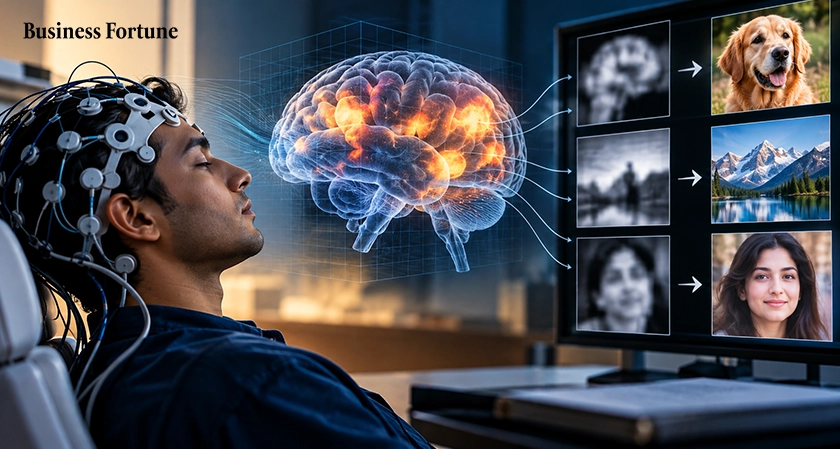
AI can now reconstruct images from brain signals, opening up a fascinating look at how technology may decode what we see and imagine.
What if a brain scan could reveal what someone is looking at and turn that activity back into an image? That possibility is becoming reality as researchers in Israel develop a new AI brain image reconstruction system called Brain-IT.
Developed by Michal Irani and her team at the Weizmann Institute of Science, the technology analyzes functional magnetic resonance imaging (fMRI) data and reconstructs images viewed by people inside an MRI scanner. The results reportedly capture both the structure and meaning of the original pictures with far greater accuracy than earlier attempts.
Brain-IT takes AI mind reading to next level
Researchers trained the system using more than 70,000 images collected while eight participants viewed pictures during brain scans. The challenge was that training a powerful AI system normally requires huge amounts of real-world data, while keeping people inside MRI machines for long periods is expensive and difficult.
The team tackled this with an encoder that can translate an image into a predicted brain scan and then turn that scan back into an image. This process allowed the system to create additional training data without scanning people for every new image.
“We realized that by translating back and forth...the models would effectively build themselves a massive dataset,” Irani explained.
The approach also helped researchers identify 128 functional brain regions linked to visual processing. Some areas responded strongly to food or sports images, while others appeared to distinguish between indoor and outdoor scenes.
Could brain scans soon become a new communication tool?
The researchers believe the technology could eventually help people with severe paralysis communicate by translating brain activity into visual information. It may also give scientists a faster way to study how different parts of the brain process what people see.
The development marks a significant step forward from earlier systems. A 2017 model from Purdue University could predict the general appearance of images but produced blurry results. Later systems produced sharper images but often depended on text to image methods.
The financial side of brain scanning remains a major problem. Neuroscientist Thomas Sprague of the University of California, Santa Barbara, noted that extended imaging is expensive, with an MRI session potentially costing hundreds of dollars per hour. AI brain image reconstruction could therefore become valuable not only for visual decoding but also for reducing the amount of expensive scanning needed to study the brain.
The future may go beyond pictures
Researchers hope the technology could eventually help scientists understand dreams, improve brain research and create new communication systems for people who cannot speak or move. However, questions around mental privacy and consent will become increasingly important if AI can interpret more personal brain activity.
As Business Fortune observes brain scan image reconstruction remains a developing research field, but Brain-IT suggests that artificial intelligence brain scans could become much more powerful in the years ahead.
Sources: https://nypost.com/2026/10/06/tech/ai-tool-can-read-minds-and-recreate-with-frightening-accuracy/ https://timesofindia.indiatimes.com/technology/tech-news/scientists-build-mind-reading-ai-program-that-can-tell-what-you-are-thinking-and-recreates-photos-with-striking-accuracy/articleshow/134754426.cms https://www.technologyreview.com/2026/10/01/1145588/ai-mind-reading-reconstructs-what-youre-looking-at/


.webp)































Comments