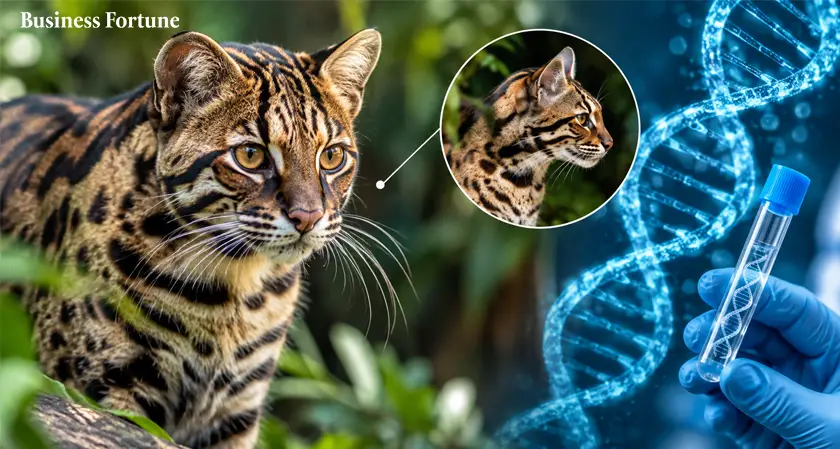
Scientists thought this mysterious spotted cat was just another tiger cat. But DNA revealed a new cat species. So what other unknown wild cats could still be hiding in Bolivia’s forests?
Scientists were shocked to discover the tiger cat that is hiding in Bolivia’s cloud forests. DNA analysis proved that the small cat with spots had been mistaken for other wild cats now belong to a new species called Leopardus tilcayo.
The discovery began with a 10 year old cat nicknamed Tigrino, now living at a wildlife sanctuary in Bolivia. A local resident had found it as a kitten near a forest and initially believed it was a domestic cat. As it grew, its wild behavior became impossible to ignore.
Bolivian biologist Paola Nogales-Ascarrunz noticed that Tigrino looked different from other tiger cats she had seen. Years later, while preparing a guide to Bolivia’s wild cats, she paid closer attention to its unusually large rosettes. That observation led her to work with an international team to investigate the animal’s DNA.
What Did the DNA Reveal?
The complete genomes of 38 animals belonging to the Leopardus genus were studied. It was found that the Bolivian cat belongs to an independent line within the cat family tree, having split from the other tiger cats about 1.4 million years ago. The new species was called Leopardus tilcayo by the scientists, using the traditional name given to the cat by local residents.
“It’s an amazing result that we have a new species for the world,” said Nogales-Ascarrunz of Universidad Mayor de San Andres in La Paz.
Scientists previously believed there were 3 different tiger cat species. But the new study in Current Biology suggests that those 3 may actually be 5 separate species.
Why This Discovery Matters for Conservation
As Business Fortune observes scientists currently know only one confirmed L. tilcayo individual, and its population in the forest remains unknown. The species is believed to live in Bolivia’s Yungas forests, where the Andes meet the Amazon basin.
That lack of information matters. If tiger cats are divided into several distinct species, each one may have a much smaller range and population than previously thought. Conservation geneticist Eduardo Eizirik said the cats had been “hiding because nobody was looking,” partly because there are so few records and museum specimens. This discovery is a reminder that even the most familiar animals can surprise us scientifically.
FAQs
What is the new tiger cat species?
The newly described species is Leopardus tilcayo, discovered in Bolivia’s Yungas forests.
How was the species identified?
Scientists used genetic analysis and compared its genome with those of other Leopardus cats.
Where does Leopardus tilcayo live now?
It is currently in Bolivia’s Yungas forest ecosystem.
How many of these cats are known to exist?
Only one confirmed individual is currently known, although researchers believe others may live in the wild.
Why are tiger cats difficult to study?
They are small, elusive animals with similar spots and stripes, making different species difficult to distinguish.


.webp)































Comments