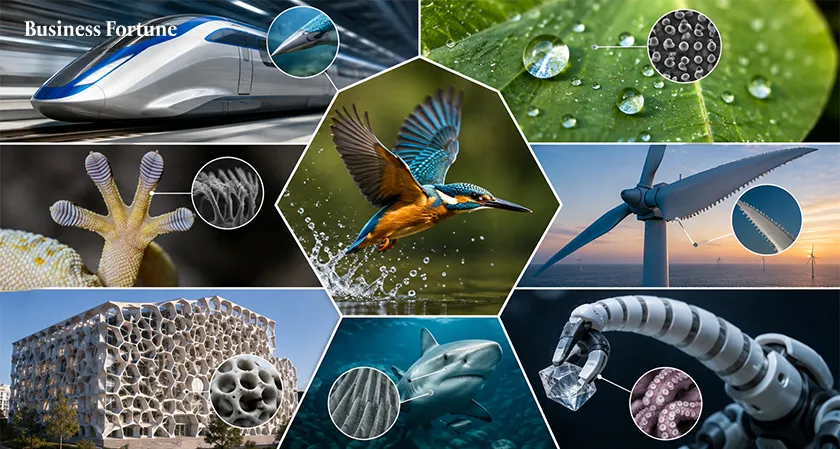
What if some of the smartest ideas in technology have been sitting in nature all along? From geckos climbing walls to pine cones responding to humidity, nature has spent millions of years solving problems with very little waste or energy. Explore the best innovations inspired by nature.
The best innovations inspired by nature prove that nature has been doing some pretty impressive engineering without ever opening a laptop. A pine cone knows when to open and close. A gecko climbs walls without glue. Fish move through water without propellers (no disrespect to humans).
Nature has been solving problems for millions of years, often using less energy and wasting very little. So why not learn from the best? From coral-inspired cooling materials to fish-like robots, nature-inspired technology is turning some of nature's cleverest tricks into ideas we can actually use.
What Is Nature-Inspired Technology?
A bird’s wing inspired aircraft design. Lotus leaves have inspired water-repellent surfaces. Termite mounds have given architects ideas for natural building ventilation. This approach is called biomimetic technology. Sometimes engineers copy a structure. Sometimes they copy a process. And sometimes they copy an entire strategy.
Rather than asking “how do we make this?” engineers first ask “how does nature make this?”
A building shaped like a seashell may look interesting but using the shell’s structure to make the building stronger while using less material is true biomimicry. Today, nature-inspired technology is finding its way into robotics, textiles, cooling systems, advanced materials, clean energy and manufacturing. Keep reading this Business Fortune article to discover some of the most fascinating nature-inspired innovations.
The Best Nature-Inspired Innovations of 2026
Sometimes we look at animals, insects, and nature and wonder how they just know what to do. So much of it is built in and honestly, isn’t science amazing? It keeps surprising us, showing us that we’re surrounded by little miracles every day.
- Gecko-Inspired Wall-Climbing Robots
The super power that geckos have is the ability to stick to any wall or surface without using any form of glue at all. The reason for this is the microscopic structures found on their feet that allow adhesion because of the closeness of the contact with the surface. Engineers have spent years trying to reproduce this trick.
For example NASA’s Jet Propulsion Laboratory has created wall climbing robots called LEMUR 3 that use a number of types of adhesion, such as gecko adhesion and microspines. These devices will help robots to walk on walls, staircases and other difficult surfaces.
Another famous example is the Stanford StickyBot. The robot has foot pads, which work just like the gecko’s feet, allowing it to stick to walls and climb. This innovation is important because it would enable the robot to examine bridges, buildings, airplanes, industrial tanks and even spacecraft without having to have a human do the dangerous tasks.
- Coral-Inspired Passive Cooling Materials
Coral might not appear to be an obvious choice for cooling technology, but the unique porous nature of coral has drawn the interest of scientists.
Coral-like pores and layers are being used in the manufacture of passive radiative cooling materials. Unlike the active cooling method which uses an air conditioner and the compressor, the passive method uses materials which will reflect sunlight and emit heat energy in the form of infrared radiation. For example scientists at Southeast University developed coral-like porous radiative cooling film but large-scale commercialization remains a challenge.
The cooling materials that were inspired by the coral have the ability to reflect the sun’s energy and remain cooler compared to their environment. In addition, in 2026, there was the development of a fabric inspired by the coral, which could reduce body temperature by 17.1° in hot weather.
Currently, however, most of these coral-based systems exist only in R&D phase and not in commercial form. Yet this specific case of biomimicry might be one way to cool down stuff without wasting energy.
- Bio-Inspired Radiative Cooling Technology
There are many smart solutions from nature for dealing with heat. Both animals and insects have been the inspiration for materials that cool themselves without refrigeration systems.
How does radiative cooling take place? Radiative cooling happens because of the capability of the material surface to reflect much of the energy received from the sun and sending the heat away as infrared radiation into outer space. The technology is particularly interesting because it can work without consuming electricity for the cooling process itself.
The review conducted in 2026 on bio-inspired radiative cooling explained how scientists are studying living creatures such as beetles, butterflies, plants, mammals, and reptiles to develop temperature-responsive materials.
Roofs could stay cooler. Warehouses could reduce cooling demand. Food and medicine could potentially benefit from low-energy thermal management. Researchers are also trying to make these materials more durable, colourful, weather-resistant and suitable for real buildings. This is where nature-inspired design becomes more than an aesthetic choice. The structure itself can determine how the material handles heat.
- Biomimetic Adaptive Building Envelopes
Think about a structure that reacts to the climate instead of depending on machines to regulate the environment inside of it. This is what biomimetic adaptive building envelopes can do for us.
Nature constantly responds to changes in its surroundings. Leaves change orientation. Flowers open and close. Pine cones react to humidity. These concepts are being used by architects and engineers to design building skins which are able to adapt their behavior depending on climate conditions.
One remarkable example is Solar Gate, developed by researchers at the University of Stuttgart and the University of Freiburg. Inspired by pine cones, its cellulose-based elements respond to humidity and temperature, changing shape without motors, sensors or operational electricity. In winter, the system can allow more sunlight into the building. In summer, it can provide more shading.
- Fish-Inspired Underwater Robotics
Underwater usually rely on the propeller. However, fish do not. Instead, fish bend their body, move their fins, and utilize the water around them, rather than fight against it. This has led to the invention of a new type of underwater robots.
Researchers have developed robotic fish that use body and tail movements for propulsion, allowing quieter and more flexible movement. A 2026 study of UJIFISH-I, for example, explored a modular robotic fish for aquaculture inspection, environmental monitoring and sensor deployment. Its fish-like propulsion was designed to reduce disturbance compared with conventional thruster-based systems.
Companies are also considering such concepts. For example, company called ScrubMarine employs the use of a robot in the shape of a fish to inspect ships underwater without employing divers or dry docks.
In India, Xera Robotics has also created an underwater robot called DeepDive based on biomimicry of the way turtles move.
- Spider-Silk-Inspired Sustainable Materials
Spider silk is nature's perfect example of getting maximum results with minimal resources. It is light, flexible, and surprisingly strong. However, the problem is that we cannot start mass-producing spider silk by filling factories with spiders. So scientists are making silk-inspired materials using biotechnology.
Companies such as AMSilk are producing materials based on recombinant spider silk proteins. These materials are being explored for textiles, medical applications and consumer products. AMSilk says its silk-based materials are bio-based and biodegradable, with applications including fibres, coatings and protein formulations. Other companies, like Spiber, are researching the development of fermentation-based materials based on spider silk technology.
The bigger challenge will not be just making spider silk artificially but rather making material which could replace some petrochemical products by offering qualities of durability, elasticity and light weight. This makes spider silk as one of the sustainable innovations inspired by nature.
- Pine-Cone-Inspired Climate-Responsive Materials
The pine cone deserves another mention because it has become a celebrity in biomimetic engineering. Its scales expand under dry conditions and contract under humid conditions. It does not contain any battery, motor or computer system. Researchers have copied this simple mechanism using materials that expand and contract differently when exposed to moisture.
An earlier innovation from ETH Zurich had also shown wooden shutters inspired by pine cones which were able to open and close automatically based on humidity levels, without sensors or electricity. This concept could be applied in future to create smart materials for clothing, ventilation, packing, and robotics.
A jacket would be able to breathe based on humidity. A building shutter would respond to weather. Packaging would be able to change based on moisture. The pine cone is suggesting us that sometimes the smartest machine is a material that can act on its own.
Nature Becoming a Technology Blueprint`
-
Nature is efficient
-
Nature is adaptable
-
Nature wastes very little
This concept is becoming more relevant as sectors examine circular manufacturing, renewable materials and energy-efficient production.
And this is why the concept of biomimicry is becoming popular in AI, robotics, green energy, materials science and nature-inspired engineering. AI technology can help scientists in identifying the biological forms. Robotics will be able to mimic animal movement. Materials science will help in reproducing the natural surface and fibers. Architects will be able to learn from nature’s passive climatic design strategies.
Where Nature-Inspired Technology Goes Next
The future could be even more interesting because researchers are moving from copying individual features to building systems that behave more like living things.
-
Self-cooling buildings
-
Self-healing materials
-
More efficient robots
-
Low-energy manufacturing
-
Smart textiles
-
Sustainable packaging
-
Bio-inspired transportation
-
climate-adaptive architecture
The more an engineer learns about nature, the more he or she realizes there is so much left for them to learn. Maybe the future of nature-inspired engineering does not lie in creating something entirely new. Maybe it lies in understanding what nature already knows.
FAQs
What is biomimicry in simple words?
Biomimicry means learning from nature and using its ideas to solve human problems. Instead of copying nature's appearance, engineers study how it actually works.
What is the most interesting example of nature-inspired technology?
Gecko-inspired wall-climbing robots are hard to beat. They copy the tiny structures on gecko feet to stick to surfaces without traditional glue.
Can nature-inspired technology really help fight climate change?
Yes. Passive cooling, climate-responsive buildings, sustainable materials and energy-efficient designs can reduce energy use and waste.
Are nature-inspired innovations already being used in the real world?
Definitely. Fish-inspired underwater robots, spider-silk-inspired materials and gecko-inspired adhesives are already being developed or used in practical applications.
What could nature-inspired technology look like in the future?
Buildings could adjust themselves to the weather, materials could repair small cracks, clothes could respond to temperature and robots could move more like animals. The possibilities are surprisingly wide.


.webp)






























Comments