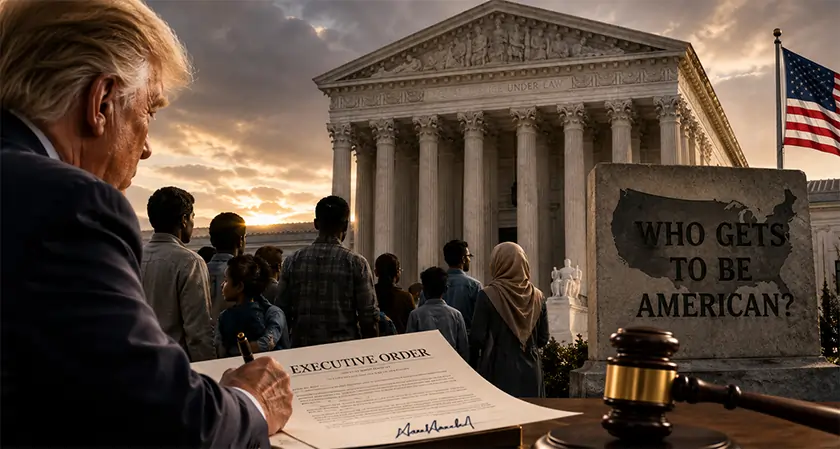
Explore how the Trump order US Supreme Court ruling on birthright citizenship could reshape constitutional debates and immigration policy.
The Trump order US Supreme Court battle has ended with one of the most significant constitutional rulings in recent years. In a 6-3 decision, the U.S. Supreme Court struck down President Donald Trump’s executive order that sought to end automatic citizenship for many children born on American soil. The ruling reaffirmed that birthright citizenship remains protected under the Fourteenth Amendment of the U.S. Constitution.
Who Qualifies as an American Citizen at Birth?
Trump’s executive order, signed shortly after the start of his second term in January 2025, argued that children born in the United States to parents who were in the country illegally or temporarily should not automatically receive citizenship. The administration claimed such children were not fully “subject to the jurisdiction” of the United States.
However, Chief Justice John Roberts, writing for the majority, rejected that interpretation. The court concluded that the Constitution clearly guarantees citizenship to nearly all children born on U.S. soil, regardless of their parents’ immigration status.
More Than an Immigration Debate
This case was never only about immigration. It was also about constitutional limits on presidential power. The Supreme Court traced birthright citizenship back to the Fourteenth Amendment, adopted in 1868 after the Civil War. The amendment was designed to ensure citizenship rights for formerly enslaved people and has since been interpreted to cover almost everyone born in the country. The court also relied on the landmark 1898 case involving Wong Kim Ark, which confirmed that children born in the United States are citizens even if their parents are foreign nationals.
Could Congress Change the Rules?
Some justices argued that Congress might have the authority to modify citizenship laws through legislation. Justice Brett Kavanaugh agreed that Trump’s order was invalid but suggested lawmakers could potentially create exceptions in the future. For now, however, no such law exists, and the constitutional guarantee remains intact.
What Does This Mean Beyond America?
The ruling has renewed global discussions about citizenship laws. Unlike the United States, countries such as India no longer grant unconditional birthright citizenship. India gradually moved away from the practice through amendments to the Citizenship Act in 1986 and 2003. The decision highlights how different nations balance immigration concerns with citizenship rights.
Looking Ahead
As Business Fortune observes, the Supreme Court’s ruling is likely to influence immigration and constitutional debates for years to come. While future administrations and lawmakers may continue exploring changes to citizenship policies, the court has made one thing clear: altering a constitutional promise is far more difficult than issuing an executive order. As immigration remains a defining political issue, this decision will serve as a major reference point for future legal and policy battles.
FAQs
What did the Supreme Court decide about Trump’s executive order?
The court ruled that the executive order ending birthright citizenship for certain children born in the U.S. was unconstitutional.
What is birthright citizenship?
Birthright citizenship is the principle that most people born within a country automatically become citizens of that country.
Why did the court reject Trump’s order?
The majority found that the order conflicted with the Fourteenth Amendment and more than a century of legal precedent.
Does the ruling apply to children of undocumented immigrants?
Yes. The court reaffirmed that children born in the U.S. are citizens regardless of their parents’ immigration status.
Does India have birthright citizenship today?
No. India previously granted citizenship based largely on birth, but legal changes in 1986 and 2003 introduced restrictions tied to the citizenship status of parents.


.webp)