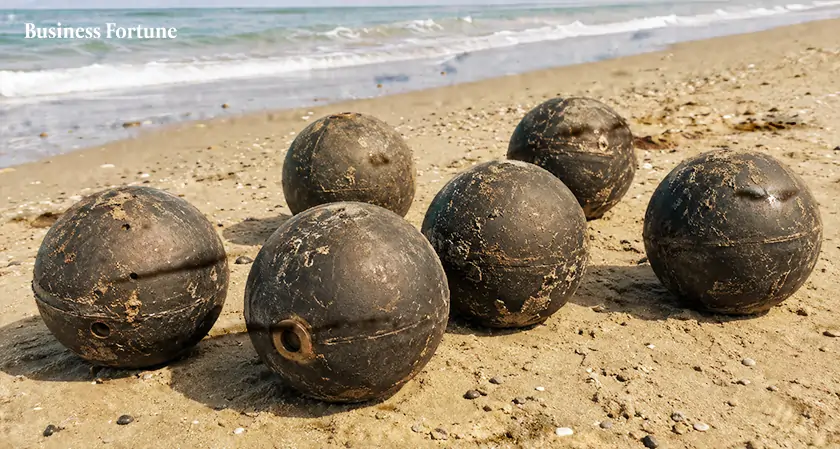
Mysterious space balls found on a Queensland beach have been linked to a foreign rocket, sparking curiosity and a major investigation.
Residents of a quiet coastal town in northern Australia were surprised when several mysterious space balls appeared along the shoreline over the weekend. The unusual objects, discovered at Forrest Beach near Townsville in Queensland, have now been linked to a rocket that recently re-entered Earth’s atmosphere, according to the Australian Space Agency (ASA).
The six large spherical objects initially sparked concern among local authorities and residents. Emergency crews wearing protective hazmat suits were deployed, and a 50-metre exclusion zone was established around the objects as a precaution. Officials feared the spheres could contain hazardous materials or remnants of rocket fuel.
Experts Believe the Objects Came from a Rocket
On Monday, the ASA announced that it had identified the likely source of the objects. The agency said the recovered items appear to be pressure vessels from a space launch vehicle and are consistent with debris from a foreign rocket body that recently returned to Earth from orbit.
The agency is now working with international authorities to formally identify the rocket and the country responsible for the launch. Space archaeologist Associate Professor Alice Gorman explained that these objects are commonly known as “space balls.” They are pressurized fuel tanks used in rocket propulsion systems and are among the most common pieces of space debris that survive atmospheric re-entry.
“The recovered objects appear to be pressure vessels from a space launch vehicle, and their location and characteristics are consistent with debris from a foreign rocket body that recently re-entered the atmosphere from orbit.” — Australian Space Agency
Why Did These “Space Balls” Survive the Journey Back to Earth?
Unlike many rocket components that burn up during re-entry, pressure vessels are built from strong, heat-resistant materials such as titanium alloys. Their high melting points allow them to withstand extreme temperatures and sometimes reach the Earth's surface intact.
According to experts, finding such debris does not necessarily mean a launch malfunctioned. These components often separate from rockets and eventually fall back to Earth after spending time in orbit. The incident involving the space balls found in Queensland beach has also reignited discussions about the growing amount of space debris circling the planet and the challenges of managing it safely.
Australia Has Seen Similar Incidents Before
This is not the first time mysterious space debris has appeared in Australia. In 2023, a large metal object that washed up on a beach in Western Australia was later confirmed by India to be part of a rocket launched by the Indian space program. Under international space law, ownership of such debris remains with the nation that launched it, even after it lands in another country.
Authorities have since declared the recovered objects safe, but they continue to warn the public not to touch any suspected space debris and to contact emergency services if additional objects are discovered.
As Business Fortune observes, global space activity continues to increase, experts expect encounters with returning rocket debris may become more common, making international cooperation and debris tracking more important than ever.
FAQs
What are “space balls”?
Space balls are pressurized fuel tanks or pressure vessels used in rockets and spacecraft fuel systems. They are designed to withstand high pressure and extreme temperatures.
Where were the space balls found?
The objects were discovered on Forrest Beach in northern Queensland, Australia, near the town of Ingham and north of Townsville.
Are the objects dangerous?
Authorities have declared the recovered objects safe, but initially treated them as potentially hazardous because they could have contained remnants of rocket fuel or other chemicals.
Why do some rocket parts survive re-entry?
Certain components, especially pressure vessels made from titanium alloys and other durable materials, can withstand the intense heat generated during atmospheric re-entry.
Who owns space debris after it lands on Earth?
Under the 1967 Outer Space Treaty, ownership remains with the country that launched the spacecraft or rocket, even if the debris lands in another nation.


.webp)




























Comments