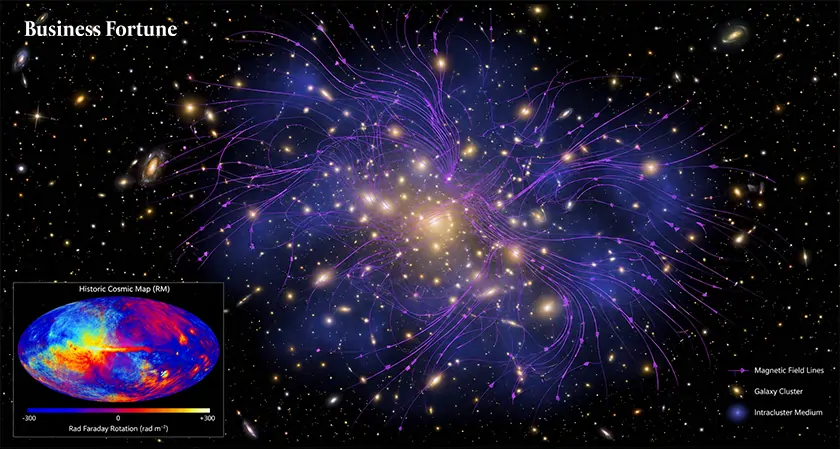
Astronomers map Abell 2255’s magnetic field, revealing cosmic structures, gas movements and galaxy cluster evolution through deep LOFAR observations.
Astronomers have achieved a major breakthrough by reconstructing the galaxy cluster’s magnetic field across the entire Abell 2255 cluster, revealing how magnetic structures extend from the central regions to the outer boundaries. Using the European radio telescope LOFAR, researchers conducted the deepest-ever observations of the billion-light-year-distant galaxy cluster, providing new insights into cosmic magnetism, gas movements and the evolution of the universe’s largest structures.
LOFAR Reveals Hidden Magnetic Structures in Abell 2255
The study was conducted under the LOFAR Galaxy Cluster Ultra-Deep Field project, where scientists collected 224 hours of radio observations to analyze Abell 2255’s complex emissions. The galaxy cluster has long attracted attention due to its powerful radio signals generated by high-energy electrons moving at nearly the speed of light.
Researchers discovered that the magnetic fields spread across millions of light-years are not randomly arranged. Instead, their patterns appear connected to the movement of hot gas during the formation and evolution of the galaxy cluster.
Key findings from the research include:
-
First complete map of cluster-wide magnetic field structures
-
Deepest radio observations ever captured by LOFAR
-
Magnetic patterns linked with cosmic gas movements
-
Abell 2255 spans several million light-years across
-
Study improves understanding of galaxy formation processes
Magnetic Fields Offer Clues about Cosmic Evolution
The reconstruction of the galaxy cluster's magnetic field provides scientists with a valuable tool for studying how galaxy clusters grow over time. These enormous cosmic formations contain extremely hot gas, dark matter, galaxies and complex magnetic environments that influence their development.
The findings suggest that gas dynamics play a critical role in shaping magnetic field lines. According to researchers, these fields can be stretched or compressed by large-scale movements occurring during cluster formation, creating the structures observed in radio wavelengths.
Breakthrough Observation Advances Radio Astronomy
Andrea Botteon from the Italian National Institute for Astrophysics (INAF), who led the research team, highlighted the importance of highly sensitive radio imaging for understanding how electrons accelerate and how magnetic fields become amplified across cosmic distances.
The team combined advanced data analysis techniques with ultra-deep LOFAR observations to overcome the challenge of detecting weak radio signals produced by electrons interacting with faint magnetic fields. This approach enabled scientists to study the detailed morphology of magnetic structures for the first time.
The research could also help explain how cosmic structures are assembled and how energy moves through galaxy clusters. Future observations may expand knowledge about the role of magnetic fields throughout the universe.
Thus, Business Fortune is of the view that this discovery marks a significant step toward understanding cosmic evolution and the hidden forces shaping galaxies.
FAQs
What is the significance of the galaxy cluster’s magnetic field study?
The study provides the first complete reconstruction of magnetic fields across the Abell 2255 galaxy cluster, from its core to its outer regions.
Which telescope enabled this groundbreaking discovery?
Researchers used the European LOFAR radio telescope to capture the deepest-ever radio observations of the Abell 2255 galaxy cluster.
Why is Abell 2255 important for space research?
Abell 2255 serves as a cosmic laboratory for studying magnetic fields, energetic particles, and the evolution of galaxy clusters.
How did scientists map the magnetic fields of the cluster?
The team combined ultra-deep LOFAR radio observations with advanced data analysis techniques to reconstruct the magnetic field structure.
What does this discovery reveal about the universe?
The findings improve understanding of how galaxy clusters form, evolve, and develop large-scale magnetic structures across the cosmos.


.webp)






























Comments