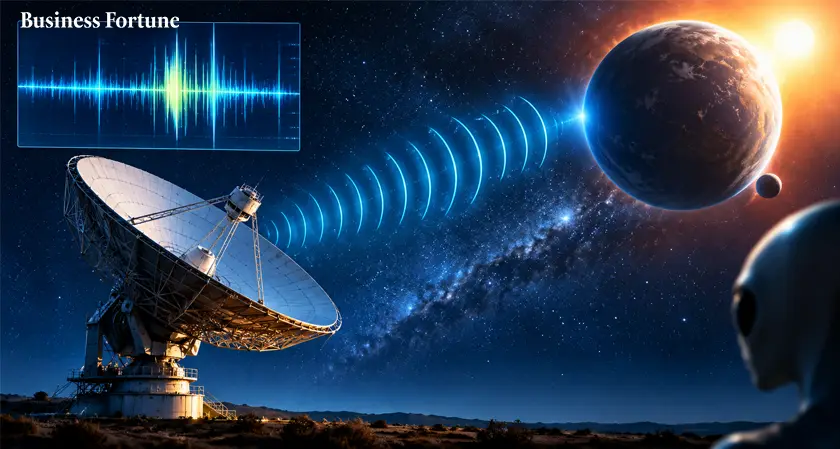
Mysterious radio signals from a giant planet are discovered and it has opened a window to magnetic field and the secrets hidden beyond our Solar System.
Far beyond our Solar System something strange has been coming from a giant planet that seems like radio signals linked to auroras. This particular exoplanet is known as Beta Pictoris b and researchers have picked up radio emissions from the distant planet, located about 63 light years away from Earth, and for the very first time have been able to trace them back to the exoplanet.
The discovery has been made by scientists at the Center for Astrophysics, Harvard & Smithsonian and the University of Oregon by using the MeerKAT radio telescope from South Africa. The results may turn out to be a significant breakthrough in investigating the characteristics of faraway planets.
Where did the radio signals come from?
Scientists have detected radio emissions from planetary systems before, but there was a major problem. They could not clearly determine whether the signal came from the planet or the star it orbits. This time, researchers used extremely distant quasars as fixed reference points to create a precise map of the Beta Pictoris system. The radio emission matched the position of Beta Pictoris b rather than its parent star.
Joe Callingham, an astronomer and researcher at the University of Amsterdam’s Anton Pannekoek Institute for Astronomy said that, “It’s an incredibly, incredibly strong magnetic field, much stronger than anything in our solar system.”
What are the radio signals from the exoplanet?
The exoplanet radio signals are Auroras. They are created when charged particles interact with a planet’s magnetic field and upper atmosphere. Earth’s northern and southern lights are familiar examples, while similar auroral activity has been observed on planets such as Jupiter and Saturn.
Astronomer Yvette Cendes explained the excitement around the finding while also addressing the obvious speculation: “When people see ‘radio signal from an exoplanet,’ they think aliens.” The researchers stress that there is no evidence of alien communication. Instead, the radio emission appears to come from natural auroral activity.
The observations may reveal even more. Researchers estimate that Beta Pictoris b has a magnetic field of at least 1,250 gauss where the radio waves are produced, potentially providing the first direct measurement of an exoplanet’s magnetic field strength.
What happens after this discovery?
These scientists are already looking past Beta Pictoris b. There are seven more giant planets in five nearby star systems that can be examined using the same technique.
Scientists have already detected similar auroral radio emissions from planets in our Solar System and from some very cool, small stars. But this is the first time they have clearly confirmed that the radio emission is actually coming from an exoplanet.
As Business Fortune observes, the discovery could open a new way to study planetary magnetic fields, atmospheric conditions and even the interiors of young giant worlds. In the coming years, more sensitive observations may reveal whether Beta Pictoris b is the beginning of a much larger population of such radio-bright exoplanets.
FAQs
What are the radio signals from Beta Pictoris b?
They appear to be radio emissions produced by auroral activity around the exoplanet.
Is Beta Pictoris b communicating with Earth?
No. The observations point to a natural process involving charged particles and the planet’s magnetic field.
How far away is Beta Pictoris b?
The planet is roughly 63 to 64 light-years from Earth.
Why is its magnetic field important?
Magnetic fields can influence how planets interact with charged particles and help scientists understand planetary environments.
How are radio signals detected from exoplanets?
Scientists use powerful radio telescopes like MeerKAT to pick up faint radio waves from distant exoplanet systems. They then map the signal’s exact location and analyze its pattern to determine whether it comes from the planet or its host star.


.webp)






























Comments