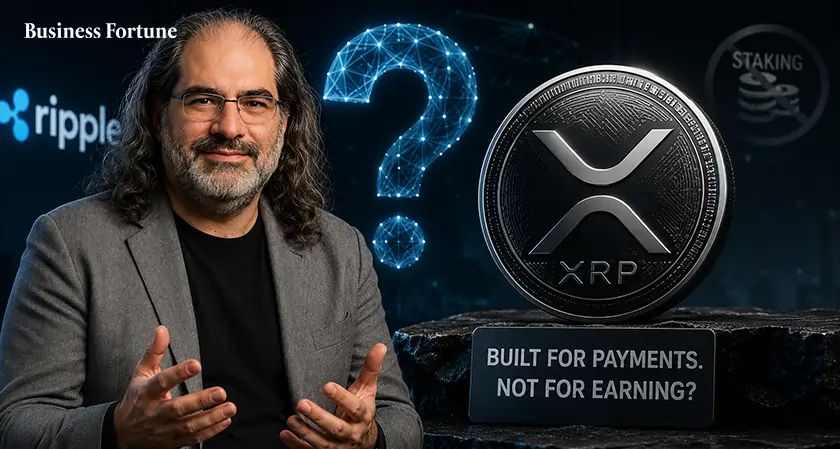
Ripple CTO questions staking and reignites debate over whether XRP should offer native rewards, raising concerns about control, yield, and the XRP Ledger’s core design.
The debate around XRP staking has returned to the spotlight after Ripple CTO questions staking XRP. The discussion began when an X user revisited comments Schwartz made during the XRP Apex 2025 event, where he was asked whether XRP holders would eventually be able to stake their tokens on the XRP Ledger (XRPL) and earn rewards from network transaction fees.
Ripple CTO Emeritus David Schwartz shared a thought-provoking view that challenged one of the crypto industry's most popular features. Using a simple banking analogy, Schwartz responded: “Do you want to be your own bank or do you want someone else to pay you to be their bank?” The remark has sparked fresh discussion across the XRP community, especially as investors continue searching for ways to generate passive income from their digital assets.
XRP’s Design Was Never Built Around Staking
Unlike many modern blockchain networks, the XRP Ledger does not operate on a proof-of-stake system. Networks such as Ethereum allow token holders to stake assets and earn rewards because validators are compensated for securing the network.
XRPL follows a different approach. It relies on a consensus mechanism often described as Proof of Association, where validators help maintain the network without receiving protocol-generated rewards. The system was designed to prioritize stability, speed, and efficiency rather than financial incentives. As a result, native XRP staking does not currently exist.
Can XRP Support Native Staking in the Future?
At first glance, adding staking may seem straightforward. However, the challenge runs much deeper. For native staking to work, the network would need:
-
A source of staking rewards
-
A mechanism to distribute those rewards
The problem is that XRPL transaction fees are intentionally burned rather than redistributed. This design helps maintain a deflationary supply model while keeping the network efficient and inexpensive to use. Redirecting those fees to stakers would require significant changes to the ledger’s economic structure and long-standing philosophy.
Is the Real Debate About Yield or Control?
Schwartz's comments suggest that the staking conversation is not only about technology but also about ownership and control.
Holding XRP in a personal wallet gives users full control over their assets. Many staking models, however, require users to hand over some level of control to a third party in exchange for rewards. According to Schwartz's analogy, that trade-off resembles allowing someone else to act as a bank on the holder's behalf.
Even without native staking, demand for yield remains strong. Platforms such as Uphold, Flare, Doppler Finance, and Axelar already offer XRP-related yield opportunities through exchange and DeFi-based products. However, these services operate outside the XRP Ledger itself and come with additional risks and custody considerations.
Looking Ahead
As Business Fortune observes crypto investors increasingly seek passive income opportunities, hence pressure for XRP staking is unlikely to disappear. Yet Schwartz's remarks highlight a bigger question: should XRPL evolve to offer staking rewards, or preserve the design principles that have defined the network for years?
The answer could shape not only XRP’s future utility but also the identity of the XRP Ledger as the blockchain industry continues to evolve in the years ahead.


.webp)