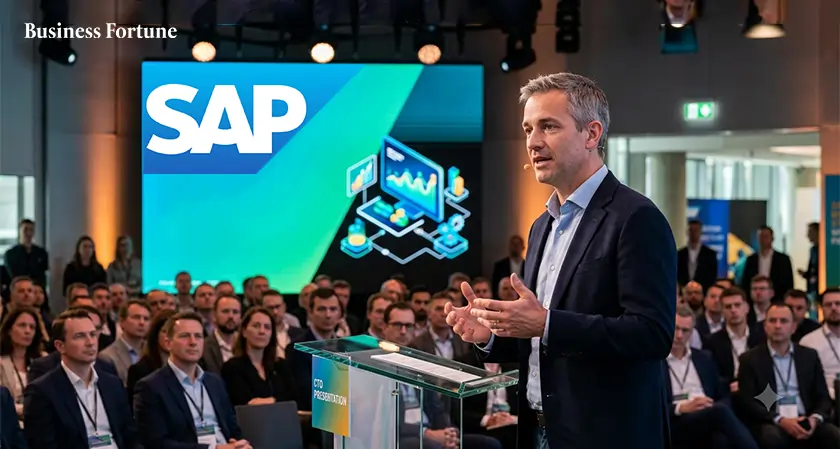
SAP AI monetization strategy links AI pricing to business value, signaling a major shift from traditional software licensing models.
The SAP AI monetization strategy is taking a different path from traditional software pricing, according to SAP Chief Technology Officer Philipp Herzig. Speaking at the Bank of America Global Research C-Suite TMT Conference, Herzig outlined how the company plans to build, deliver, and monetize AI across its enterprise software ecosystem.
At the center of SAP’s vision is what the company calls the Autonomous Enterprise, a future where AI helps organizations automate processes and achieve measurable business outcomes across key business functions. To support this goal, SAP plans to introduce 50 AI-powered assistants by the third quarter of 2026, with each assistant coordinating multiple specialized AI agents. The company already offers around 200 AI agents through its cloud software portfolio.
SAP Is Building AI Around Business Results
Herzig explained that the newly launched SAP Business AI Platform will serve as the foundation for this strategy. The platform combines SAP’s existing technology and data solutions with enhanced AI development and governance tools.
The goal is to help businesses identify areas where AI can improve operations, deploy intelligent agents, and monitor outcomes more effectively. Rather than treating AI as a standalone feature, SAP wants it embedded directly into everyday business workflows.
“Customers buy a pool of AI Units that unlocks premium AI capabilities across the entire SAP portfolio, with pricing tied to the value delivered,” Herzig explained while discussing SAP’s AI approach.
Could AI Units Replace Traditional Software Licenses?
One of the most significant changes is SAP’s move away from conventional seat-based software subscriptions. Instead, the company is introducing AI Units, a value-based consumption model that allows customers to access premium AI features across SAP products from a single pool of credits.
According to SAP, this approach better reflects how businesses use AI. As intelligent agents automate tasks and workflows, charging based on the number of software users becomes less relevant. Instead, pricing will be linked to AI usage and the business value generated, such as efficiency gains and cost savings.
To support growing AI demand, SAP is also increasing investments in infrastructure and platform development. Internal reports indicate the company is tightening hiring, travel, and third-party spending to redirect resources toward AI initiatives, computing capacity, and platform expansion.
The Future of Enterprise AI Pricing
SAP’s strategy highlights a broader shift taking place across the software industry. As AI becomes more autonomous and capable of handling complex business processes, software companies are searching for pricing models that align with outcomes rather than user counts.
As Business Fortune observes, SAP’s AI Units model could become a blueprint for enterprise software pricing, potentially changing how businesses measure and pay for digital transformation in the AI era.
FAQs
What is SAP’s AI monetization strategy?
SAP is introducing a value-based pricing model called AI Units, where customers pay based on AI consumption and business outcomes rather than user licenses.
What are AI Units?
AI Units are a shared pool of credits that unlock premium AI features across SAP’s software portfolio.
What is SAP’s Autonomous Enterprise vision?
It is SAP’s long-term strategy of using AI to automate business processes and deliver measurable operational improvements.
How many AI assistants does SAP plan to launch?
SAP aims to release 50 AI-powered assistants by Q3 2026, supported by multiple specialized AI agents.
Why is SAP reducing spending in other areas?
The company is redirecting resources toward AI infrastructure, platform development, and the computing power needed to support growing AI workloads.


.webp)































Comments