An origami-inspired 3D printing method could accelerate manufacturing by creating complex structures faster, reducing production challenges and improving design possibilities.
Researchers have developed an innovative technique that uses an origami-inspired 3D printing approach to reduce production time and improve efficiency in additive manufacturing. The method applies principles from paper folding to create complex structures more quickly, potentially addressing limitations that have slowed the wider adoption of 3D printing technologies across industries.
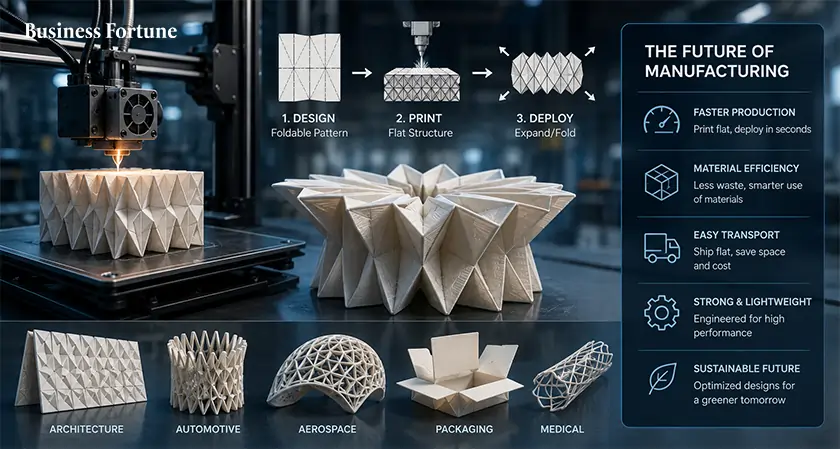
Traditional 3D printing typically builds objects layer by layer, a process that can require significant time when producing large or intricate components. The newly developed strategy focuses on designing structures that can be manufactured in a compact, folded form before being expanded into their final shape. This approach could allow printers to create larger and more complex objects while reducing the amount of material and time required.
How could the new technique improve the future of additive manufacturing?
The research demonstrates how origami principles might offer fresh approaches to engineering problems pertaining to production speed, structure, and space. Researchers want to create components that are both lightweight and structurally sound by integrating folding patterns into printed designs. The method could be used in fields like industrial production, automation, aerospace, and healthcare devices.
The origami-based method enables some structures to reach their final configuration through controlled folding and transformation, in contrast to traditional techniques that only rely on sequential layering. This could simplify printing while preserving the strength and functionality required for practical applications.
According to experts, the strategy is part of a larger trend toward more intelligent manufacturing designs that take into consideration both geometry and material behavior at the production phase. However, before the technique can be widely used for commercial manufacture, more testing and investigation will be required.
The development is a result of ongoing efforts to enhance 3D printing's speed, sustainability, and ability to create complex designs that were previously challenging to produce. Origami-inspired engineering may play an important part in extending the potential of additive manufacturing as industries continue to explore next-generation production techniques.
Thus, Business Fortune is of the view that origami-inspired 3D printing could redefine manufacturing efficiency through innovative structural design.
FAQs
What is origami-inspired 3D printing?
It is a 3D printing method that uses folding concepts from origami to create complex structures more efficiently.
How does this technique reduce printing time?
It reduces time by enabling structures to be produced in compact forms that can later transform into larger designs.
Which industries could benefit from this technology?
Aerospace, robotics, healthcare, and industrial manufacturing could potentially benefit from the approach.
Is the method currently used in commercial production?
The technique is still under research and requires additional development before widespread industrial use.
How is this different from traditional 3D printing?
Traditional 3D printing builds objects layer by layer, while this method incorporates folding-based structural transformation.


.webp)