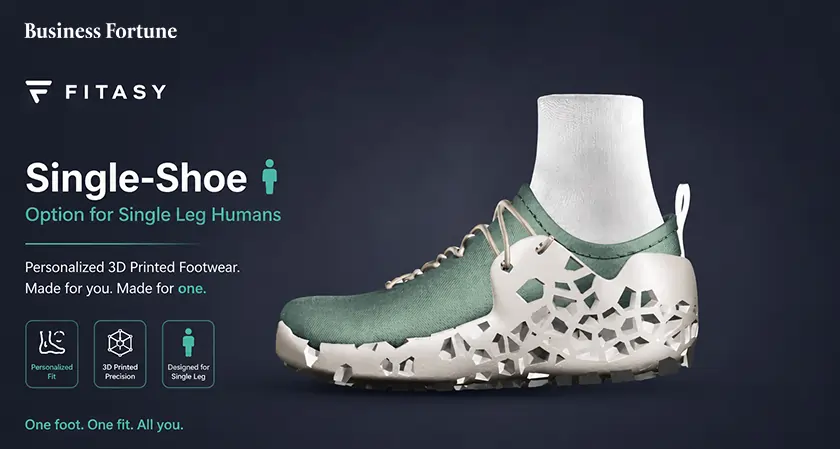
FITASY Inc introduces single-shoe 3D printed footwear using AI and scanning technology, offering custom-fit shoes for individuals and redefining inclusive, personalized shoe design.
Custom 3D-printed footwear company FITASY Inc is changing how shoes are made and sold. FITASY launches single-shoe option which now allows customers to buy a single shoe directly from its website. This option is especially useful for people who need only one shoe, including prosthetic users. FITASY offers the single shoe at exactly half the price of a full pair, making it both practical and fair.
Why has no one done this before
For decades, footwear brands have designed, produced, and sold shoes in pairs. This made single-shoe sales difficult and expensive. Some stores tried splitting pairs, but that often led to waste and extra costs. FITASY says its system avoids that problem entirely by redesigning how shoes are produced from the ground up.
How does FITASY make single-shoe production possible
The company uses a combination of spatial AI, advanced imaging, and additive manufacturing. Instead of mass-producing standard sizes, each shoe is created based on the exact shape of a customer’s foot.
Here’s how the process works:
Customers scan their feet using a smartphone
-
The Fitasy app builds a 360-degree biometric profile
-
The shoe is 3D printed to match the foot’s exact structure
-
No physical inventory or traditional tooling is required
FITASY believes this removes the inefficiencies of traditional manufacturing and opens the door to truly personalized footwear.
Yujun Wang, CEO and Co-Founder of FITASY, believes standard sizing is becoming irrelevant in a world where technology can design around individual needs. He explained that human feet are complex structures and should not be forced into limited size categories. According to him, personalization is the future of footwear, and inclusivity is central to that vision.
Who inspired this idea
The initiative has strong support from Stef Reid, a Paralympian and world champion athlete who has long pushed for inclusive footwear design through her “one-shoe campaign.” She highlighted that technology like 3D printing finally makes it possible to design shoes for real human needs rather than average measurements.
Looking ahead
As Business Fortune observes, FITASY’s single-shoe model could change how shoes are designed, made, and sold. If more brands follow this approach, it could cut down waste, remove the problem of extra stock, and bring truly custom-fit footwear into everyday use instead of it being a rare option. This could shift toward precision, comfort, and designs made for each individual, making personalized and inclusive shoes the new standard.


.webp)