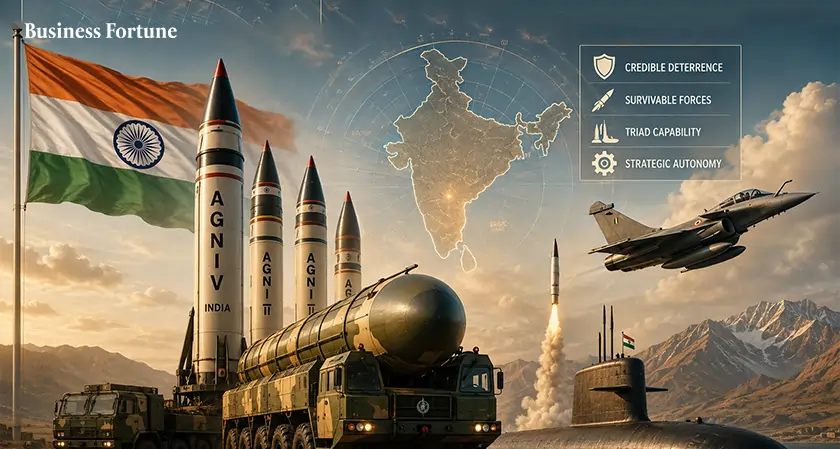
India's Nuclear Warhead deployment has entered a new phase, with 12 warheads reportedly operational in peacetime. Explore what this shift means for India's defense strategy.
India's Nuclear Warhead deployment has reportedly entered a new phase, with India operationally deploying 12 nuclear warheads in peacetime for the first time, according to the Stockholm International Peace Research Institute (SIPRI) Yearbook 2026.
The report, released on June 8, states that India has traditionally kept its nuclear warheads separate from delivery systems during peacetime. However, SIPRI now assesses that some warheads may be paired with launch systems or deployed aboard ballistic missile submarines conducting deterrence patrols.
The development marks a significant shift in India's nuclear posture and highlights the country's evolving defense strategy as it responds to changing regional security challenges.
India's Nuclear Deterrence Enters a New Phase
According to SIPRI, India had about 190 nuclear warheads as of January 2026, slightly more than the previous year. The report says the deployment of 12 warheads reflects India's efforts to strengthen its nuclear deterrence against both China and Pakistan. SIPRI also notes that India is continuing to upgrade its nuclear forces by developing new missile systems and improving its long-range strike capabilities.
Many of these upgrades are designed to reach targets across China while also addressing security concerns related to Pakistan. The deployment further strengthens India's nuclear triad, which includes aircraft, land-based missiles, and submarine-based nuclear weapons.
Why Are Nuclear Submarines Becoming More Important
One of the key reasons behind the reported deployment is the growing role of India's nuclear-powered ballistic missile submarines (SSBNs), especially INS Arighaat and INS Aridaman.
SIPRI believes some of the deployed warheads may be carried on submarines during deterrence patrols. These submarines can remain hidden underwater for long periods, making them difficult to detect. This gives India a reliable second-strike capability, meaning it could still respond to a nuclear attack even if its land-based systems were damaged.
India continues to follow its No First Use policy, which states that it will not use nuclear weapons first in a conflict. However, Defence Minister Rajnath Singh has previously said that future decisions on the policy may depend on circumstances.
Nuclear Competition in the Region Is Growing
With an estimated 190 nuclear warheads, India's arsenal is now larger than Pakistan's estimated stockpile of 170 warheads. However, it remains much smaller than China's estimated 620 warheads. The SIPRI report says Pakistan continued to develop new missile systems and increase its stock of fissile material during 2025, which could lead to a larger nuclear arsenal in the future. At the same time, China is rapidly expanding and modernizing its nuclear forces.
Experts warn that growing dependence on nuclear weapons, along with advances in military technology and weakening arms-control agreements, could increase security risks around the world.
As Business Fortune observes, the deployment of 12 nuclear warheads is about more than numbers. It signals a broader shift in India's nuclear strategy toward greater readiness and stronger deterrence. As India, China, and Pakistan continue to modernize their nuclear capabilities, the future of regional security will likely depend on both technological progress and diplomatic efforts to prevent tensions from escalating.
FAQs
1. What is the significance of India's deployment of 12 nuclear warheads?
It marks the first reported peacetime deployment of Indian nuclear warheads, indicating a shift from the traditional practice of storing warheads separately from launch systems.
2. How many nuclear weapons does India currently possess?
According to SIPRI estimates, India had approximately 190 nuclear warheads as of January 2026.
3. What is a nuclear triad?
A nuclear triad refers to a country's ability to launch nuclear weapons from three platforms: aircraft, land-based missiles, and submarines.
4. Why are SSBNs important for nuclear deterrence?
Ballistic missile submarines can remain hidden underwater, providing a secure second-strike capability if a country comes under nuclear attack.
5. Does India still follow a No First Use policy?
Yes, India officially maintains a No First Use nuclear doctrine, under which nuclear weapons are intended for retaliation rather than initiating a nuclear strike.


.webp)