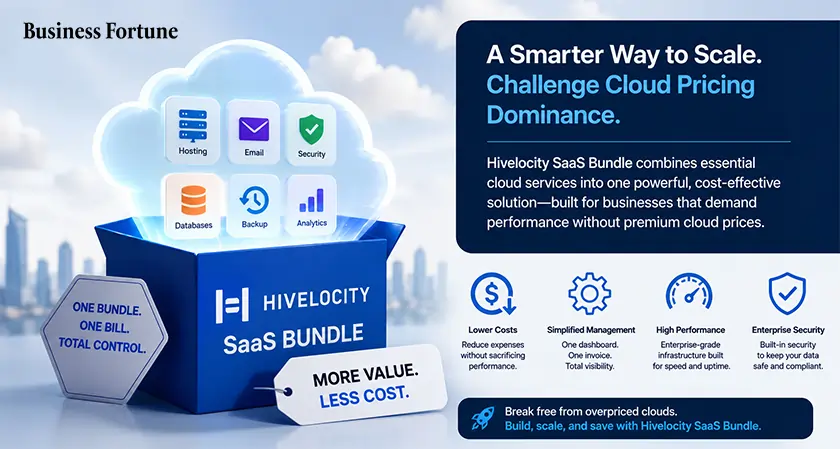
Hivelocity Launch SaaS Bundle introduces a bold infrastructure shift, raising questions about cost control, scalability, and future SaaS competitiveness.
Hivelocity launches SaaS bundle as the company moves to reshape how SaaS infrastructure is deployed and billed, combining cloud-style workflows with bare metal economics and fixed-cost predictability. The announcement introduces a three-tier compute structure designed to serve engineering, production and high-scale enterprise workloads on dedicated infrastructure.
The new product, according to bare metal, edge and cloud infrastructure vendor Hivelocity, is targeted at SaaS firms who are having trouble with growing hyperscale cloud costs and erratic billing trends. The company claims that standard cloud pricing models frequently don't match actual workload behavior because the majority of SaaS systems function in steady-state settings rather than elastic bursts.
Three computing layers make up the bundle's structure. Development, testing, CI pipelines and internal tools are examples of non-production contexts for which Engineering Compute is intended. Multi-tenant SaaS workloads, such as application servers, database systems, caching layers and search infrastructure, are the focus of production compute. Hi-Scale Compute, the third tier, is designed for big enterprise deployments that need disaster recovery plans, high-capacity databases and multi-region designs.
How does the bundle address steady-state SaaS infrastructure challenges?
The company's main justification for the launch is that SaaS workloads are more suited for dedicated hardware than elastic cloud pricing because they are primarily predictable and sustained. According to Hivelocity, this discrepancy is especially evident in database and backend systems, which frequently account for the majority of infrastructure expenditures.
Additionally, the company offers infrastructure provisioning via an API-based platform with Terraform support, emphasizing automation and developer experience. This enables teams to preserve physical, dedicated performance characteristics while deploying and managing bare metal servers with cloud-like agility. The bundle's positioning heavily relies on features like integrated lifecycle management, network automation and quick setup.
As part of its corporate readiness approach, Hivelocity has also emphasized its compliance structure, which includes SOC 2 Type II alignment. It does point out that customers are still in charge of application-level security configurations on bare metal installations, even when infrastructure controls are certified.
What this means for enterprise SaaS infrastructure strategies
A wider change in infrastructure strategy is indicated by the SaaS Bundle, as businesses are increasingly investigating hybrid solutions that distinguish between steady-state workloads and burst computing requirements. The bundle is positioned by Hivelocity as a means of lowering long-term operating expenses while preserving adaptability for distributed deployments and scalability.
The launch reflects the growing demand for more cost-stable infrastructure models, especially among SaaS vendors operating at consistent utilization levels, even though hyperscale cloud providers still dominate elastic computing.
Thus, Business Fortune is of the view that hybrid bare metal SaaS models may reshape enterprise cloud cost strategies significantly.
FAQs
What is the Hivelocity SaaS Bundle?
It is a three-tier infrastructure offering combining engineering, production, and high-scale compute on bare metal systems.
Who is the target audience for this bundle?
Primarily SaaS companies running steady-state workloads such as databases, application servers, and backend systems.
How does it differ from traditional cloud platforms?
It focuses on predictable pricing and dedicated hardware instead of elastic, usage-based cloud billing.
Does it support automation tools?
Yes, it includes API access and Terraform integration for automated infrastructure management.
Is the platform compliant with enterprise standards?
Hivelocity states it maintains SOC 2 Type II compliance for its infrastructure controls.


.webp)