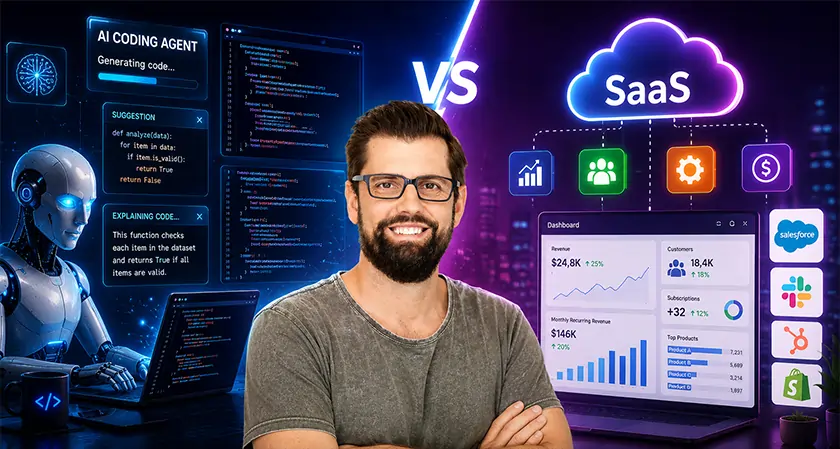
AI coding agents vs SaaS is becoming a major debate as SiteMinder CTO Tom Varsavsky argues that AI will speed up software development rather than eliminate SaaS businesses, while helping engineering teams innovate faster.
AI coding agents vs SaaS: SiteMinder CTO says AI will accelerate, not replace software firms
AI coding agents vs SaaS has become one of the hottest debates in the technology industry as generative AI rapidly transforms software development. While investor concerns have weighed on the valuation of several software-as-a-service (SaaS) companies, SiteMinder Chief Technology Officer Tom Varsavsky believes AI coding agents will strengthen and not replace the SaaS business model by enabling companies to innovate faster and deliver greater customer value.
Speaking about the evolving role of AI, Varsavsky emphasized that writing software has never been the most challenging aspect of building a successful business. Instead, understanding customer needs, acquiring users, delivering reliable services, and maintaining long-term relationships remain the true differentiators.
AI boosts productivity instead of replacing SaaS
According to Varsavsky, AI-powered coding tools are dramatically accelerating software development across SiteMinder. Projects that once required months can now be completed within weeks, while smaller engineering teams are delivering significantly more output.
He noted that recent advances in agentic coding have shifted developers' focus from manually writing code to collaborating with AI assistants, allowing engineers to concentrate on solving business problems rather than repetitive programming tasks.
"I'm spending all my time trying to figure out how my engineers can now go faster with AI to deliver our roadmap so we can grow the business," said Tom Varsavsky, CTO of SiteMinder.
AI transforms the entire software lifecycle
Beyond coding, AI is helping SiteMinder improve prototyping, automate software upgrades, reduce technical debt, and streamline quality assurance. Product managers now build prototypes using AI before handing projects to engineering, enabling faster customer feedback and quicker product iterations.
The company has also developed AI-powered internal tools that automate version upgrades and provide engineering dashboards by combining data from GitHub, Jira, Slack, Confluence, and email.
Token costs become the next CTO challenge
While AI adoption continues to rise, Varsavsky believes managing AI token consumption will become a major priority for technology leaders. He compared AI spending to the early days of cloud computing, where organizations eventually learned to optimize consumption while maximizing business value.
Despite rapidly increasing AI expenses, SiteMinder remains focused on expanding AI adoption while maintaining high standards for quality, security, and platform reliability.
Why it matters
Business Fortune believes that as AI coding agents become increasingly capable, industry experts expect SaaS companies that embrace AI to gain a competitive advantage. Businesses that combine AI-driven productivity with strong customer relationships, reliable platforms, and continuous innovation are likely to emerge as long-term winners in the evolving software landscape.
FAQs
What is the AI coding agents vs SaaS debate?
It focuses on whether AI coding tools will replace SaaS companies or simply improve software development and productivity.
Why does SiteMinder's CTO believe SaaS will survive?
He believes that coding is only one part of building a successful business, while customer experience, service, and innovation remain critical.
How is SiteMinder using AI?
The company uses AI for coding, prototyping, software maintenance, quality assurance, engineering analytics, and automating repetitive development tasks.
What are AI coding agents?
AI coding agents are advanced AI tools that generate, edit, review, and automate software development with minimal manual coding.
What is the biggest future challenge with AI development?
According to Varsavsky, the biggest future challenge would be managing AI token costs and measuring engineering productivity.


.webp)





























Comments