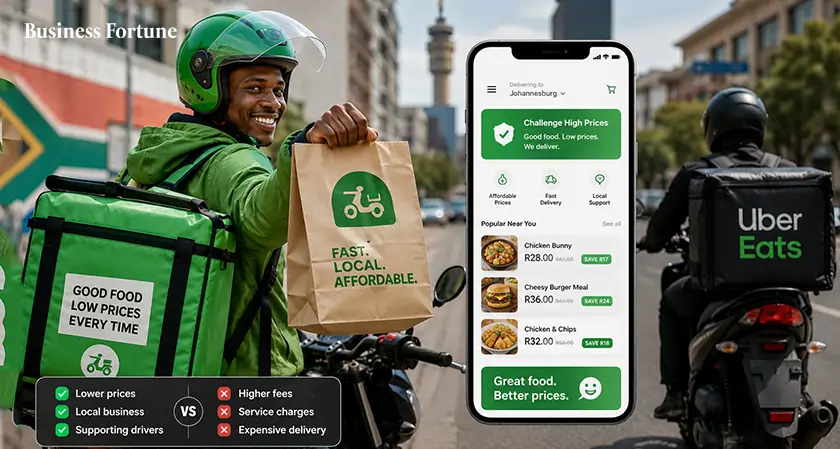
Skedadel expands rapidly with lower-cost deliveries, targeting underserved regions while challenging Uber Eats and Mr D across South Africa markets.
Uber Eats and Mr. D, the two biggest food delivery companies in South Africa, are being challenged by a South African delivery app with cheap price that offers far lower costs and expands its services into areas that are completely untapped by current players.
In a market long dominated by local and international heavyweights, Skedadel, a fleet management and delivery company located in the Western Cape, is presenting itself as an affordable option. The company claims that, depending on the brand and area, their pricing approach enables restaurants and patrons to take advantage of delivery prices that can be up to 20% less than those imposed by Mr. D and Uber Eats.
Vernon Marais, a restaurateur who first had trouble with the constraints of third-party delivery providers, developed the platform in September 2020 during the COVID-19 epidemic. After additional companies expressed interest in using the system, what started out as an internal solution for handling restaurant deliveries swiftly expanded into a more comprehensive logistics platform.
Since then, Skedadel has quickly expanded to handle over 100,000 deliveries each month. In addition to operating in major South African cities like Cape Town, Johannesburg and Pretoria, it is also growing into rural and underdeveloped areas that big rivals frequently ignore.
Targeting "white space" areas, or places with little or no delivery infrastructure, is a crucial component of Skedadel's approach. According to the company, this approach has enabled it to form solid alliances with restaurant chains and merchants looking to expand their customer base. Major companies including KFC, Nando's and Pedro’s Chicken are among its partners; other partners include Scooters Pizza, Food Lover's Market and Medirite Pharmacies.
Skedadel executives contend that a lean operational strategy is what drives their company's lower-cost structure. The company claims that it can retain higher margins while still providing competitive pricing to both restaurants and customers with a smaller internal team and simpler infrastructure.
In addition to price, Skedadel is concentrating on driver engagement, a persistent issue in the gig economy. In South Africa, a lot of delivery drivers use many apps at once, which lowers their availability and consistency. To combat this, the company has implemented gamified incentive programs that award top-performing drivers with gasoline vouchers, meal discounts and airtime bonuses.
Additionally, the platform tracks deliveries and performance using real-time monitoring technologies with the goal of proactively resolving problems before they impact customers. The leadership of Skedadel claims that in addition to competing with well-established firms, the objective is to enhance driver working conditions by providing greater incentives and support networks.
According to analysts in the industry, prominent competitors like Uber Eats and Mr. D continue to control urban markets in South Africa's fiercely competitive meal delivery market. However, the emergence of leaner, locally oriented platforms like Skedadel suggests increasing pressure on traditional companies as consumers and restaurants look for more adaptable and affordable solutions.
With aims to become a premier logistics and fleet management partner across the African continent, Skedadel has stated that its ultimate goal goes beyond food distribution.
Thus, Business Fortune is of the view that Skedadel’s expansion intensifies competition and reshapes South Africa’s delivery market dynamics significantly.


.webp)