The India election results 2026 reflect a mix of continuity and disruption, reshaping the political landscape across five key states. Tamil Nadu stood out with a historic breakthrough, while the BJP expanded in Bengal and Assam and Congress staged a comeback in Kerala. The results point to a more competitive and dynamic political environment.
Introduction
An important turning point in Indian politics was the April 2026 Assembly elections in Tamil Nadu, West Bengal, Assam, Kerala and Puducherry. The State election results India 2026, reflecting a broader political shift in India 2026, kept the focus firmly on Tamil Nadu, where Vijay upset the political establishment with a historic victory, even if each state told its unique story.
These elections shown that voters in India are willing to give up traditional loyalties in the face of a compelling alternative. More than ever, narrative, leadership and credibility were important.
Tamil Nadu: A New Political Force Emerges
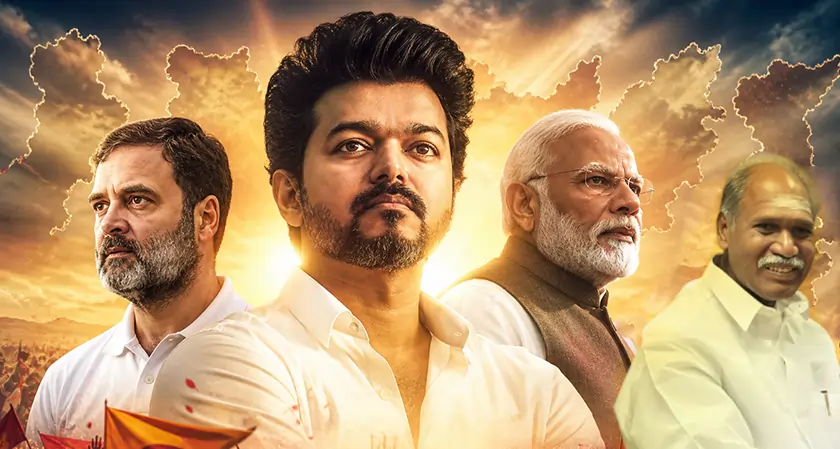
Tamilaga Vettri Kazhagam, Dravida Munnetra Kazhagam and All India Anna Dravida Munnetra Kazhagam participated in a three-way race in Tamil Nadu. The Tamil Nadu election results 2026 highlighted a major shift in the state’s political landscape.
TVK became the largest party with 108 seats. AIADMK secured 47 seats, while DMK came in second with 59 seats. TVK won about 32 to 34% of the vote, beating DMK's estimated 28 to 30%, with AIADMK following closely behind.
Many things contributed to Vijay's success. A fresh start of support was established by his powerful appeal to young citizens and urban voters. Momentum was further shifted by anti-incumbency sentiment against the DMK government. Above all, he presented himself as a tidy and approachable alternative.
His film Jana Nayagan played an indirect yet powerful role in shaping perception, reinforcing his image as a leader connected to people’s struggles.
But that was a huge struggle. Without a formal political party or cadre network, TVK depended mainly on messaging and direct participation. In the end, Vijay's campaign strategy worked because it prioritized emotional connection over organizational strength.
AIADMK is still a major but reduced influence on the opposition side, with M. K. Stalin leading the DMK as the dominant opposition force.
West Bengal: BJP Breaks Through
The Bharatiya Janata Party and the All India Trinamool Congress faced off in West Bengal, with the West Bengal election results 2026 highlighting a decisive political shift in the state.
In the 294 member assembly, the BJP won a historic victory with over 200 seats. TMC lost its long-held dominance and slipped well behind.
Strong central leadership messaging, years of organizational growth and growing dissatisfaction with the current government all led to the BJP's success. Both urban and rural constituencies showed tremendous interest, as seen by the high participation in elections.
The opposition is now headed by Mamata Banerjee, which represents a crucial political change in the state.
Assam: BJP Maintains Stability
The Bharatiya Janata Party-run alliance faced off against the Congress and local parties in Assam, with the Assam election results 2026 reaffirming its political dominance.
With a strong majority in the 126 seat assembly, the BJP was able to hold onto power for a third term in a row. With steady governance and welfare programs, its vote share stayed high.
Consolidating voter trust was greatly aided by Himanta Biswa Sarma's leadership. The ruling party benefited from political stability and development initiatives.
Congress's performance was greatly impacted by the opposition's continued division and inability to form a cohesive challenge.
Kerala: Congress Returns to Power
Kerala continued its political alternation pattern. The United Democratic Front (UDF), led by Congress, and the Left Democratic Front (LDF) were the main rivals, with the Kerala election results 2026 reinforcing this long-standing trend.
The UDF secured a clear majority in the 140 seat assembly, pushing the LDF out of power. Congress improved its vote share greatly, benefiting from anti-incumbency and strong grassroots mobilization.
The LDF, led by CPI(M), moved into opposition after failing to retain voter confidence. The result reflects Kerala’s consistent trend of changing governments every election cycle.
Puducherry: NDA Holds Control
Puducherry saw a contest between the NDA and the Congress-DMK alliance, with the Puducherry election results 2026 reflecting a clear mandate in favor of continuity.
The NDA secured 18 out of 30 seats, retaining power for a second consecutive term. High voter turnout, close to 90 percent, highlighted strong political participation in the union territory.
Leadership under N. Rangasamy and a perception of stable governance helped the NDA maintain its position.
The opposition alliance failed to convert its support into enough seats to challenge the ruling coalition effectively.
Conclusion: India’s Political Reset Begins
The 2026 elections reveal a clear shift in Indian politics, offering a deeper Indian politics 2026 analysis and India election results 2026 perspective. Voters are becoming stronger, less tied to legacy loyalties and more open to new leadership.
The strongest example of this transformation is Tamil Nadu. Vijay's rise shows that even the most established systems may be changed by a compelling narrative and direct voter connection. While the Congress's comeback in Kerala shows its continued importance in crucial areas, the Bharatiya Janata Party's growth in Bengal and stability in Assam highlight the power of long-term political strategy.
This points to the future of politics being more competitive and unpredictable. Elections will probably become more performance-based, narrative-focused and personality-based. There will be greater room for new players, but governance will be crucial to maintaining power.
The political environment in India is transforming. It is changing rapidly and the results of 2026 might only mark the start of a much main transformation.
About The Author
Mahadharani Vijay is a writer specializing in digital marketing, electric and concept cars, gadgets, and media and entertainment. She focuses on turning emerging trends and innovations into clear, engaging, and accessible stories for both professionals and wider audiences.


.webp)