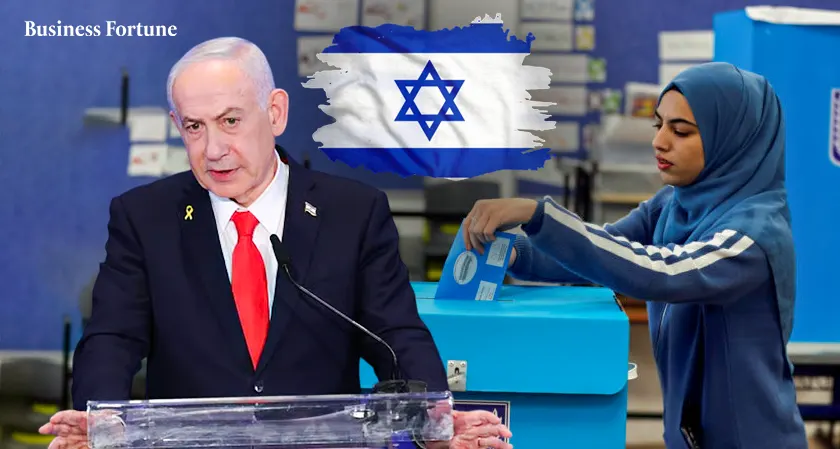
Israel's election outcome leaves Netanyahu's bloc short of a majority, raising questions over coalition negotiations, Arab parties' influence and the country's political direction.
The Israel Election Results have left Prime Minister Benjamin Netanyahu facing a challenge in forming the next government, as his Likud-led bloc secured 53 seats in the 120-member Knesset, falling short of the 61 required for a majority. The opposition won 48 seats, while the Arab parties won 19 seats in total. Coalition-building will play an essential role in the Israeli politics' future.
What Do the Final Election Results Reveal?
According to the Central Elections Committee, Netanyahu’s Likud won and became the biggest party with 27 seats. The second largest was the Yashar led by Gadi Eisenkot with 21 seats. Naftali Bennett's B’Yachad won 12 seats.
The Joint List got 11 seats, whereas The Democrats and Ra’am secured eight seats each. Seven seats were bagged by Yisrael Beytenu, United Torah Judaism and Otzma Yehudit. Shas and Religious Zionism managed to secure six seats each.
The Final results also highlighted strong voter participation, with turnout reaching 77.9% and approximately 5.7 million votes cast. Seats distribution shows that no particular political alliance has gained enough support to rule independently.
Why Is Netanyahu Facing Coalition Difficulties?
Though Likud became the biggest party, Netanyahu’s coalition still lacks eight more seats to secure a parliamentary majority. The opposition coalition also requires some more votes and in such a situation, the 19 seats of the Arab parties may become decisive.
Yet, gaining their backing might not be an easy task due to political differences regarding collaboration with Arab delegates. The opposition group will have to reconcile the differences between those holding various political interests.
The changes that have taken place have ensured that all the Israel election live updates remain centered on the possibility of alliances.
What Happens Next in Israeli Politics?
The next step will involve consultations and discussions regarding the formation of government. President Isaac Herzog will be receiving the official results of the election on November 4, after which he will consult the political figures as to who should be allowed to form a government.
The newly elected Knesset will meet for the first time on November 10th. Before then, the political parties will try to find potential partners to form the coalition government.
The results of the election may affect many crucial areas such as national security, military service exemption and relations with political representatives of the Arab world. In case the negotiations between the coalitions end up in failure, there might be another election in Israel.
Thus, Business Fortune believes that Israel's election outcome highlights the challenges of coalition politics and the uncertainty surrounding the country's next government.
Sources: The Times of India, Hindustan Times, BBC
FAQs
Who won the 2026 Israel general election?
Benjamin Netanyahu's Likud party emerged as the largest party, securing 27 seats in the Knesset.
How many seats did Netanyahu's bloc secure?
Netanyahu's political bloc won 53 seats, eight short of the 61 required for a majority.
Who leads the opposition in Israel?
Gadi Eisenkot, leader of the Yashar party, is a prominent opposition figure following the party's 21-seat result.
How many seats are required to form a government in Israel?
A political alliance needs at least 61 seats in the 120-member Knesset to secure a parliamentary majority.
When will Israel's newly elected parliament convene?
The newly elected Knesset is scheduled to convene on November 10, 2026.


.webp)






























Comments