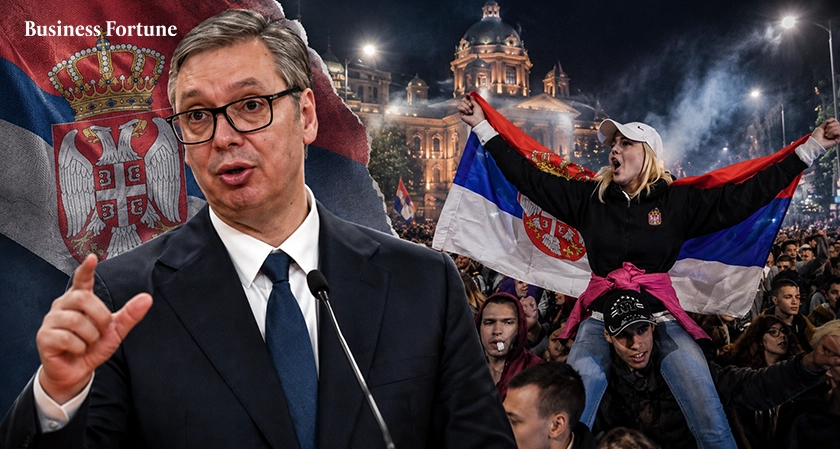
Serbia faces a political turning point as years of student protests, corruption allegations, and growing public frustration reshape its democratic future and European ambitions.
Serbia’s strongman leader Aleksandar Vucic has conceded defeat in a landmark parliamentary election, ending his party’s 14-year hold on power. The success of the opposition supported by students, fueled by widespread discontent about corruption and the erosion of democracy, represents a significant change in Serbian politics and may affect political activism in all of Europe.
Aleksandar Vucic Defeat Marks a Political Turning Point
Aleksandar Vucic, who resigned as president last month to campaign for prime minister, acknowledged the defeat of his Serbian Progressive Party (SNS). He explained that his party was hoping to capture approximately 105 seats in the Parliament, whereas The Students’ List would win 135-140 seats in the 250-seat parliament.
Vucic also stated that his party had gained nearly 1.7 million votes, while the movement backed by students had 2.2 million. Even as he accepted defeat, he attributed the loss to independent media and foreign interference.
It was an important blow to Vucic, who is a nationalist politician that received backing from Russian President Vladimir Putin, viewing the students' movement as a ploy by other countries to topple him from power.
How Student Protests Challenged Vucic’s Leadership
Protests against Aleksandar Vucic began to escalate after an accident occurred in 2024, when a railway station shelter in Novi Sad collapsed, causing 16 deaths. Citizens held Vucic responsible for this tragedy due to the corruption, favoritism and inadequate supervision of the works carried out.
This triggered national demonstrations lasting almost two years due to support from citizens who were frustrated with government accountability and democracy.
The Students’ List came out of the movement, offering a mix of different candidates that included professionals, athletes, agriculturalists and artists and not the student leaders themselves as candidates. The platform of the movement was based on rebuilding the country’s economy, fighting against corruption and re-establishing the democratic system.
Different from the traditional opposition of Serbia that had found it difficult to come together, the student movement was able to connect with voters both in urban and rural areas.
High Turnout and Election Concerns Put Serbia in Focus
The polls attracted some interest from EU authorities because Serbia is considered an EU candidate state. The turnout was expected to be close to 70%, a figure unseen since 2000.
There have been allegations of fraud, including voter intimidation, ballot box photography and efforts at vote buying. Other worries include the media control, surveillance and cyberattacks on activists.
Nonetheless, there were reports of some irregularities by independent observers, including voter intimidation, photography of the ballots and vote buying. Media control and surveillance were also issues.
Aleksandar Vucic concedes defeat also echoed political changes elsewhere in Europe, where younger voters have increasingly challenged established leaders. The result might change Serbia’s national priorities as well as its relations with the EU and Russia.
Thus, Business Fortune believes that Serbia’s political shift highlights how student-led movements can challenge entrenched power and reshape democratic governance across Europe.
Sources: https://edition.cnn.com/2026/10/25/europe/serbian-strongman-vucic-concedes-defeat-to-student-led-movement-intl-latam https://timesofindia.indiatimes.com/world/europe/serbias-vucic-concedes-defeat-as-student-led-movement-wins-parliamentary-election/articleshow/135199388.cms


.webp)


























Comments