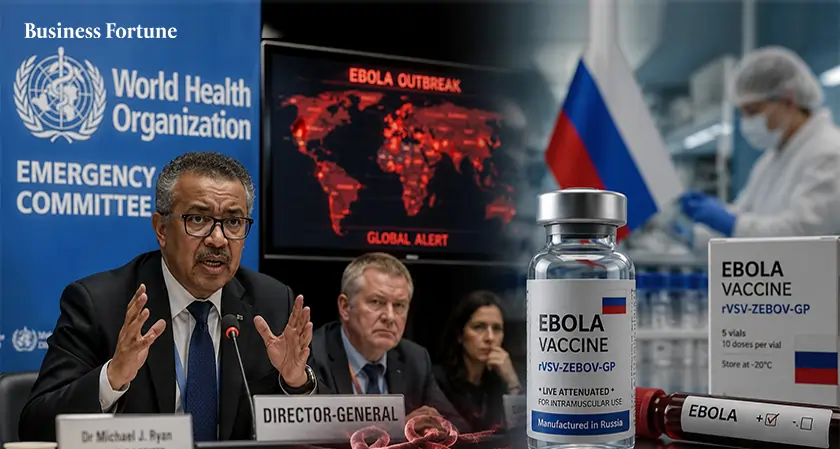
Russia has announced a possible vaccine for the rare Bundibugyo Ebola strain as WHO declares the Congo-Uganda outbreak a global health emergency amid rising infections and deaths.
The World Health Organization (WHO) has declared the ongoing Ebola outbreak in the Democratic Republic of Congo (DRC) recently. The outbreak has become even more significant when Russia announces vaccine for Ebola. The Russian scientists have developed a vaccine that may protect against the Bundibugyo strain, which currently has no approved vaccine or specific treatment anywhere in the world.
Russian Health Minister Mikhail Murashko made the announcement, according to the Russian Embassy in South Africa, which shared the update on social media platform X. Russian scientists claim the vaccine could offer protection against the strain now spreading in the DRC and Uganda.
Russia Steps Forward With Vaccine
Russia’s announcement has drawn global attention because the Bundibugyo strain is one of the rarest and least studied forms of Ebola. Existing Ebola vaccines mainly target the Zaire strain, which caused previous deadly outbreaks in West Africa. Health experts say Russia’s vaccine could become a major breakthrough if clinical trials and independent scientific reviews confirm its effectiveness.
“Transparent testing and regulatory approval will be critical before the vaccine can be widely used,” health experts said.
Why is this outbreak so concerning
The Bundibugyo strain was first discovered in Uganda in 2007 and has caused only two previous outbreaks before this one.
According to WHO and African health authorities:
-
More than 1,000 suspected and confirmed cases have been reported since mid-May
-
The DRC has confirmed 121 Ebola infections
-
At least 238 suspected deaths have been linked to the outbreak
-
Uganda has recorded one Ebola-related death and six confirmed infections
The WHO has warned that the outbreak is spreading in areas affected by conflict, migration, and weak healthcare systems, making containment much harder.
A lower death rate, but big risks remain
Despite the growing numbers, WHO officials say the current outbreak appears less deadly than earlier Ebola crises caused by the Zaire strain. The current fatality rate is estimated to be below 25 percent, compared to previous Ebola outbreaks where death rates reached as high as 90 percent.
WHO emergency response director Abdi Rahman Mahamud said early medical care is helping save lives.
Could Russia’s vaccine change the fight against Ebola
As Business Fortune observes, the WHO and Africa CDC have urged countries to strengthen border screening, surveillance, and contact tracing to stop further spread. Several neighboring countries, including South Sudan, remain at high risk. But for now, rapid detection and isolation remain the main tools against Ebola. But Russia’s vaccine announcement has introduced new hope at a critical moment.
If proven safe and effective, the vaccine could become the world’s first major defense against the rare Bundibugyo Ebola strain and reshape future outbreak responses across Africa and beyond.


.webp)