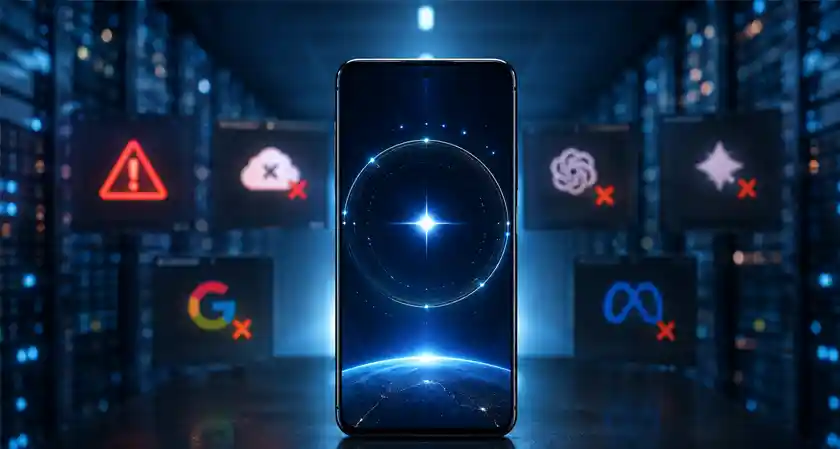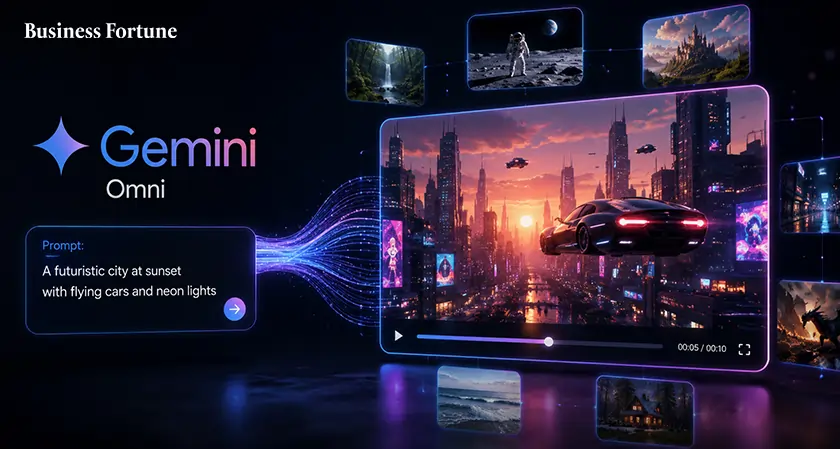
Google introduces Gemini Omni, a multimodal AI model that creates and edits videos using text, images, audio, and video inputs, expanding AI into creative production tools.
Google launches Gemini Omni, a new family of multimodal AI models designed to create and edit videos using text, images, audio, and existing footage together. The launch marks one of Google’s biggest moves yet to expand AI beyond chatbots and search into professional creative production.
The major focus of this launch is Gemini Omni Flash, a model built to generate cinematic-style videos through mixed media prompts. Unlike older AI tools that mostly relied on a single text instruction, Omni can understand and combine multiple forms of input simultaneously to create more realistic and exactly expected video content.
AI is no longer just writing text
Google says Gemini Omni is built to behave more like a creative partner than a simple generator. Users can upload sketches, photos, video clips, or audio recordings and transform them into however they want. One of the platform’s biggest features is conversational editing. Instead of using complex editing software, users can simply type instructions like:
-
“Make the lighting warmer”
-
“Add rain in the background”
-
“Change the scene to nighttime”
-
“Keep the same character but move the location”
Can AI finally understand real-world motion
Google claims Gemini Omni understands practical world compared to earlier AI video models. According to the company, the system better understands gravity, movement, lighting, and spatial relationships, helping generated videos appear more natural. The company believes this could significantly improve AI-generated storytelling, an area where many earlier models struggled with inconsistent motion and unrealistic transitions.
Gemini Omni also builds on the success of Google’s image-generation model, Gemini Flash Image, widely known online as Nano Banana, which became popular for its conversational image editing abilities.
Sundar Pichai’s AI-first future
During Google I/O 2026, CEO Sundar Pichai highlighted how deeply AI is now integrated across Google’s ecosystem. “It’s been 10 years since we pivoted the company to be AI first,” Pichai said during the keynote presentation.
Google also introduced Gemini 3.5 Flash, a faster AI model designed for coding, long-term workflows, and autonomous AI agents. The company claims the model is four times faster than competing frontier models in several coding tasks.
A growing battle for the future of content creation
The launch comes as competition in generative AI intensifies. AI-generated video has quickly become one of the fastest-growing sectors in artificial intelligence, attracting creators, marketers, film studios, advertisers, and enterprises looking for faster production workflows.
Google plans to roll out Gemini Omni Flash across the Gemini app, YouTube Shorts, Google Flow, and YouTube Create, with developer API access expected later.
What about deepfakes and fake media
As AI-generated media becomes more advanced, Google says it is expanding its transparency tools to reduce misuse.
All videos created through Gemini Omni will include SynthID watermarking technology, an invisible digital marker that helps identify AI-generated content. According to Google, more than 100 billion AI-generated images and videos have already been watermarked using SynthID.
Google is also expanding access to its deepfake detection and content verification tools through Search, Chrome, and Google Lens. Users can right-click in chrome and ask, ‘Was this generated with AI?’ and can identify along with other useful response.
As Business Fortune observes, Gemini Omni signals that the next phase of AI competition may move far beyond chatbots. With conversational video editing, multimodal generation, and integration across YouTube and Android, Google is positioning AI as a complete creative engine capable of producing, editing, and managing digital content.


.webp)