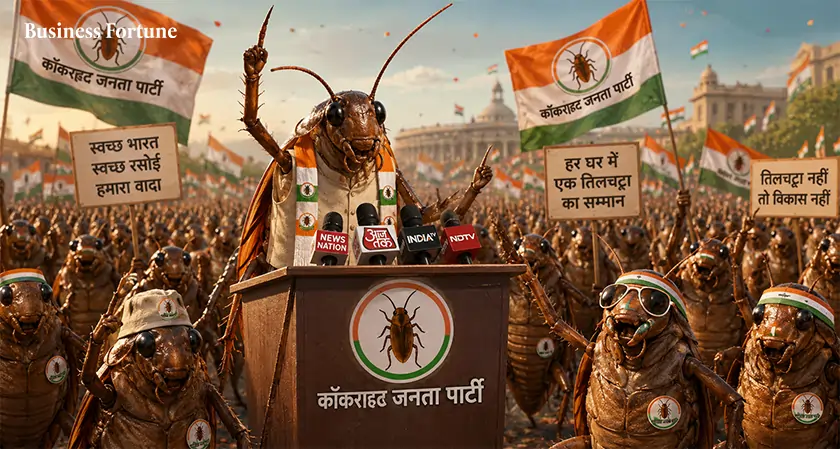
India’s increasingly polarized political environment has found an unlikely new mascot: the cockroach. What started as an online joke has quickly grown into one of the country’s most talked-about digital political movements, attracting millions of followers and drawing reactions from senior politicians within days. The contentious comments made by India's Chief Justice Surya Kant during a court hearing last week gave rise to the movement known as the Cockroach Janta Party (CJP).
According to claims, the judge likened young unemployed journalists and activists to "cockroaches" and "parasites." Later, he clarified that his words did not apply to all Indian kids, but only to those who hold "fake and bogus degrees."
On social media, however, the message had already triggered protest, memes and political parody. Abhijeet Dipke, a student at Boston University and a political communications strategist, responded by founding the CJP, a satirical internet collective modeled after the bug, which is thought to be tenacious and unkillable.
The Bharatiya Janata Party (BJP), led by Prime Minister Narendra Modi and in power in India since 2014, is mocked by its name itself. The CJP professes to be a movement for the "lazy and unemployed," and it employs internet culture, sarcasm and comedy to attract youngsters who are not satisfied with established politics.
Many onlookers were taken aback by the movement's quick ascent. Thousands of people registered online in a matter of days and the hashtag #MainBhiCockroach, which stands for "I too am a cockroach," quickly gained recognition. Leaders of the opposition, such as Kirti Azad, Mahua Moitra and Akhilesh Yadav, openly acknowledged or endorsed the tendency.
This week, the CJP's account exceeded the BJP's official Instagram following of over 8.7 million, with over 10 million followers. Simultaneously, its account on X, formerly Twitter, was reportedly withheld in compliance to a legal demand, rendering it inaccessible in India.
According to supporters, the movement provides a unique alternative for younger Indians who are dissatisfied with traditional political parties. Critics argue that the CJP is little more than opposition-backed online theater, citing Dipke's previous affiliations to the Aam Aadmi Party (AAP).
The movement represents deeper discontent among India's youth, despite its lighthearted appearance. Despite the nation's expanding economy, many young Indians nevertheless worry about unemployment, inequality and rising living expenses. According to surveys, a major portion of youngsters completely shun getting involved in politics because they feel ignored or underrepresented.
The CJP combines satire with serious political issues like electoral openness, media reform and accountability. Its meme-based appealing reflects a generation that is becoming more and more influenced by political burnout and online culture.
Although observers are unsure whether the movement will expand beyond social media, the CJP has already accomplished something rare in Indian politics: it has given many young Indians a language to communicate their dissatisfaction through comedy, sarcasm and an unexpected insect symbol.
Thus, Business Fortune is of the view that the CJP reflects growing youth frustration reshaped through satire, memes and digital activism.


.webp)