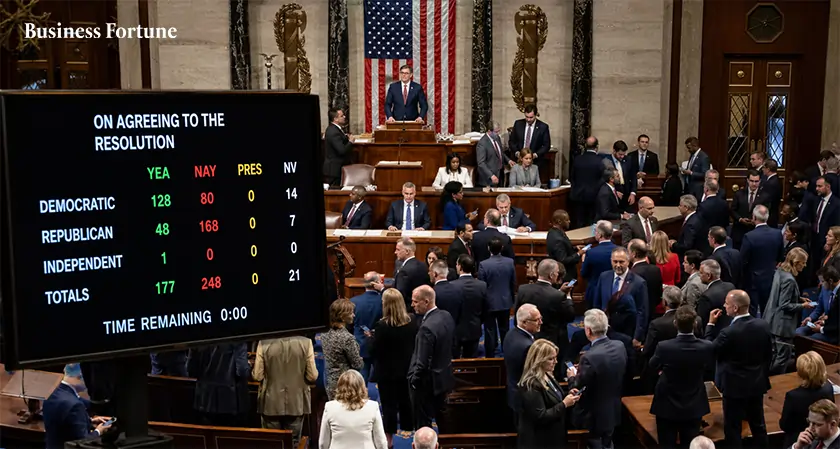
US House votes to block Trump as lawmakers push to restrict his Iran war authority, raising tensions between Congress and the White House over military control.
The US House of Representatives has voted to curb President Donald Trump’s ability to continue military action in Iran without congressional approval. US House votes to block Trump as lawmakers backed a war powers resolution aimed at restricting further escalation and forcing the White House to seek permission from Congress before expanding operations.
Will Congress step in to control the Iran conflict?
The decision is a reflection of Washington's growing apprehension about the extent to which the administration may operate without legislative supervision. Given the ongoing tensions with Iran, a number of MPs contended that the president should not be the only one to make choices involving sustained military engagement.
Can the president act without Congress in this war?
The 1973 War Powers Act, which mandates that presidents consult Congress before using or maintaining military force, is the foundation of the resolution. It indicates that Congress wants more control over how the crisis is handled, but it does not immediately put an end to US activities. The Senate will now consider the bill and it is unclear what will happen there.
The administration has not provided a clear explanation of its long-term objectives in Iran, according to lawmakers who supported the measure. They advised that continued military action without explicit authorization could push the US farther into hostilities. In a rare instance of cross-party cooperation, some Republicans voted alongside Democrats.
The White House has retaliated, claiming that the president already has the power to take action to safeguard US interests and national security. Limiting those powers, according to officials, might make the nation's response in a hazardous region less effective.
The resolution will now be considered by the Senate, initiating a new round of discussion on the president's and Congress's relative power in making war choices.
Thus, Business Fortune is of the view that the vote signals rising pressure on presidential war powers as Congress seeks stronger control over military decisions.
FAQs
What did the US House vote on?
The House voted on a war powers resolution aimed at limiting President Trump’s authority to continue military action in Iran without congressional approval.
Does the resolution immediately end the Iran war?
No, it does not immediately stop the conflict. It is a legislative measure that requires further approval and action from the Senate and potentially the President.
Why is Congress challenging the President’s war powers?
Lawmakers argue that prolonged military engagement requires congressional authorization under the US Constitution and the War Powers Act.
Did any Republicans support the resolution?
Yes, a small number of Republicans joined Democrats in supporting the measure, reflecting bipartisan concern over executive war authority.
What happens next after the House vote?
The resolution now moves to the Senate, where lawmakers will debate and vote on whether to advance or block it further.


.webp)