Food insecurity on college campuses has quietly become one of the country’s fastest-growing student issues.
A student can attend lectures, submit assignments, and still spend part of the week figuring out how to stretch one meal across an entire day. National estimates suggest roughly one in four college students in the United States experiences some level of food insecurity during the academic year. Beyond campuses, nearly 47 million Americans continue to struggle to access nutritious food reliably.
For years, the standard response has mostly looked the same: food drives, pantry shelves, donated groceries, emergency distribution.
Useful, certainly. But limited. To tackle the growing hunger crisis, Naveena Neerada Dasa (Nithyanand Kashi Prasad) introduced a new food security model in the Akshaya Patra Foundation. He believed the problem required something closer to infrastructure.
As Executive Director of Strategy and International Relations for The Akshaya Patra Foundation and the World Food Movement, Dasa has spent more than 25 years helping build one of the largest hot-meal systems in the nonprofit sector.
The scale is difficult to picture at first. What began with a single kitchen in Bengaluru now reaches millions of people daily through a network that combines centralized production kitchens, logistics software, route planning, and institutional partnerships across multiple countries.
The organization currently serves around 2.35 million schoolchildren each day in India. But Dasa rarely talks about the work in dramatic terms. Instead, he describes it like an engineer discussing systems design.
Dasa says: “In the non-profit space, where many initiatives struggle with sustainability, this integrated approach has enabled us to operate as a $100 million organization in India while continuously innovating to serve more with greater efficiency.”
He also shares: “My technical training taught me to design for scale, while Vedic principles taught me that true happiness lies in the happiness of others.”
According to Asha Saxena, Founder & CEO of World Leaders in Data and AI and Adjunct Professor at Columbia University, Mr. Dasa is “deeply grounded in humanitarian principles while operating with the pragmatism and strategic clarity that effective institutional leadership demands.”
Prof. Anurag Mairal, Adjunct Professor at Stanford School of Medicine and Director of Global Translation & Outreach Programs at the Mussallem Center for Biodesign, highlights the personal qualities that underpin his professional effectiveness: "Naveena is, quite simply, one of the most humble and polite people I have met. He is gracious and generous with his time. When I invited him to address the Knight-Hennessy Scholars, he shared the stage with other high-profile speakers. But what set him apart was how fully he engaged, answering the scholars' questions in depth and effectively mentoring them in the room."
That combination — engineering discipline mixed with service philosophy — shaped the operating model that Akshaya Patra eventually became known for.
From Engineering to Humanitarian Operations
Back in 2000, Dasa chose a very different path from many engineering graduates of his generation. Instead of pursuing a conventional corporate career, he volunteered full-time with ISKCON Bangalore.
At the time, Akshaya Patra was still small. The organization served around 1,500 children across five schools in Bengaluru.
There was no indication yet that it would become one of the world’s largest nonprofit meal programs. Over the next two decades, Dasa held several operational and strategic leadership positions within the organization. He worked in communications, strategic projects, systems coordination, and international outreach before becoming Executive Director of Strategy and International Relations in January 2024.
Colleagues say his approach consistently leaned toward process-building rather than short-term visibility. The guiding principle behind the work comes from the Sanskrit phrase Sarve Janah Sukhino Bhavantu — “May all live happily.”
Today, Akshaya Patra operates 78 kitchens and has served more than 5 billion meals overall.
According to Madhu Pandit Dasa, Founder and Chairman of The Akshaya Patra Foundation and World Food Movement, “Akshaya Patra is a social innovation that has invested in creating a value-driven organization, integrating technology and good governance. We currently operate state-of-the-art kitchens at 78 locations across 16 states and 3 union territories in India, feeding over 2.35 million children every day. Our kitchen facilities are certified to ISO 22000 and ISO 45001 international standards.”
The organization crossed the 5-billion-meal milestone in March 2026 during an event at Rashtrapati Bhavan attended by the President of India.
Mr. Shridhar Venkat, CEO of The Akshaya Patra Foundation, notes that Naveena Neerada Dasa led the organization’s relationship with the United Nations for the 4-billion-meal commemoration and secured the high-level engagement with the President of India’s office for the 5-billion-meals milestone, demonstrating his capacity to open doors for methodology transfer and institutional recognition.
Every year, the Foundation now produces roughly 480 million mid-day meals and another 120 million morning servings. Perhaps the most surprising figure is the cost. The average meal remains around 20 cents.
Independent evaluations conducted by Nielsen in 2025 reported substantial improvements in the areas where the program operates. School enrollment rose by 78%, attendance increased by 86%, and dropout rates declined by 60%. Around 78% of parents surveyed also reported improvements in their children’s health.
Those numbers helped turn the organization into something larger than a local feeding initiative. Governments, universities, and nonprofit groups began studying the model itself.
Inside Akshaya Patra’s Centralized Kitchen Technology
Dasa’s philosophy sounds spiritual, but in practice the organization translated it into 4 systems: Kitchen, Transportation, Forecasting, and Training. The first thing visitors usually notice is that the kitchens do not resemble traditional charity kitchens. They operate more like industrial production facilities. Large steel vessels line the cooking floors. Conveyor systems move ingredients between preparation stages. Delivery schedules are timed tightly because the meals are meant to arrive hot.
Each centralized kitchen can produce up to 100,000 freshly cooked meals in about five to six hours. The organization has the capacity to serve 500 meals in the US, but is planning to scale up to 5000. Still, despite the scale, the organization avoids standardized menus. That part matters more than it sounds.
Meals are adapted to regional food habits because food habits are deeply local. Children in different parts of India expect different flavors, textures, and staple foods. The same philosophy now extends to the United States, where the World Food Movement aims to ensure meals feel familiar to students rather than institutional.
Behind the scenes, an increasing share of the operation depends on forecasting and logistics systems.
Teams track meal demand, transportation timing, delivery windows, and route efficiency daily. Artificial intelligence tools now help estimate meal volumes and optimize transportation routes.
Dasa explains: “It sounds technical, but most of the technology exists for a simple reason: less waste and more reliability. Each day we strive to become better than the day before, integrating AI and process refinements.
Data gathered from operations in one kitchen can inform the design of future kitchens. Small things do make a difference. Saving a few minutes in the loading process. Improved routing. Decreased fuel consumption and increased heat retention during transportation. Millions of meals later, those differences become very important.
The Difference Between the Model and Traditional Food Banks
Emergency food distribution models typically rely on donations of surplus food. The organization acquires, organizes, stores, and distributes food through regional networks. Akshaya Patra did things differently. Instead of organizing around collecting food, it organized around producing food.
Meals are prepared continuously inside purpose-built facilities. The emphasis is not simply on providing calories during emergencies, but on ensuring reliable access to meals every day.
Dasa often describes the kitchens as underutilized assets if they only operate for a single meal window: “Each facility can produce 100,000 meals in just five to six hours. After completing midday service, these kitchens often remain underutilized.”
That observation shaped much of the organization’s scaling strategy: “If kitchens can also support evening meals, after-school programs, weekend service, or emergency response distribution, operating costs spread across a much larger meal base,” Dasa reveals. “The economy improves. So does reach.”
The result is a nonprofit system that operates more like large-scale manufacturing while still preserving dignity in meal delivery.
He adds that the point comes up repeatedly in conversations with students: “Many students experiencing food insecurity are not visibly homeless or unemployed,” Dasa reveals.
“Some are balancing rent, tuition, transportation costs, and part-time work simultaneously. Skipping meals becomes a budgeting strategy. What we do is try to remove some of the stigma attached to food assistance by focusing on fresh, prepared meals rather than emergency rations.”
The Five Operating Values
Inside the organization, Dasa explains the culture through five principles:
The first is transparency. Donors and institutional partners are expected to understand where funding goes and how meals are delivered.
The second is efficiency. Transportation schedules, production timing, kitchen utilization, and delivery systems are continuously refined.
The third is innovation. No kitchen is treated as a finished design. Every new facility incorporates lessons from earlier operations.
The fourth principle is teamwork. Large humanitarian systems cannot depend entirely on charismatic individuals. Processes need to survive leadership changes.
The fifth principle is organizational culture. Senior leaders in both organizations forgo salaries, allowing more operational funding to be directed directly to meal production and infrastructure.
Dasa describes the five values less like corporate branding and more like operating rules:
“We uphold five foundational values that have become hallmarks of our organizational culture,” he says.
“True accountability begins with radical openness, enabling donors and institutional partners to trace every dollar directly to meals served and infrastructure built. This transparency has fostered the deep trust that sustains multi-million-dollar partnerships across continents.”
He adds: "Operational discipline demands relentless refinement of every link in the supply chain—synchronizing production capacity with real-time demand, optimizing logistics routes, and maximizing the utilization of our high-volume kitchens on both continents we have a presence.”
For Dasa, this approach ensures the cost per meal remains exceptionally low while maintaining five-star nutritional and hygiene standards.
When it comes to innovation, he reveals: “No kitchen is treated as a finished design; each new facility is engineered to surpass its predecessors through data-driven improvements, artificial intelligence for forecasting and routing, and the systematic capture of operational lessons. This makes the entire model more efficient and adaptable with every deployment.”
Dasa believes sustainable impact in large humanitarian systems cannot rest on any single leader: “We build robust processes, meticulously documented protocols, and empowered teams that create institutional resilience capable of surviving leadership transitions and successful geographic expansion.”
Finally, he cultivates an environment where service is both the mission and the workplace ethos.
Dasa reveals: “Senior leaders forgo personal remuneration, allowing more resources to flow directly into meal production and infrastructure. Highly skilled professionals and dedicated volunteers work alongside corporate CEOs who contribute their expertise in technology, strategy, and scaling.”
He adds: “The result is an organization that genuinely feels like a great place to work—one that attracts and retains talent committed to something far larger than themselves.”
Why the Model Scales Efficiently
For Dasa, the underutilization of kitchens is a waste of potential. When a kitchen can run additional service counters at other times of day, the company will be able to provide services such as after-school programs, weekend meals, or emergency meals without making major infrastructure investments.
This is because every newly added kitchen has learned from the past ones. The routes have been optimized. The production lines have been perfected.
The organization treats scale as a system-building exercise rather than simply expanding headcount: “Scale is not just an operational metric. It multiplies impact,” Dasa says.
That philosophy explains why the organization invests heavily in governance structures, kitchen engineering, operational training, and long-term funding models: “The meals are the output, but the real product is the institution itself,” he adds.
Madhu Pandit Dasa, Founder and Chairman of The Akshaya Patra Foundation and World Food Movement, says: "Naveena has been instrumental in expanding the feeding programs of The Akshaya Patra Foundation in India and abroad. Without his work, we could never have accomplished our goals.
“He has been instrumental in the social innovation that has invested in creating a value-driven organization, integrating technology and good governance.”
Bringing the Model to the United States
The push into the United States accelerated after an event at United Nations Headquarters in New York marking Akshaya Patra’s four-billionth meal milestone.
University representatives, local officials, and civic leaders attending the gathering encouraged Dasa to adapt the model for American campuses.
Dasa recalls: “Local U.S. leaders, community organizers, mayors’ offices, and political representatives approached us, asking why we could not bring this same legacy of excellence, technology, and compassion to American students and vulnerable populations.” Those conversations marked the true beginning of the transatlantic journey and directly led to the formal launch of the World Food Movement in March 2025.
The Akshaya Patra Foundation serves as the India-based flagship of a federated structure, while the World Food Movement independently leads the organization's feeding programs in other countries, registered separately in each state or nation where it operates. Both entities are built on the same founding vision, share executive leadership, and draw from the operational systems and expertise developed by Akshaya Patra. Meals provided internationally are always adapted to local palates and cultural norms.
The timing reflected a growing concern around student hunger in higher education. Community colleges and public universities increasingly reported students struggling with food costs while trying to remain enrolled.
The organization now operates programs at Rutgers University, NJIT, Middlesex College, the College of Staten Island, Medgar Evers College, Kingsborough Community College, De Anza College, and Foothill College.
Programs also run across New Jersey, New York, Boston, and the Bay Area. In Fairfax County, Virginia, local schools receive meals through additional partnerships. The growth has been gradual rather than explosive.
According to Shridhar Venkat, the CEO of the Foundation: “Naveena’s strategic thinking in terms of thinking big, thinking transformational, has immensely helped Akshaya Patra. He makes the right connections that are required for decision-making at the policy level, at the state level and at the country level, which directly help Akshaya Patra in rendering its service to the children more effectively.”
He adds: “Building strong relationships is one of the core strengths of Naveena, which is very important for a not-for-profit. The attributes of kindness, generosity, and the ability to forge good relationships have helped Akshaya Patra scale up its program. They have helped us reach out to public sector units which are government funded.”
Venkat goes on: “Naveena can resolve a crisis by reaching out to the decision makers in the government, policy level, ministries, bureaucracy. He is a good troubleshooter. And has always led from the front and has tried to resolve any problem we have faced.”
In 2025, the World Food Movement delivered more than 20,000 hot meals in the United States.
Its long-term targets are considerably larger: 100,000 meals annually by 2027 and 1 million cumulative meals by 2030.
Many organizations that have been part of the partnerships indicate that the effect has gone beyond just providing meals. According to NJIT, the partnership has accounted for a significant portion of the institution's efforts to tackle student hunger. While Middlesex College offers weekly meals through its institutional systems, Medgar Evers College is now providing hot vegetarian meals to students experiencing financial insecurity.
Mukesh Aghi, President and CEO of the US-India Strategic Partnership Forum (USISPF), frames the significance of this work for American communities: "Naveena's contribution to the United States is both original and of major significance. No comparable non-sectarian, vegetarian, low-carbon food program operating across HBCUs, urban community colleges, and unhoused communities exists at this scale in the country.
“His model is non-discriminatory and universally inclusive. Muslim students, Black and Brown communities, immigrant families, and individuals of no religious affiliation are served with identical dignity."
Dasa says: “Hot, vegetarian meals tailored to local preferences are restoring dignity, improving concentration, and helping young people remain enrolled and engaged in their studies. This is food for transformation and food for education.”
Public officials have also started formally acknowledging the initiative. The City of Newark, through Mayor Ras J. Baraka, recognized the World Food Movement for its efforts to address campus and community hunger. The New Jersey State Legislature later passed a joint resolution recognizing the organization’s work.
Dasa says: “Our aspiration in the United States is the same as it has always been in India and Kenya: to eliminate food insecurity as a barrier to opportunity. We believe by doing this, we are strengthening the future workforce and civic fabric of this great nation. Every hot meal delivered is an investment in human potential and national progress.”
Serving As An Open-Source Model Across Borders
One aspect of the model that surprises many nonprofit leaders is how openly the organization shares its operational knowledge. Most institutions guard logistics systems carefully. Akshaya Patra largely does the opposite.
In November 2024, Dasa signed a Memorandum of Understanding with Food for Education, a Kenya-based organization. The agreement included sharing kitchen designs, vendor systems, logistics processes, and operational frameworks. The Kenyan organization now delivers more than 500,000 meals daily using an adapted version of the model.
Asha Saxena, Founder and CEO of World Leaders in Data and AI and Adjunct Professor at Columbia University, notes that Mr. Dasa’s work “requires not only organizational acumen but also the ability to build credible, sustained relationships with institutions across sectors and borders, a competency he has demonstrated consistently over the course of our association.”
He adds: “Naveena communicates across cultural and organizational contexts with notable skill, consistently fostering dialogue oriented toward shared goals rather than division. These qualities are central to the work he is doing and to the impact he is generating.”
Dasa sees the approach as necessary if food insecurity is going to be addressed at a larger scale: “We maintain an open-source philosophy regarding our best practices,” he says.
Over the years, delegations from governments, nonprofits, and academic institutions have toured the kitchens and studied the operational systems firsthand.
Since 2017, Dasa has also spoken at policy and academic events, including the World Economic Forum in Davos, Stanford University, and several conferences across the United States and Europe.
He says: “These platforms have allowed me to share twenty-five years of operational experience in large-scale food security while learning from global leaders in technology, policy, education, and social impact. At Davos, serving freshly cooked meals to world leaders was a powerful demonstration that our model can transcend borders and inspire new solutions wherever hunger threatens human potential.”
Reflecting on the initiative's broader purpose, Dasa adds: "Food and nutrition form the foundation of a nation's growth and the wellbeing of its people. The Akshaya Patra Foundation represents a social innovation model. One where technology, innovation, and collaboration come together to improve nutrition, health, and gender outcomes."
The organization’s operational discipline became especially important during the COVID-19 pandemic. During that period, the Foundation coordinated delivery of an additional 240 million meals through expanded logistics networks and rapid beneficiary identification systems.
That experience now influences how the World Food Movement builds emergency-response capacity into new U.S. operations.
Dasa says: “Every challenge we have faced, whether scaling from 1,500 children to 2.35 million daily beneficiaries in India or navigating the unprecedented demands of the COVID-19 crisis, has strengthened our ability to serve with excellence. The experience of delivering 240 million additional meals during the pandemic now directly informs how we design sustainable, resilient programs for American students and families—ensuring that compassion is always supported by rigorous systems and unwavering execution.”
The Current Growth Curve
Akshaya Patra was founded in 2000 to feed 1,500 children in five Bengaluru schools. Now, it serves 2.35 million children every day and has provided over 5 billion meals. Independent studies, including the Nielsen 2025 Impact Study, show a 78% increase in school enrollment, an 86% rise in daily attendance, and a 60% drop in dropout rates in program areas. About 78% of parents say their children’s health has improved, and the program has an 80% satisfaction rate among teachers, parents, and administrators.
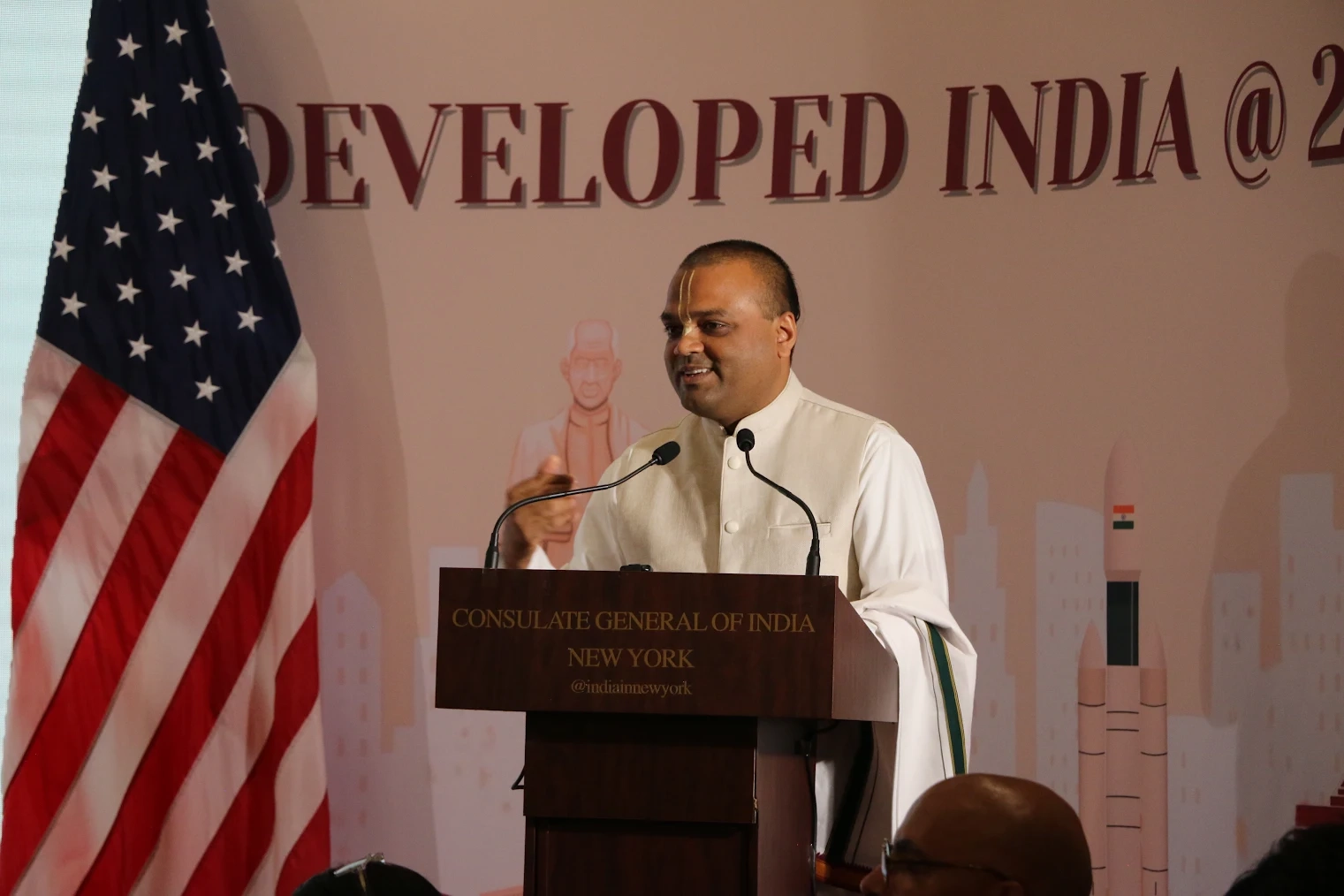
Dasa measures success in individual transformations as much as statistics. He recalls: “In India, I recall the daughter of a vegetable vendor whose family struggled to make ends meet. Our meals, combined with educational support, enabled her to excel academically. She later joined a major multinational company and returned to Akshaya Patra to donate her first salary—an act of reciprocity that encapsulated the cycle of empowerment we seek to create.”
Saxena affirms that Mr. Dasa’s “presence in the United States is tied directly to substantive humanitarian work of clear public benefit,” underscoring his focus on building frameworks that produce lasting, quantifiable outcomes.
"Scale is not just an operational metric. It multiplies impact," Dasa says. “This view explains why he focuses on building institutions, kitchens, endowments, governance, and training pipelines as the real achievements.”
Heading Towards a Million Meals
Inside the World Food Movement, the long-term target is already clear. The organization wants to serve one million cumulative meals in the United States by 2030.
On paper, that sounds ambitious for a relatively new operation. But internally, the target is treated less like a slogan and more like a capacity equation. The model has already been tested at a far larger scale in India. The real challenge now is adapting infrastructure, regulations, and funding systems to American conditions.
Dasa says successful expansion depends on three things above all else: operational execution, regulatory approvals, and long-term financing.
“Organizations and institutions seek my involvement because I deliver proven systems for scaling hot-meal delivery, navigate complex stakeholder landscapes, and build enduring funding mechanisms,” he says.
The strategy over the next several years is expected to focus on building additional kitchens, strengthening partnerships with universities and municipalities, and creating funding structures that reduce dependence on unpredictable year-to-year fundraising cycles.
There is also a strong emphasis on efficiency. One kitchen operating below capacity is viewed as unused potential: “If production schedules, transportation systems, and staffing can be optimized,” Dasa says.
“Then the same facility can support after-school programs, weekend meal delivery, emergency response operations, and campus partnerships without dramatically increasing infrastructure costs. That mindset — treating humanitarian work as a systems problem — runs through nearly every part of the organization.”
Still, despite the scale of the planning, Dasa often talks about the work in surprisingly personal terms.
“What keeps me awake is the gap between the requests we receive and our current capacity to serve,” he says. “Compassion does not tolerate the suffering of others.”
Then he shifts away from logistics entirely: “My deepest motivation is the sound of the delivery vehicle departing, loaded not merely with food but with love, affection, compassion, and dignity.”
Deepa Prahalad, an author and design strategist, has observed these qualities across multiple engagements: "I have always found Naveena to be kind, inclusive, and gracious despite his hectic schedule. He is open to learning from everyone and seeks counsel from those whose experience could benefit the organization. His passion for his work is palpable, and he is quick to implement ideas that create real impact.”
For all the data, engineering, and operational complexity behind the system, the final outcome remains very human: whether someone receives a warm meal when they need one most.
About the Author
Mahadharani Vijay is a dedicated and highly creative content writer specializing in news writing, blogs, and SEO-focused articles. She is passionate about creating content that is not only informative but also engaging, clear, and easy for readers to connect with. Her ability to simplify complex topics into meaningful and reader-friendly content makes her writing stand out across different audiences, from everyday readers to professional communities.
With a strong focus on understanding the reader’s perspective, Mahadharani carefully develops every piece of content to answer questions, deliver value, and maintain audience interest from beginning to end. Her writing reflects strong research, attention to detail, and a professional approach that helps businesses and readers trust the information she shares. She believes that great content should educate, inspire, and create a lasting impact.
Beyond her writing skills, Mahadharani is known as a positive and approachable professional who values communication, collaboration, and strong networking relationships. Her commitment to quality, consistency, and audience engagement makes her a reliable content writer who brings professionalism, creativity, and purpose into every project she handles.
.webp)






























Comments