~Vinay Kumar
The startup ecosystem often loves fast wins– grow quickly, raise money, and expand again. As a result, venture capital can feel like the only viable option. However, for many SaaS founders, especially those outside Silicon Valley, this mindset often leads to growing too soon.
Agustín Suárez took a different approach. He grew Ventia, a CRM and sales performance SaaS, to $360K in annual recurring revenue by focusing on fundamentals rather than external pressure: “ So you naturally think differently about how you build. You can’t just copy what Silicon Valley is doing and expect it to work,” he shares.
Instead of chasing rapid expansion or investor validation, this Uruguayan engineer focused on building something useful and sustainable: “Some people try to force AI or growth where it doesn’t really belong. I prefer building things that genuinely work and create real value. I try to be very realistic by focusing on what people actually want and need, and not just what looks interesting on paper,” he explains.
That discipline defined how Ventia was built. Suárez learned to code at 15 and built the company from the ground up as a full-stack developer. Without outside funding, he grew it to support more than 30 small and mid-sized businesses across Latin America. He recalls how the work was hands-on and demanding: “It meant optimizing queries, shipping updates every week, and making sure the system stayed reliable as more users came on,” he says.
It was through this process that clients began to recognize not only his technical depth but also his calm, consultative approach to leadership. One of them is Gastón Kehyaian, who worked closely with Suárez when his company, Viasono, hired Ventia. Kehyaian first encountered Suárez through Uruguay’s main innovation hub at Universidad ORT, where Ventia was incubated, before later engaging him directly during a complex CRM implementation.
From the outset, Kehyaian describes Suárez as someone who stood out not just for his technical skill but for how he approached problems: “Agustín has this rare mix of being incredibly analytical while still genuinely caring. Before jumping in with solutions, he really listens and tries to understand the client’s situation,” Kehyaian shares.
Throughout the project, Suárez led the integration of data from multiple systems into Ventia’s CRM, working closely with vendors, internal teams, and an external ERP provider.
Kehyaian recalls being especially impressed by how calm and collected Suárez remained even when under pressure: “Even when things got complex, he never lost his calm,” he notes. “He had a strong grasp of how we operate commercially, especially in consultative selling for home products like furniture and mattresses. He could clearly see how his product needed to evolve.” Beyond execution, it was Suárez’s transparency and attitude that left a lasting impression: “He was always clear about progress, proactive with solutions, and honestly a pleasure to work with. Without a doubt, Agustín is a strong technical leader, but he also knows how to keep things light. That mix makes a big difference when the work gets challenging,” adds.
That same mix of execution and empathy appeared early on, when Antonio Suárez, now CEO of Ventia, first worked with Agustín not as a mentor but as a client. At just 19, Agustín stepped into a struggling sales operation, studied how the team actually worked, and built a practical system that solved real tracking and management issues under pressure. That internal fix later became the foundation of Ventia itself.
Antonio recalls: “Agustín embedded himself in the day-to-day operation. He studied how the sales team actually worked and built a platform that addressed the problem from the inside out. He wasn’t interested in abstract ideas. He built a solution that held up in practice—under pressure, with real teams relying on it.
That internal fix would later become the foundation for Ventia itself. For Antonio, this moment revealed that Agustín’s real strength went beyond technical ability: “It was his clarity and courage.”
He describes Suárez as deeply results-oriented, yet unusually empathetic—someone who stays calm under uncertainty, takes responsibility, and doesn’t shy away from hard problems: “He’s confident in his decisions, honest about his values, and fully committed to making things work,” Antonio says.
The experience revealed Suárez’s defining strength: technical clarity and emotional steadiness—proof that Agustín stays calm in uncertainty, takes responsibility, and is deeply committed to making things work in practice, not just in theory.
That mindset now shapes how Suárez builds products. He observes how people truly operate, simplifies aggressively, and designs systems for real behavior—not ideal scenarios. As Ventia’s CTO, he ultimately transformed a single internal operational challenge into a scalable, differentiated SaaS platform—proof that disciplined execution, not hype, is what creates lasting impact.
That discipline was also evident to those building Ventia from the inside. Federico Barboni, Co-founder and Chief Growth Officer of Ventia, has worked alongside Suárez for more than four years, partnering closely as Suárez led technology and product while Barboni oversaw commercial strategy and operations. From the earliest days, Barboni saw how Suárez translated complex, real-world sales problems into clear technical systems: “Agustín has an unusual ability to connect advanced technology with how businesses actually function. He understands the realities of sales teams in Latin America—multiple ERPs, large teams, low tolerance for complexity—and builds products that are simple, flexible, and tied to measurable results,” Barboni explains
What truly set Suárez apart, Barboni notes, was his refusal to build unnecessary features. Instead of blindly delivering what clients asked for, Suárez consistently dug deeper to uncover the real pain point. During Ventia’s expansion into Peru, Barboni recalls a moment when a prospective client requested functionality outside the roadmap: “Agustín analyzed the problem, identified what really mattered, and built an MVP in under a week. That speed and clarity helped us validate the solution quickly and win several clients,” he shares. For Barboni, Suárez’s edge lies in that combination of pragmatism, technical depth, and long-term systems thinking—designing scalable architecture early, aligning product decisions with business reality, and leading with a relentless focus on quality and impact.
Suárez was a founding engineer at Domu, a startup that uses voice AI to support critical customer service and account resolution. In these high-stakes situations, speed, accuracy, and trust are essential.
As part of Domu’s founding engineering team, Suárez helped build the company’s technical foundation from the ground up. In this role, he had to create new systems from scratch, rather than maintain them.
Suárez also redesigned the core database to reduce system strain, built queueing systems that handle millions of calls each month, and developed internal tools that run and manage Domu’s voice agents.
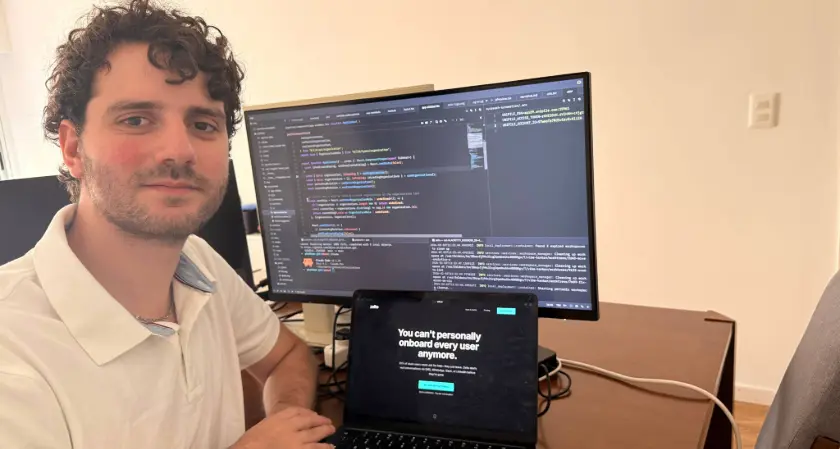
Today he is involved in creating a new startup called Zelto.ai, where he is solving the problem of user retention with AI, with an AI that detects when users get stuck on a SaaS product. Zelto has conversations with users to help them reach product value faster, preventing churn and augmenting conversion.
His work reflects a consistent approach throughout his career, using technology to solve real problems, not to impress: “AI is where you can create real impact right now, but only if you’re honest about what it can and can’t do,” he says.
At Domu, this mindset shows up in systems designed for scale, reliability, and real-world use—where smart engineering decisions directly shape business results and user trust.
His journey, from a small-town upbringing near Montevideo, to bootstrapping a profitable SaaS, to building AI systems used by large enterprises, offers a grounded counterpoint to growth-at-all-costs thinking: “No matter where you come from or what people expect of you, you can still build something meaningful if you stay focused on fundamentals,” Suárez shares.
Roots in Resourceful Entrepreneurship
Suárez grew up far from the startup spotlight. He was raised in Montevideo, Uruguay, in a small coastal town outside the capital, where entrepreneurship was simply part of everyday life. His parents ran technology retail and telecom businesses, and watching them build from scratch made starting a business feel normal: “In a small town, having a business meant freedom, but it also came with responsibility,” he shares.
That mindset showed early. By 12, he was running small ventures at school—organizing paid chess tournaments and selling custom photo magnets during lunch. This hands-on learning showed him how pricing really works and what customers value. By 15, he was learning to code. At 19, he launched his first startup.
His technical foundation came just as early. He earned an IT and Programming Technician diploma from ESI Buceo between 2017 and 2019, then began a Bachelor’s degree in Computer Systems at Universidad ORT Uruguay in 2021, which he is set to complete in 2026: “ESI Buceo helped me see how systems really operate, from the networks behind them to the parts that can cause issues,” he shares.
That experience paid off later. It gave him the skills to refine databases, backend systems, and infrastructure in demanding environments. It also shaped how he builds: focus on what customers need, keep iterating, and grow through revenue.
That mindset and skill set were put to use when he noticed inefficiencies in his family’s satellite TV sales business. Everything was tracked naturally, data was scattered, and getting clear insights was slow and frustrating. Suárez fixed it with custom scripts and a basic CRM: “It wasn’t fancy, but connecting the systems properly gave us leverage,” he recalls.
When this sought-after expert realized that many small and medium-sized businesses across Latin America faced the same challenges, he saw an opportunity. He turned that internal fix into a product. In June 2021, Ventia was born.
That early, hands-on problem-solving shaped Ventia’s core promise: deliver measurable sales improvements through data-driven tools. What began as a simple solution for one business eventually evolved into Ventia’s analytics layer—now one of its most valuable features and a key driver behind client sales performance gains of up to 30%.
Mastering Full-Stack Execution
As Ventia’s CTO and first—and initially only—developer, Suárez built the entire product from the ground up: “It was the first time I was creating a real solution,” he recalls, describing the pressure of competing early on with established players who had been in the market for years.
He designed the entire system himself, choosing Next.js and React Native for cross-platform development, Node.js and Express for the backend, MongoDB for data storage, AWS for infrastructure, and Redis for performance.
With experience across JavaScript, TypeScript, Python, and AI SDKs, he worked across the entire product: “I built the MVP on my own and stayed focused on one thing: sales efficiency. The priority was to build something that could actually improve how sales teams worked day to day,” he recalls.
As Ventia gained customers across multiple LATAM markets, this deployment discipline became essential. This tech expert focused on shipping quickly, then improving the product based on how customers actually used it: “It was a lot of trial and error at first, but every iteration came directly from what customers were asking for,” Suárez admits. That feedback-driven approach shaped Ventia’s most distinctive feature: its advanced analytics dashboards. These tools helped client sales teams boost performance by up to 30%.
The results echoed his earliest success. Years earlier, internal systems he built for his father’s company increased salesperson productivity by roughly 30%, convincing him the idea could work beyond a single business. Building on that foundation, Suárez added lightweight predictive insights powered by historical sales data, reflecting his growing focus on AI: “I’m always thinking about how to do things better than before,” he says. “How do you optimize, automate, and remove wasted effort?”
As those improvements took shape, the team expanded right alongside the product. What began with just two founders grew into a tight team of four, and Suárez was managing three developers and one designer, grew to a team of 14. This growth also strengthened Suárez’s leadership.
He became known for his ability to turn product vision into execution across both engineering and design. Colleagues describe him as someone who “goes deep into problems and doesn’t settle for the first solution,” a mindset he openly embraces: “I’m obsessive about modularity. If one part breaks, the whole system shouldn’t collapse,” he explains.
He applies the same thinking to AI. For Suárez, building effective AI products goes beyond choosing the right model. It requires careful planning, memory, and behavior design: “You have to think about AI agents the same way you think about humans. It’s a pipeline—input, interpretation, reasoning, and response,” he explains.
As the company continued to grow, he expanded the team while keeping a product-first, engineering-led approach. That discipline paid off. By September 2025, Ventia reached $360K in ARR and served more than 30 SMB clients across LATAM—all without venture funding: “We were fully bootstrapped. That forced us to be disciplined; every feature had to justify itself in real value,” Suárez shares.
By its fourth year, Ventia had expanded into Colombia and Argentina, grown to 14 employees, and brought on a CEO co-founder. Such success is a clear example of how strong technical execution, paired with operational discipline, can drive steady, sustainable growth without outside capital.
Accelerating Without Dilution
Ventia’s early traction earned it spots in several highly selective programs, including Endeavor ScaleUp, Itaú Cubo, and the Mana Tech Miami Immersion. These programs offered mentorship, operational guidance, and regional visibility, while allowing the company to retain full ownership and strategic control: “They gave us validation and frameworks without forcing us to trade equity for growth,” Suárez says.
He points out that these were not open-enrollment programs, but competitive, selection-based environments: “Getting in was a signal in itself,” he explains. Rather than acting as funding channels, the programs helped sharpen execution, improve decision-making, and bring more structure to how the company operated.
Participation in these programs also broadened Suárez’s exposure to startup ecosystems and enterprise-level expectations across regions. Through accelerators in Uruguay and Miami, followed by a San Francisco immersion via the Puentes program, he connected directly with founders, operators, and investors across Latin America and the U.S: “It really put me inside the ecosystem,” he says of his time in San Francisco, where he remained for six months after the program to deepen those relationships and benchmark Ventia against global standards.
That external momentum was matched by Ventia's internal engineering. Suárez credits much of Ventia’s early success to a systems-first approach. Instead of building everything as a single block, the platform was designed as a set of modular components and optimized for performance from the outset. That made it easier to grow fast without driving up infrastructure costs.
By pairing that modular setup with automated deployment tools such as Git and Docker, Ventia was able to handle a tenfold increase in users without disruption. That technical discipline proved essential as the company expanded quickly across borders, securing customers in Colombia and Argentina within months of its first sale. “It had to move fast. It was the first time I was building a real solution while competing with companies that had been around for years,” Suárez recalls.
Key Takeaways for Founders
Suárez’s journey distills into a set of practical principles founders can apply at any stage: start by solving problems you’ve lived by yourself; focus early on features that generate revenue; optimize relentlessly; and lead with authenticity and consistent over-delivery.
“If something is manual, automate it. If it’s brittle, redesign it,” Suárez says. That philosophy didn’t stop with Ventia—it became the backbone of Suárez's approach to AI systems. Applying the same disciplined approach to AI orchestration, Suárez has cut database load by 80 percent and built infrastructure ready to support millions of voice interactions each month.
Moreover, his work went beyond optimization. He designed a high-throughput, smart queue system that balances call timing and load distribution, enabling enterprise-scale Voice AI without service degradation. He also built internal tools to manage Voice AI agents and led technical implementations for U.S. and enterprise clients, translating startup speed into production-grade reliability.
Suárez’s path from a resource-constrained startup scene in Uruguay to global AI work proves one thing: capital isn’t everything. In emerging markets, progress is driven by practical engineering, close attention to users, and an unrelenting focus on solving real problems.
About the Author:
Vinay Kumar is a content contributor with experience covering business insights, technology developments, and emerging market trends. He has worked on editorial and research-driven content focused on startups, enterprise strategy, and digital innovation. Vinay has contributed to written pieces across business and technology domains, supporting publication-ready articles aligned with editorial standards. His work emphasizes clarity, accuracy, and audience-focused storytelling.


.webp)