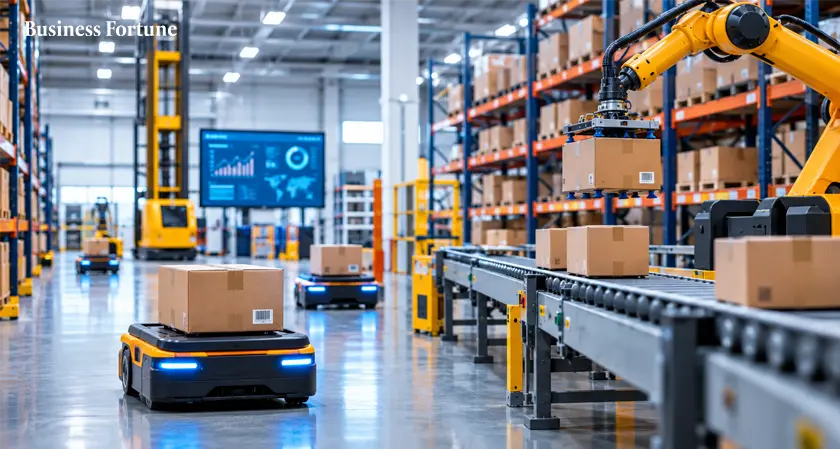
For the better part of the last decade, artificial intelligence has been a brilliant but disembodied mind. It lived in the digital void, trapped behind glass screens and buried deep within massive data centers. We admired at its ability to write poetry, generate code and paint surreal landscapes, yet it remained a creature of bits and pixels. As we move into early 2026, that era of isolation is coming to an end. The "brain" is finally meeting the "body." In a move that has basically redefined the semiconductor landscape, chip architecture giant Arm Holdings has officially launched its Physical AI unit.
Unveiled during the robotics-heavy halls of CES 2026, this strategic pivot is far more than a corporate reorganization. It is a loud and clear signal that the tech world is done talking about chatbots. We have entered the era of Embodied Intelligence, where AI no longer just processes your emails but actively builds your products, sorts your warehouses and navigates your city streets. By creating a dedicated division for Physical AI, Arm is positioning itself as the foundational nervous system for a new species of machines that sense, reason and act in the tangible world.
Beyond the Chatbot: Why AI is Growing Hands and Feet
The transition we are witnessing in 2026 is often described as the "GPT-3 moment" for the physical world. For years, AI was limited by its lack of a physical presence, but the emergence of specialized hardware and "world models" has changed the game. Physical AI refers to systems that do not just provide information but interact with their environment in real-time. This requires a radical shift in how we think about computing. While a digital AI can take a few seconds to generate a response, a physical AI, such as a robotic arm on a high-speed assembly line must make decisions in milliseconds to avoid a collision or a safety breach.
The industry is rapidly pivoting because the digital market for generative models is becoming increasingly crowded. The real border for the next decade lies in automation that can handle the messy, unpredictable nature of reality. Whether it is a humanoid robot helping in a hospital or a drone navigating a dense forest, the demand for localized, reliable intelligence has reached a fever pitch. Arm’s entry into this space acknowledges that the next trillion dollars in economic value will be unlocked by machines that can physically manipulate the world around them.
The Merger of Motion: Arm’s Strategic Bet on Auto-Robotics Synergy
Perhaps the most telling aspect of Arm's new division is the decision to merge its automotive and robotics teams into a single powerhouse. Led by Executive Vice President Drew Henry, this unit operates on the realization that a self-driving SUV and a humanoid factory laborer are essentially two sides of the same technological coin. Both require a sophisticated central nervous system capable of ingesting and interpreting massive streams of sensor data, from Lidar and high-definition cameras to ultrasonic sensors without any delay.
By grouping these sectors together, Arm is streamlining the development of silicon that meets the rigorous standards of both the road and the factory floor. The safety-critical nature of an autonomous vehicle, which must protect its passengers at all costs, is identical to the safety requirements of a "cobot" working alongside human employees. This convergence allows Arm to offer a unified, scalable architecture that appeals to both legacy automakers and the new wave of robotics startups.
Silicon Sovereignty: The Efficiency War at the Edge
In the high-stakes world of Physical AI, raw performance is only half the battle. The other half is power efficiency. Unlike a server in a temperature controlled data center, a robot must carry its own energy source and manage its own heat. If a robot requires a massive, power-hungry chip to "think," its battery life will be severely limited, making it impractical for long shifts in a warehouse or an all day commute. This is the exact territory where Arm’s RISC-based architecture, which already powers nearly every smartphone on the planet, becomes an indispensable strength.
Arm’s focus is centered on the "Edge" the concept of performing complex AI tasks directly on the device rather than relying on the cloud. By moving intelligence from distant servers to the silicon inside the machine, Arm addresses the two biggest hurdles of robotics: latency and privacy. A robot that processes its own vision data doesn't have to wait for a signal to travel to the cloud and back before deciding to stop.
Scaling the Future: The Trillion-Dollar Robotics Land Grab
The launch of the Physical AI unit puts Arm at the center of a global "clash of the titans." We are seeing an unprecedented rush by tech giants and automakers to claim their stake in the robotics ecosystem. Tesla is pushing its Optimus program, betting that humanoid robots will eventually exceed its vehicle business in total revenue. Meanwhile, Nvidia has unveiled its "Alpamayo" models and the "Jetson Thor" hardware platform, designed specifically to be the "brain" for autonomous machines.
Arm’s advantage in this race is its unique business model. Unlike Tesla or Nvidia, which often build their own end-to-end solutions, Arm acts as the neutral, foundational layer of the entire market. They license their designs to everyone from Boston Dynamics to Mercedes-Benz, allowing different companies to build customized versions of the same reliable architecture. This makes Arm the "Switzerland" of the robotics world a common ground where competitors can all find the high-efficiency silicon they need. As industrial leaders like Hyundai and BMW begin deploying production-ready humanoids at scale, Arm's influence is quietly expanding into every corner of the global supply chain.
Conclusion: Welcome to the Age of the Intelligent Machine
The formal launch of Arm’s Physical AI unit marks a historic pivot in the evolution of technology. We are moving past the era where AI was a novel tool for digital productivity and entering an age where it is a fundamental part of our physical infrastructure. By consolidating the expertise of the automotive and robotics sectors, Arm has identified the true driver of the 2026 economy: the need for efficient, safe and autonomous intelligence that can function anywhere.
As we look toward the future, the success of this change will be measured by how effortlessly these intelligent machines integrate into our daily basis. With its focus on the Edge and its peerless reputation for energy efficiency, Arm is well-positioned to be the silent architect of this new mechanical age. We are no longer just looking at a world of connected devices; we are witnessing the birth of a world that is truly alive with motion and intelligence.


.webp)