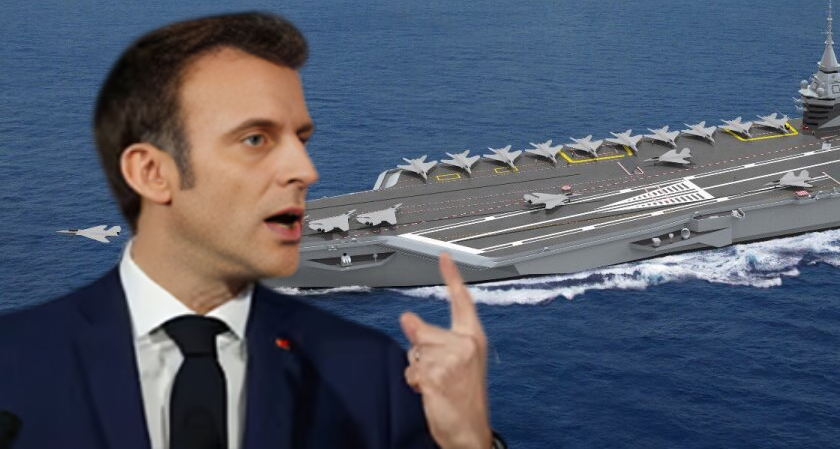
The newly approved PA2 carrier will replace Charles de Gaulle, improving France’s naval power with a larger, nuclear-powered warship.
On Sunday, French President Emmanuel Macron declared that he had officially approved the construction of a France new aircraft carrier to replace France's flagship, the Charles de Gaulle. After more than ten years of construction, the vessel, the only nuclear powered carrier outside the US Navy, entered service in 2001.
During a visit to French troops in the United Arab Emirates, Macron declared that, following a thorough and complete review and in accordance with the past two military programming laws, he has decided to equip France with a new French aircraft carrier pa2. He added that this week was the final approval decision.
In 2018, France started studying replacing the Charles de Gaulle, and two years later, preliminary work started. Despite a budgetary deadlock plaguing the second largest economy in the European Union, the official start of construction has been declared. Fears of a European war with Russia had prompted criticism in France, particularly from General Fabien Mandon, the country's military chief, about whether other more urgent issues should take precedence.
According to Macron's office, this official launch will enable the signing of all contracts required for the project. The France new aircraft carrier will be far bigger than the current flagship and will run on nuclear power. In contrast to the Charles de Gaulle, which is forty-two thousand tons and 261 meters long, it will displace almost eighty thousand tons and be about 310 meters long. It will fit 30 fighter jets and have a workforce of two thousand.
The US Navy's eleven enormous super France navy aircraft carrier, each weighing over 100,000 tons, will still dwarf the future vessel, but only China and the Royal Navy of Britain currently have carriers of a comparable size that are all conventionally powered.


.webp)