Artificial intelligence (AI) from science fiction to our everyday lives has arguably revolutionized how we live and work. AI stands ready to change the workforce by transforming jobs, increasing productivity and driving demand for new skills in 2025 as we approach the deadline. In this piece, I outline how AI is rewriting the work landscape, the skills required in an AI world, and how companies and workers can adjust to survive in this increasingly digital terrain.
The Impact of AI on the Future of Work
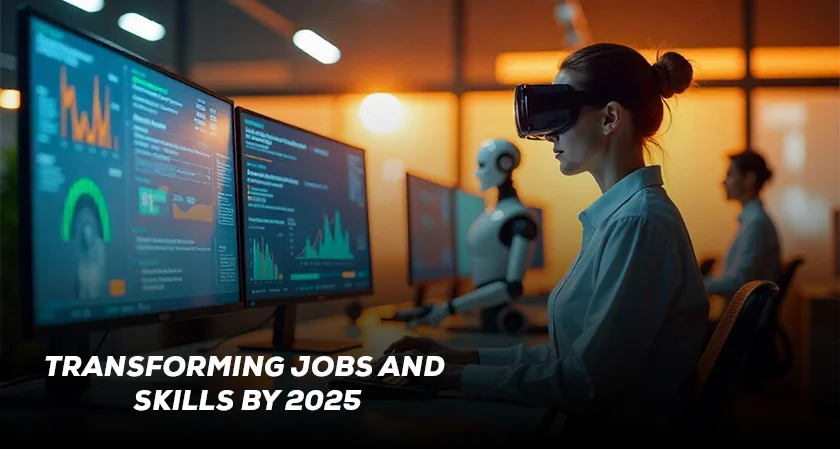
With its ever more powerful AI technologies, the workplace is being heavily impacted day by day. AI jobs will transform totally by 2025 when companies utilize automation for boosting efficiency and reducing operational costs in the workplace. It is not just about replacing human labor with machines but rather providing human capabilities and augmenting overall productivity.
Productivity driven by AI will open new paths for businesses to learn and perfect their processes. Say, for instance, mundane and repetitive tasks can be automated and this gives the employee the opportunity to focus more on the job that involves critical thinking, creativity, interpersonal skills and much more. The benefits of this transformation are a more engaged workforce — employees can spend hours of time on their fulfilling and strategic tasks instead of routine work.
Job automation does, however, spur concern about job displacement. As people become better at employing AI, certain roles can become obsolete. But history also has proven that technology has usually increased the number of jobs than it has killed. Some jobs are disappearing — technology in areas of AI oversight, management and development will create new jobs.
Essential Skills Needed in an AI-Powered World
To navigate this evolving job market, workers must develop future job skills that complement AI technologies. These skills will become more important: Skills that emphasize creativity, emotional intelligence and critical thinking. These aren’t capabilities that machines can easily replicate; they will be essential for human AI collaboration.
-
Technical Skills: Understandably, a fundamental knowledge of AI and machine learning will be a necessary part of the workforce as AI makes its way into the workplace. In order to stay competitive, workers should develop skills in programming, data analysis and the management of AI system.
-
Soft Skills: As human-AI collaboration becomes the norm, so too will superiority in communication, problem solving and teamwork. It’s going to be necessary to have the ability in the future workforce to be effective in working with automated system and to be able to effectively work with AI tool.
-
Adaptability and Continuous Learning: So there is no time to catch up and learn how to adapt quickly. To ensure they can keep up with ever changing job requirements, workers in other words need to be prepared to embrace lifelong learning and should seek opportunities to upskill and reskill as they arise.
-
Ethical Understanding: With the impact of AI growing everywhere more would be required to grasp on to the ethical dimensions of AI’s role in employment. Workers should be prepared to get into conversations around bias, privacy and the ethical use of AI technologies.
Human-AI Collaboration: The New Workplace Dynamic
How humans and AI will interact in the workplace will change. Instead of thinking about AI as replacing human jobs, organizations should be interested in human-AI collaboration. The collaboration potential of this partnership can promote better decision making, exciting solutions, and better customer experiences.
At a more fundamental level, in sectors such as healthcare, it helps doctors make an accurate diagnosis by examining enormous amounts of medical data; take for instance, diagnosing disease using AI. In customer service too, AI-enabled chatbots can handle common questions to free up the human help desk for issues that are complicated, need empathy and context.
By the time we get to 2025, AI will be integrated into the workplace and we’ll see more and more teams of humans working alongside AI. The new dynamic highlights the significance of soft skills as human workers will be expected to translate Artificial Intelligence insights into understood conclusions and make informed decisions built on those.
Preparing for the Future: How Businesses and Workers Can Adapt
Businesses and employees must do their part to fully leverage the power of AI and ease the shift to an AI powered workforce. Here are several strategies for adaptation:
For Businesses:
-
Invest in Training and Development: Amongst the workforce, organizations should make a priority of skill development for AI. Companies can help prepare their employees for the future by offering training programs, such as emerging technologies and essential skills, themselves.
-
Foster a Culture of Innovation: Organizations that encourage experimentation and innovation will be more able to adapt more quickly when subjected to technological changes. It will create an environment where employees can contribute ideas and solution.
-
Implement AI Responsibly: AI deployment requires that companies take its implications on ethics into consideration and then make the AI technologies used transparent. This will ensure that employees trust which will, in turn, prevent concerns of job replacement.
For Workers:
-
Embrace Lifelong Learning: Research workers should strive for opportunities to further educate (and train) in AI and other related technologies. You can learn valuable information and skills in online courses, workshops and certification programs.
-
Network and Collaborate: At the same time, building a professional network can help open doors to other such opportunities and insights. Being in communication with others in the field that might assist you could lead to working together to build on skills and knowledge.
-
Stay Informed About Trends: Knowing where the industry is going and how the technologies part of it progress helps workers to know what to expect in the job market and explore opportunities.
Conclusion
The impact of AI on the workforce is inevitable – as we begin to think about the year 2025. AI will reshape jobs, increase productivity, and push the need for new skills to create the future of work.
In this new landscape, Workers who invest in developing essential skill will survive and Businesses that invest in training and ethical AI practices will also. If we can lean into the available with AI, we can build a workforce that not merely survives the worlds to come, but thrives in a world more and more automated. On this journey ahead, let’s be curious, proactive, and committed to a future where we work more together with humans and less with between ourselves and the machines to achieve far more.
FAQs
- How is AI affecting job availability in 2025?
AI will create new job opportunities while automating certain roles, leading to a shift in job availability that emphasizes emerging tech jobs and collaboration with AI.
- What skills will be most important for workers in an AI-powered job market?
Essential skills include technical proficiency in AI, soft skills like communication, adaptability, and a commitment to lifelong learning to thrive in an AI-integrated workplace.
- Will AI replace all human jobs in the future?
AI will not replace all human jobs; instead, it will automate specific tasks while creating new roles that emphasize creativity, emotional intelligence, and collaboration with AI technologies.
- How can workers prepare for AI-driven changes in the workplace?
Workers can prepare by embracing lifelong learning, developing essential skills, networking, and staying informed about industry trends to adapt effectively to AI-driven changes.
- What industries will be most affected by AI in the future?
Industries such as healthcare, customer service, finance, and manufacturing will be significantly impacted by AI, driving changes in job roles and skill requirements.


.webp)